RevisionDojo was developed independently of the IBO and as such is not endorsed by it in any way.
Choosing between History and Geography can feel more consequential than it really is. Parents see two respected IB subjects, a two-year commitment, and a decision that may affect university options. Their child may simply see two timetables and wonder which one will cause fewer late nights.
The reassuring answer is clear: choose History for a student who enjoys reading, evaluating sources, and building written arguments; choose Geography for one who prefers connecting real-world issues with data, diagrams, case studies, and fieldwork. Neither subject is universally easier, and neither is inherently the better university choice.
For families searching IB History vs Geography which to take, the best decision rests on three things: the student's natural way of thinking, the assessment style they can sustain, and any specific university entry requirements. The subject title matters less than the fit.
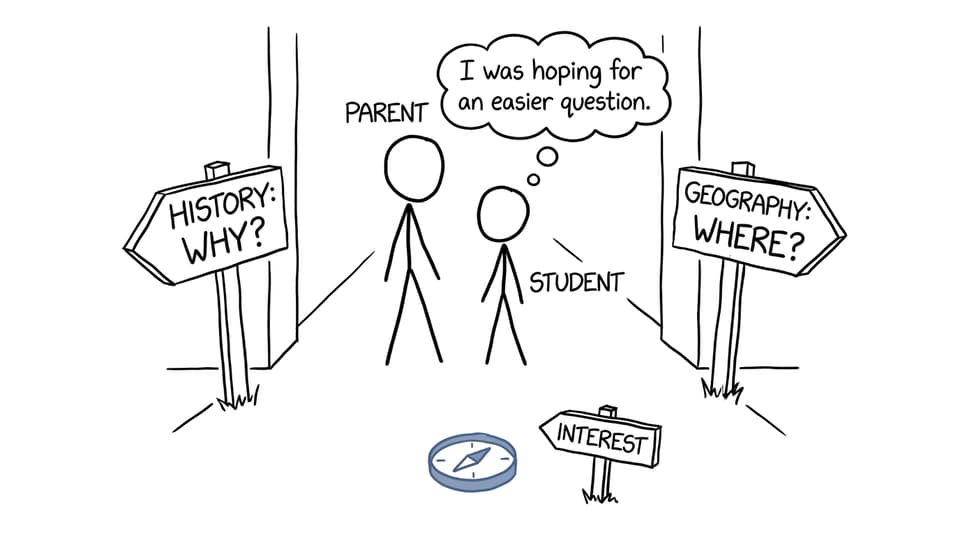
A student facing the History and Geography decision
The short decision checklist
Before comparing syllabuses in detail, ask your child:
Do they prefer explaining why events happened or examining how places and systems interact?
Are they more comfortable interpreting written sources or combining text with maps, graphs, and data?
Would they rather complete an independent historical investigation or a fieldwork-based report?
Which teacher and course options are available at their school?
Does a likely university course require or prefer a particular HL subject?
Which subject would they still find interesting when revision becomes demanding?
If most answers point toward evidence, perspectives, and sustained essay argument, History is probably the stronger fit. If they point toward global challenges, spatial patterns, mixed data, and applied examples, Geography is likely better.
IB History vs Geography at a glance
Both belong to the IB Individuals and Societies group. Both require analytical writing, content knowledge, evaluation, and an internal assessment. The distinction is not that History is purely literary while Geography is purely scientific. Each crosses that boundary, but from a different starting point.
Consideration
IB History
IB Geography
Central question
Why did events develop, and how should evidence be interpreted?
How do people, places, environments, and systems interact?
Typical material
Written and visual sources, historical interpretations, contextual evidence
Maps, graphs, infographics, data, geographic models, and case studies
Strong fit
Students who enjoy reading, debate, source evaluation, and essays
Students who enjoy current issues, mixed evidence, patterns, and applied analysis
Internal assessment
An independent historical investigation
A report based on geographic fieldwork
Common challenge
Retaining context while constructing precise arguments under time pressure
Selecting relevant case evidence and interpreting unfamiliar data accurately
Useful preparation
Source analysis and timed essay planning
Data interpretation, concise case-study recall, and fieldwork evaluation
This comparison should be treated as a guide, not a personality test. A student can enjoy numbers and still excel in History. Another can love writing and thrive in Geography. The better clue is the kind of work they voluntarily engage with.
What studying IB History actually feels like
IB History is an interpretative, evidence-based subject. Students do not simply memorize a timeline and reproduce it. They examine sources, compare perspectives, establish context, and form arguments about causation, consequence, change, continuity, and significance.
That makes History a strong choice for students who enjoy asking why reasonable people interpret the same evidence differently. They need to read carefully and write selectively. Knowing many facts helps, but an answer becomes valuable only when those facts support a direct judgment.
The internal assessment is a historical investigation chosen and developed by the student within IB and school requirements. It suits independent researchers who can narrow a broad interest into a focused inquiry, select evidence, and evaluate sources.
There is also an important timing point for IB Diploma parents. The updated History course begins teaching in August or September 2026, with first assessment in May 2028. Students assessed before that point follow the previous course. The new specification retains source analysis, thematic study, essays, and a historical investigation, but changes aspects of the papers and streamlines the HL Paper 3. Families should ask the school which specification applies rather than relying on a generic online summary. RevisionDojo's guide to the new IB History curriculum structure explains the incoming course, while the IB History HL and SL comparison clarifies the level difference.
What studying IB Geography actually feels like
Geography is grounded in interactions among individuals, societies, places, and physical processes. The current course includes global change, optional geographic themes, and fieldwork. Topics may include changing populations, climate vulnerability, resource security, hazards, urban environments, freshwater, or food and health, depending on the options taught by the school.
The subject suits students who like moving between scales. One lesson may examine a local place; another may explore a global network. Students interpret maps, graphs, visual stimuli, and written material, then use geographic concepts and located examples to produce an explanation or evaluation.
Geography still requires extended writing. Choosing it to avoid essays would be a mistake. The difference is that its arguments often combine concepts, data, processes, and real-world case evidence rather than centring primarily on historical sources and interpretations.
Its internal assessment is based on fieldwork, data collection, analysis, and evaluation. Students who like investigating a real environment may find this concrete and satisfying. Others may prefer the source-led independence of a History investigation. Families can preview the subject through the IB Geography course guide and explore IB Geography resources by topic.
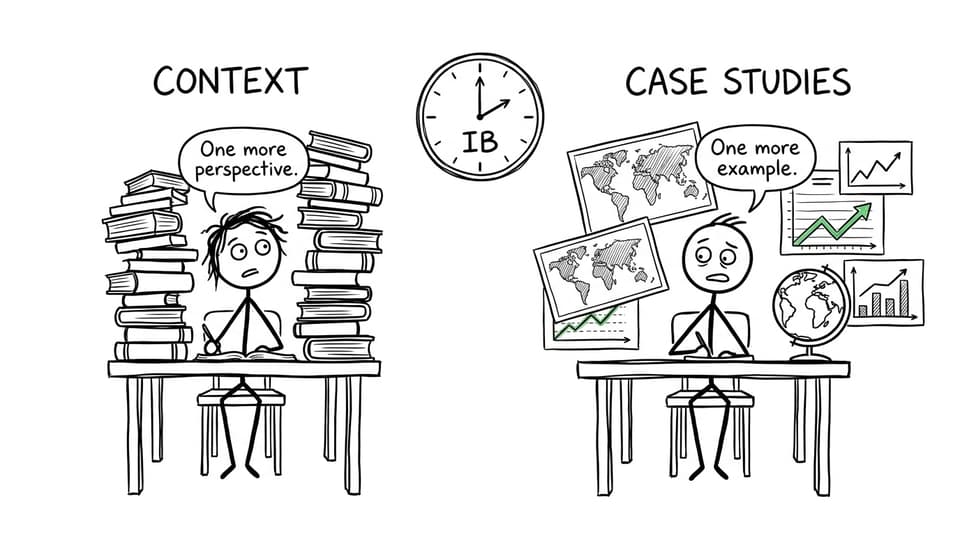
Two different but equally busy IB study desks
Which subject is harder?
There is no responsible universal ranking. Difficulty is partly the distance between the assessment and the student's strongest habits.
History may feel harder when a student dislikes extensive reading, struggles to build a thesis, or treats essays as fact lists. Geography may feel harder when a student dislikes interpreting unfamiliar visual material, confuses description with analysis, or finds it difficult to remember precise case evidence.
A useful test is to examine actual classroom tasks. Ask each teacher for a representative source question, essay prompt, data-response exercise, and internal assessment overview. Give your child a short sample from each. The question is not simply, “Which score was higher?” Ask instead:
Which task held their attention?
Which feedback made intuitive sense?
Which mistakes seemed teachable rather than exhausting?
Which subject would they be willing to practise every week?
Interest does not remove difficulty. It makes repetition tolerable, and repetition is where exam technique develops.
How HL vs SL changes the decision
IB students normally take three subjects at HL, with the possibility of four, and complete the remainder at SL. The IB recommends 240 teaching hours for HL and 150 for SL. HL therefore represents a substantial commitment, not merely a slightly longer examination.
In the current Geography course, HL students study an additional optional theme and the HL extension on global interactions, alongside an additional examination paper. The Geography SL vs HL comparison gives families a closer look at that distinction.
For the updated History course first assessed in 2028, HL adds a regional study and Paper 3. Both levels retain the historical investigation, but their assessment weightings differ. Students on the earlier specification should follow their school's guidance because its structure is not identical.
The practical rule is simple: place an HL where interest, performance, and future relevance overlap. A student who likes History but needs demanding Mathematics and sciences at HL may sensibly take History SL. Another targeting a humanities degree may benefit from History HL. RevisionDojo's guide to choosing IB HL subjects can help families assess the whole combination rather than viewing one subject in isolation.
Consider university plans without trying to predict everything
Subject selection should preserve credible future options, but it should not become an attempt to design an entire career at age 15 or 16.
The IB advises students to examine individual university and programme requirements because some degrees specify required, preferred, or recommended HL subjects. Requirements differ by institution, country, course, and entry year. Check the official admissions page for every realistic destination, then confirm uncertainties directly with the university or school counsellor.
History can provide strong preparation for degrees involving argument, evidence, policy, culture, or interpretation. Geography can support pathways involving society, development, environment, planning, sustainability, and spatial analysis. These are useful forms of preparation, not guarantees of admission.
This matters when comparing the IB vs alternatives such as national curricula: universities assess applicants within the qualification they actually study. For IB Diploma parents, the most useful question is therefore not which subject appears more prestigious, but whether the complete set of IB HL and SL subjects satisfies published entry conditions.
Factors that can outweigh the syllabus
A subject exists on paper. A course exists in a school. The difference matters.
Teacher experience, available options, fieldwork arrangements, timetable blocks, class size, and the school's approach to internal assessment can shape the student's experience. History topics also vary by school, as do Geography's optional themes. A child fascinated by one area should verify that it is actually taught.
Speak with current students, but treat their opinions as personal evidence rather than universal truth. “Geography is easier” may mean that Geography matched one student's strengths. “History is too much content” may reflect another student's revision habits or course combination.
Also inspect the entire Diploma workload. A writing-heavy combination can create clusters of essays and coursework. A student taking demanding quantitative HLs may appreciate Geography's mixed modes, while another may find History complements their existing strengths. Balance is about how deadlines and thinking styles interact, not about collecting supposedly easy subjects.
How to make the final choice calmly
Use a simple decision process:
Check university constraints. Remove any option that closes a serious, likely pathway.
Confirm the school offering. Compare the topics, teachers, fieldwork, and specification relevant to the student's assessment year.
Review sample tasks. Let the student experience the work rather than choose from course names.
Score the fit. Rate interest, demonstrated skill, willingness to practise, and workload compatibility for each subject.
Let the student own the decision. Parents can test the reasoning, but the student will attend the lessons and complete the assessments.
Whichever subject they select, academic support need not be the deciding factor. RevisionDojo has dedicated IB History resources and Geography resources ready, including Study Notes, Flashcards, Questionbanks, AI Chat, and exam-style practice. Students can use the IB History Questionbank for targeted source and essay work, while Geography students can strengthen applied reasoning through guidance on analysing IB Geography data.
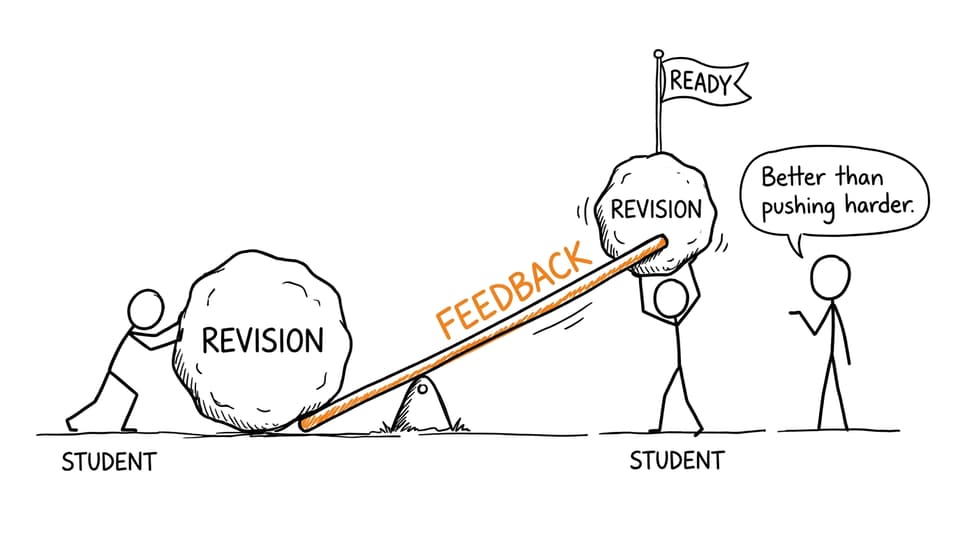
A student using feedback as leverage for revision
The best choice is the one they can sustain
History and Geography reward different kinds of curiosity. History asks students to reconstruct and challenge explanations of the past. Geography asks them to trace connections across people, places, systems, and environments. Both develop analysis. Both demand evidence. Both can support ambitious university applications when chosen as part of a coherent Diploma.
So start with fit, verify future requirements, and then look at the whole HL and SL combination. Once the choice is made, RevisionDojo can support the journey with Questionbank practice, Study Notes, Flashcards, AI Chat, Grading tools, Predicted Papers, Mock Exams, a Coursework Library, and Tutors. The goal is not to find a subject without difficulty. It is to choose the kind of difficulty your child is willing to master.