RevisionDojo logoRevisionDojo logo
FeaturesSubjectsPricingSchools
Back to all posts
  1. Home
  2. /Blog
  3. /IB Integrity: How Teachers Build Original Thinking

IB Integrity: How Teachers Build Original Thinking

IB
RevisionDojo Team
•Last updated: 19 Jul 2026•10 min read
ShareShare on XShare on WhatsAppShare on LinkedInShare on Facebook
Add as a preferred source on Google
IB Integrity: How Teachers Build Original Thinking

Join 650k+ students breezing through the IBReady to breeze through the IB?

Footer

General

  • Download apps
  • For parents
  • For schools
  • Pricing
  • Gift RevisionDojo
  • Tutoring
  • IB syllabus
  • MYP syllabus
  • Blog
  • Student Questions

Features

  • Question Bank
  • Test Builder & Exam Mode
  • Predicted Papers
  • Past Papers
  • Study Notes
  • Interactive Lessons
  • Flashcards
  • Jojo AI Tutor
  • Coursework Studio
  • View all features

Research

  • All research
  • Jojo AI vs leading AI study tools
  • 2026 State of Learning Survey
  • 2025 State of Learning Survey
  • IB Moderation Analysis
  • Jojo AI vs ChatGPT
  • Jojo AI vs Gemini
  • Jojo AI vs Perplexity
  • Jojo AI vs Claude
  • Jojo AI vs Poe

Platform

  • About RevisionDojo
  • RevisionDojo vs Others
  • Content philosophy
  • Trustpilot
  • Join usWe're hiring
  • Student Ambassador
  • Help center
  • Contact us
  • Terms of Service
  • Data & privacy
  • Privacy policy
  • Cookie policy
  • Trust Center

IB Subjects

  • Arabic A
  • Arabic A Lit
  • Arabic ab initio
  • Arabic B
  • Biology
  • Business Management
  • Chemistry
  • Chinese A Lang & Lit
  • Chinese B
  • Computer Science (CS)
  • Computer Science (First Exam 2027)
  • Design Technology (DT)
  • Design Technology (First Exam 2027)
  • Digital Society (DS)
  • Economics
  • English A Lang & Lit
  • English A Lit
  • English B
  • Environmental systems and societies (ESS)
  • French A
  • French A Lit
  • French ab initio
  • French B
  • Geography
  • German A
  • German A Lit
  • German ab initio
  • German B
  • Global Politics
  • History
  • History (First Exam 2028)
  • Mathematics Analysis and Approaches (AA)
  • Mathematics Applications & Interpretation (AI)
  • Philosophy
  • Physics
  • Psychology
  • Psychology (First Exam 2027)
  • Spanish A
  • Spanish A Lit
  • Spanish ab initio
  • Spanish B
  • Sports, exercise and health science (SEHS)
  • Theory of Knowledge (TOK)
  • World Religions

MYP Subjects

  • MYP Biology
  • MYP Chemistry
  • MYP Design
  • MYP English Lang & Lit
  • MYP Extended Mathematics
  • MYP History
  • MYP Individuals & Societies
  • MYP Integrated Sciences
  • MYP Physics
  • MYP Standard Mathematics
  • MYP Biology
  • MYP Chemistry
  • MYP Design
  • MYP English Lang & Lit
  • MYP Extended Mathematics
  • MYP History
  • MYP Individuals & Societies
  • MYP Integrated Sciences
  • MYP Physics
  • MYP Standard Mathematics
RevisionDojo logo

© 2022 - 2026 RevisionDojo (MyDojo Inc)

RevisionDojo was developed independently of the IBO and as such is not endorsed by it in any way.

Download on the App StoreGet it on Google Play
GDPR compliant

Related Articles

DP1 Reassurance & Mindset · Oct 21, 2026 · 11 min read

What I Wish I Knew: IB DP1 Lessons That Matter

What I wish I knew IB students understood sooner: a reassuring DP1 guide to study systems, deadlines, feedback, CAS, rest, and starting this week.

DP1 Reassurance & Mindset · Oct 21, 2026 · 11 min read

Switch From IB Diploma to Courses: Is It Failure?

Switch from IB Diploma to courses without shame. Compare credentials, university implications, warning signs, and practical next steps for DP1 students.

DP1 Reassurance & Mindset · Oct 21, 2026 · 11

Straight-A Student Struggling in IB? A DP1 Reset

Straight-A student struggling in IB? Learn why DP1 feels different, reset your study system, and take practical steps to regain confidence this week.

DP1 Reassurance & Mindset · Oct 21, 2026 · 12

Why IB Teachers Grade Harsh in DP1, and What to Do

IB teachers grade harsh in DP1 for several reasons. Learn how marking works, check whether feedback is fair, and build a practical study plan this week.

DP1 Reassurance & Mindset · Oct 21, 2026 · 12

IB October Burnout: Why DP1 Feels the Worst

IB October burnout can make DP1 feel unmanageable. Learn why the dip happens and use a realistic one-week reset to regain energy, focus, and control.

DP1 Reassurance & Mindset · Oct 21, 2026 · 10

Good First Semester IB: What Progress Looks Like

Good first semester IB progress is not perfection. Learn what DP1 students should understand, organize, practise, and improve during their first term.

In the IB, the temptation is rarely dramatic.

It usually arrives quietly, late at night, when your brain is soft from revision and your cursor blinks like a metronome. You tell yourself you are just looking for inspiration. Just checking how someone else structured it. Just borrowing a phrase.

And then something subtle happens: the work stops sounding like you.

Teachers can’t sit beside every student during every deadline. But in the IB, teachers can shape the conditions that make integrity feel normal and original thinking feel possible. For you, as a student preparing for exams, that matters more than any lecture about rules. Because integrity isn’t just moral. It’s practical. Original thinking is how you earn marks when questions shift, contexts change, and rote answers stop fitting.

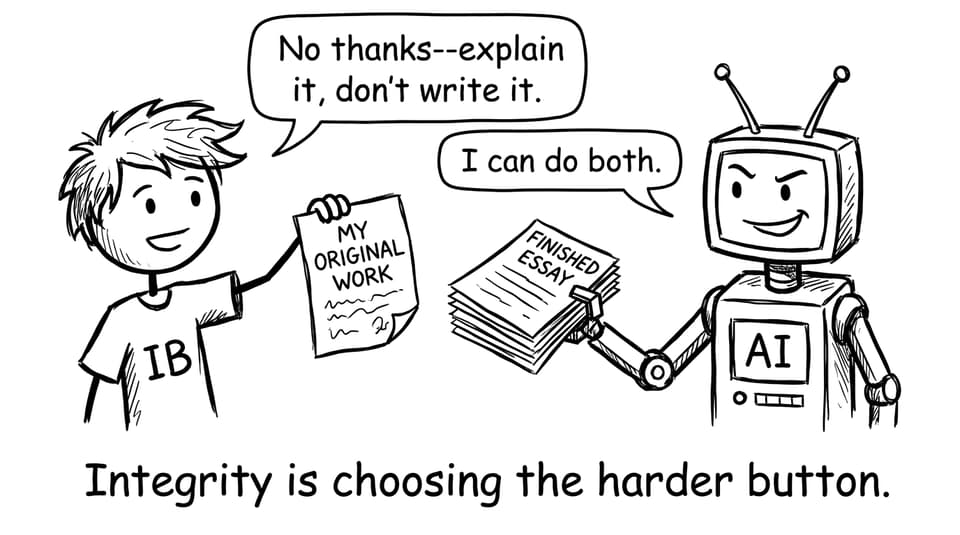
Comic about choosing explanation over AI-written work

A quick IB checklist teachers use (and you can borrow)

If you want the fast version, this is what strong IB classrooms quietly repeat all year. Use it as a self-check when you study:

  • Your teacher models citations and shows their thinking process.

  • Tasks are personal or specific enough that copying feels awkward.

  • Feedback arrives early, before final submissions.

min read
min read
min read
min read
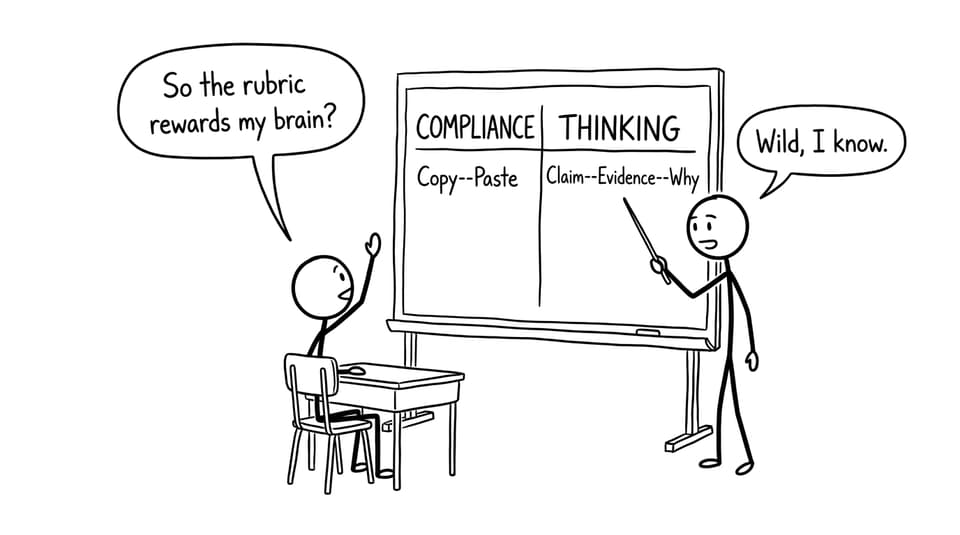
  • Rubrics reward reasoning, not just polished wording.

  • AI is used for explaining and practicing, not generating assessed writing.

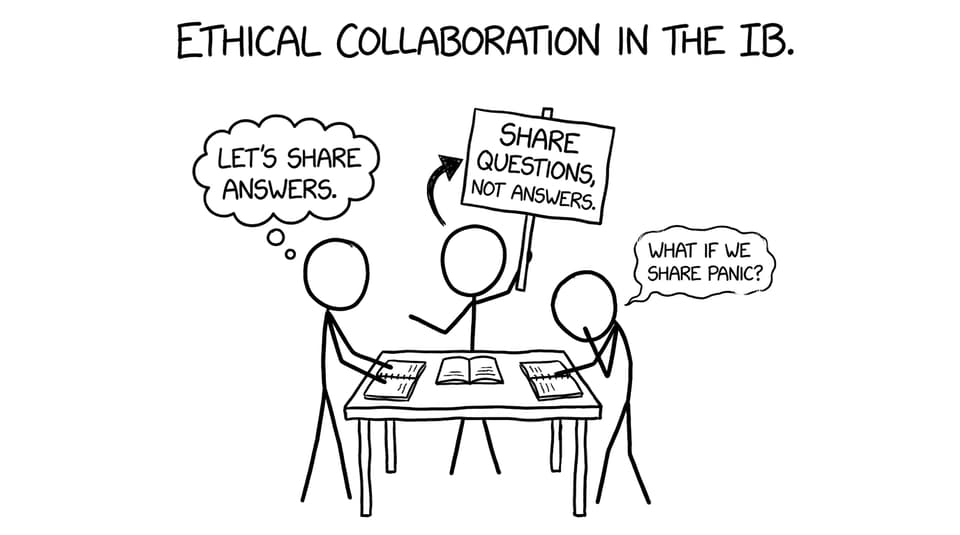
  • Collaboration is structured so it builds understanding, not shared answers.

  • RevisionDojo is built around these same ideas: learn, practice, get feedback, and keep ownership of your work through Study Notes, Flashcards, Questionbank, AI Chat, Grading tools, Predicted Papers, Mock Exams, the Coursework Library, and Tutors.

    Integrity in the IB is a thinking skill, not a rule

    In the IB, integrity is often described as “don’t plagiarize.” But that framing is too small. Real integrity is the ability to show how you know.

    That’s why the best teachers talk about integrity the way athletes talk about form. It’s not a speech you hear once. It’s a habit you practice until it becomes automatic.

    When teachers build integrity well, students start doing three things naturally:

    • They trace ideas: “This came from a source, this came from class discussion, this came from my own interpretation.”

    • They explain choices: “I used this example because it proves the claim under this assumption.”

    • They tolerate uncertainty: “I’m not sure yet, but here’s the best argument I can defend.”

    That last point is where original thinking begins.

    If you’re revising right now, pair that mindset with an exam-ready loop like the one in How to Study for IB Mocks (Without Burning Out) and Perfect Night-Before Routine for IB Exams. Integrity becomes much easier when your system reduces panic.

    How teachers design tasks that make IB originality unavoidable

    Copying thrives in generic prompts. Originality thrives in prompts with friction.

    In the IB, smart teachers reduce misconduct by making the easiest route also the most authentic route. That often looks like:

    They anchor tasks in personal context

    Instead of “Discuss globalization,” they ask for globalization through a local case, a family story, a school policy, or a recent event. Suddenly, your thinking matters.

    They demand the “why” behind the claim

    Many students can produce a claim. Fewer can defend it. Teachers who consistently ask for reasoning train you for exam command terms.

    They reward method, not just polish

    When the rubric values analysis steps (definitions, assumptions, counterclaims, evaluation), borrowed language loses its advantage.

    If you want to practice that style of thinking on your own, use a targeted practice loop: Study Notes for a short clarity patch, then Questionbank questions to prove you can apply it. RevisionDojo is designed for this exact rhythm.

    Comic about compliance vs thinking on a whiteboard
    Comic about compliance vs thinking on a whiteboard

    The classroom culture shift: from “gotcha” to “growth”

    A surprising thing happens when teachers treat integrity as a growth skill: students stop hiding.

    In the IB, many integrity mistakes are not driven by evil intent. They’re driven by:

    • weak note-taking and messy sourcing

    • misunderstanding paraphrasing

    • time pressure

    • unclear boundaries in group work

    • over-reliance on AI tools

    Good teachers build a culture where students can admit confusion early, because early confusion is fixable. Late confusion becomes risk.

    If you want a student-friendly explanation of why integrity matters beyond school, read Why Academic Integrity Matters in the IB: Lessons for Life and University. It reframes integrity as credibility you carry with you.

    Responsible AI use in the IB: what teachers should teach you to do

    AI isn’t going away. The question is whether it makes you sharper or lazier.

    In the IB, teachers who handle AI well do something simple: they make the “allowed” uses concrete, and the “not allowed” uses equally concrete.

    What responsible AI use looks like for students

    • Asking for concept explanations in simpler language

    • Requesting practice questions, then answering without help

    • Checking grammar and clarity after you’ve written your ideas

    • Using AI to identify missing counterarguments you then develop yourself

    What crosses the line

    • Submitting AI-generated analysis, evaluation, or paragraphs as your own assessed work

    • Using AI to produce a final commentary, IA section, or EE writing that you did not author

    If you want an integrity-focused guide you can share with your teacher or use for yourself, RevisionDojo has a clear student-facing article: How RevisionDojo Helps You Maintain Academic Integrity While Studying.

    Ethical research mentorship: EE, IA, and the “source trail”

    The IB core and coursework components reward students who can research honestly and think independently. Teachers foster integrity here by mentoring the process, not editing the product.

    Strong mentorship includes:

    • helping you choose a question you genuinely care about

    • setting checkpoints so you don’t write everything in one desperate weekend

    • teaching citation habits early, before drafting

    • asking you to explain your sources aloud (a fast way to detect shallow understanding)

    For students, the best protection is a clean system: keep a running source log, save quotations with page numbers, and write tiny reflections about how each source changed your thinking.

    If you’re working on the EE, these internal resources help you keep your IB work authentic and high-quality:

    • Mastering IB Extended Essays: How to Research, Write, and Revise

    • IB Extended Essay Guides

    • What Are IB’s Expectations for Academic Honesty in the Extended Essay (EE)

    And if TOK is where you practice intellectual honesty explicitly, start with IB Theory of Knowledge Resources and refer to IB Theory of Knowledge (TOK) Examples to see what authentic thinking looks like across markbands.

    Collaboration without collusion: how teachers keep group work clean

    In the IB, collaboration is valuable. Collusion is costly. Teachers foster integrity by making the boundary visible.

    Healthy collaboration usually means sharing:

    • questions, approaches, and planning

    • feedback on clarity

    • resources and citations

    Unhealthy collaboration usually means sharing:

    • paragraphs, drafts, or “final answers”

    • identical data sets without independent analysis

    • copied structures that produce suspicious similarity

    If you want a practical read on collaboration done ethically, see IB Test Sharing: Access Community-Created Practice Exams. The idea is simple: share practice and thinking, not finished work.

    Comic about sharing questions not answers
    Comic about sharing questions not answers

    Conclusion: in the IB, integrity is how you become exam-proof

    The goal isn’t to become a student who never makes a mistake. The goal is to become a student whose work is unmistakably theirs.

    In the IB, teachers foster integrity and original thinking by designing better tasks, normalizing transparent process, and teaching responsible tool use. As an exam student, you can adopt the same structure: practice honestly, track your reasoning, and build a system that makes your thinking stronger each week.

    If you want one place to do that without cutting corners, use RevisionDojo as your home base: train with the Questionbank, tighten understanding with Study Notes, retain essentials with Flashcards, unblock confusion with AI Chat, learn markbands with Grading tools, and rehearse exam pressure with Mock Exams and Predicted Papers. Integrity in the IB becomes easier when your study system is built to reward real understanding.
    How helpful was this article?
    Add as a preferred source on Google

    Continue studying with RevisionDojo

    • IB Coursework GraderCheck an IA, EE, or TOK draft against IB assessment criteria.
    • IB Coursework ExamplesLearn from high-scoring coursework across IB subjects.
    • IB Grade CalculatorEstimate an IB grade using session-specific boundaries.
    • IB Grade BoundariesExplore historical grade boundaries by subject and session.

    Frequently Asked Questions