
A quiet problem in IB revision season
IB exam season has a particular kind of silence. It is not calm. It is the silence of tabs multiplying, deadlines approaching, and a brain that wants certainty more than it wants understanding. In that moment, “help” can start to look like “hand me the answer.”
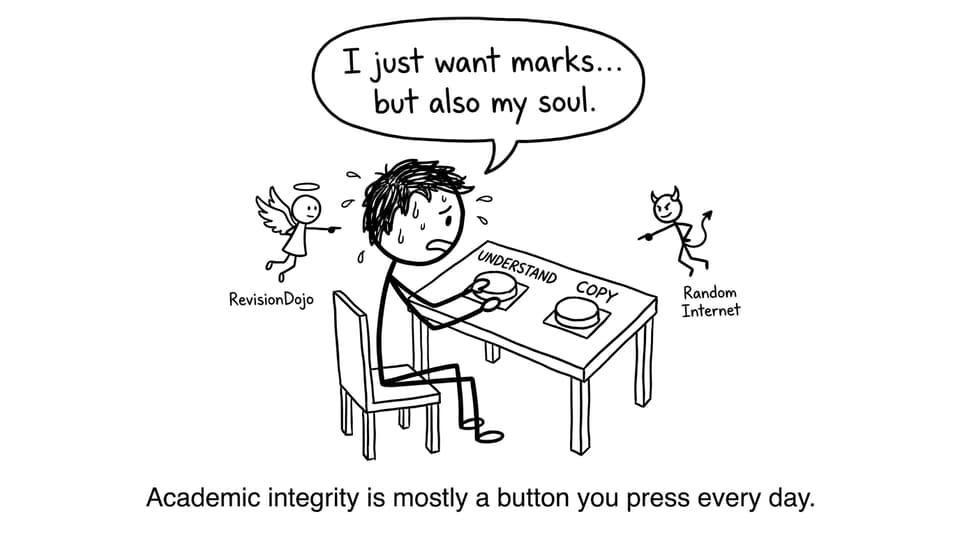
Academic integrity in IB is rarely lost through villainy. It is usually lost through fatigue, pressure, and unclear systems. When your plan is messy, shortcuts start to feel like strategy.
That is why RevisionDojo is built the way it is: as a single, structured place to learn, practise, and get feedback without crossing the line. The goal is not to make you fearful. The goal is to make honest work easier than dishonest work.
Quick checklist: staying IB-safe while you study
Use this as your 60-second reset before a revision session or any submission:
-
Use RevisionDojo to understand, then close the notes and answer from memory.
-
Treat examples as models of reasoning, not text to reuse.
-
Keep a live sources log (links, page numbers, dates) for any research-heavy task.
-
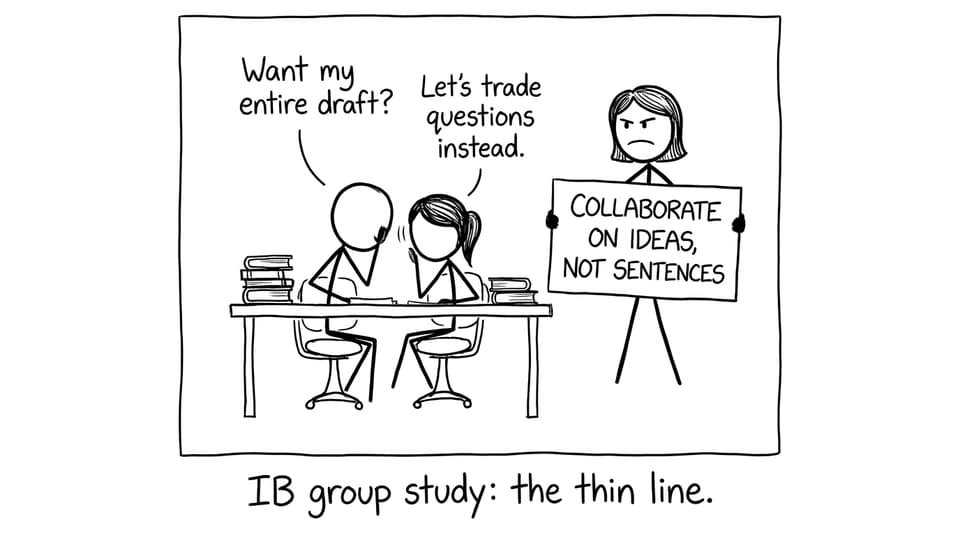
Collaborate on ideas and methods, not sentences and paragraphs.
-
Use AI like a tutor (explain, quiz, critique) not a ghostwriter (produce final prose).
-
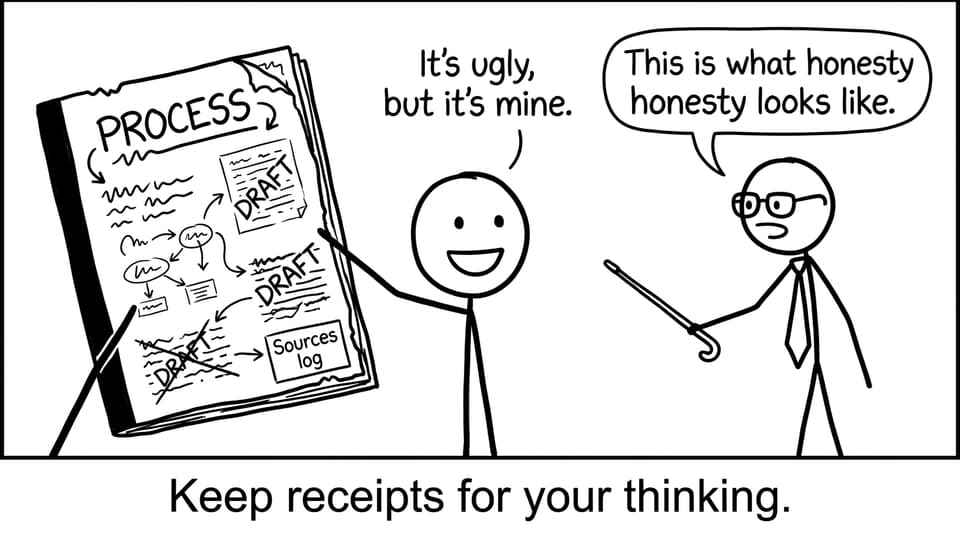
Build a “proof of process” folder: outlines, drafts, corrections, mistake logs.
If you can explain your work out loud, step by step, you are usually on solid IB ground.
Why academic integrity matters in IB (beyond rules)
The IB is assessing what your mind can do with information, not whether you can access information. That is why academic integrity in IB is so tightly connected to exam performance: honest studying forces retrieval, practice, and decision-making.
Integrity also protects you from a more frustrating outcome than getting caught: submitting work that you cannot defend. The fastest way to panic in a viva, teacher conference, or final exam is to realise you do not actually own the thinking.
If you want a broader framing of this, read Why Academic Integrity Matters in the IB and keep it as a mindset anchor.
How RevisionDojo helps IB students maintain academic integrity
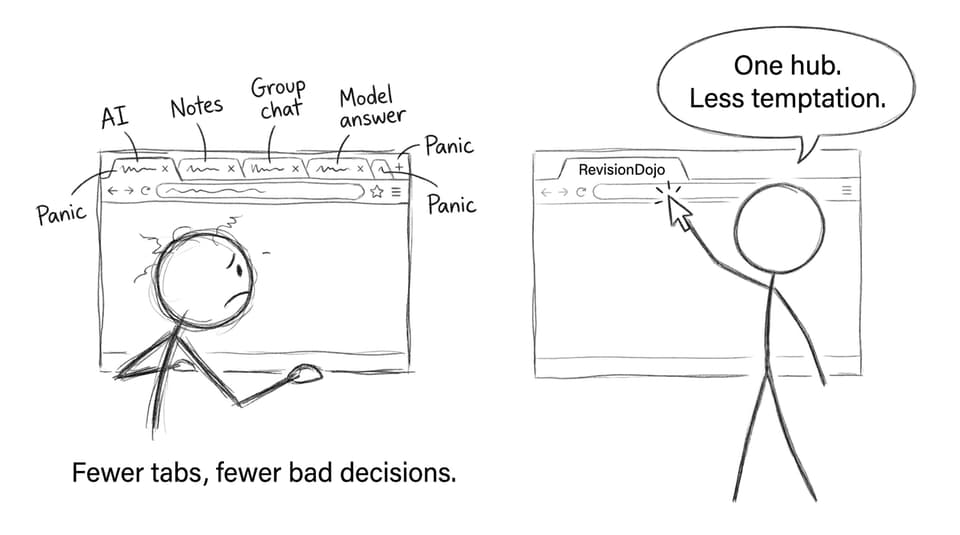
It reduces the “27 tabs” problem that leads to bad choices
When your revision is scattered, temptation is everywhere: copied notes, recycled explanations, sketchy “model answers,” and AI outputs that sound confident but are not yours. RevisionDojo helps by centralising the work: learn, practise, review, repeat.
You can start from RevisionDojo for IB and keep your entire routine inside one ecosystem: Questionbank, Study Notes, Flashcards, AI Chat, Grading tools, Predicted Papers, Mock Exams, Coursework Library, and Tutors.
Structured Study Notes that teach process, not copy-ready answers
Good IB integrity is often just good learning design. RevisionDojo’s Study Notes are built to explain concepts clearly and move you toward application. That matters because plagiarism thrives when students feel they cannot start.
Instead of hunting for phrasing to borrow, you learn the underlying logic, then practise producing your own explanation. This is especially helpful for IB command terms: you stop asking “what do I write?” and start asking “what is the examiner rewarding here?”
For a full workflow, see RevisionDojo App: The Smarter Way to Prep for IB Exams.
Questionbank practice makes integrity the default
In IB, the most integrity-safe study move is also the highest scoring one: practise questions under constraints.
RevisionDojo’s Questionbank nudges you into honest effort because it is built around doing, not downloading. You attempt, you get feedback, you reattempt. You cannot “copy” your way through skill-building for long.
To use this ethically (and effectively), try this rhythm:
-
Read one small slice of notes.
-
Do a short Questionbank set on that slice.
-
Review mistakes and write one “error rule” per pattern.
-
Reattempt similar questions within 24-48 hours.
If you want a specific example of targeted practice, read How to Use the Questionbank for Targeted Math Revision or explore a subject hub like IB Chemistry Questionbank.
Flashcards support ownership: you can only recall what you learned
Academic integrity in IB is easier when your memory is warm. The more you remember, the less desperate you feel. The less desperate you feel, the less you reach for shortcuts.
RevisionDojo’s Flashcards keep daily recall light and consistent. You can also turn your own mistake patterns into cards, which quietly trains the most honest form of authorship: “I know this because I fixed it.”
If your problem is studying for hours but retaining little, IB: I Study All Day but Remember Nothing is a useful reset.
Jojo AI Chat helps without replacing your thinking
The tricky part about AI and IB integrity is not whether AI exists. It is whether you use it at the end of the process, when you are tempted to submit what it produced.
RevisionDojo’s Jojo AI Chat (see Meet Jojo AI: Your Personal IB Study Assistant) is most powerful when it plays the role of a tutor:
-
Explain a concept you cannot unpack.
-
Quiz you until you can answer without hints.
-
Point out gaps in your reasoning.
-
Help you translate feedback into next steps.
That is why it supports IB academic integrity: it keeps you moving without stealing authorship.
For an IB-focused view of safe AI behaviour, read Are There Any IB-Approved AI Study Resources? What’s Actually Safe?.
Grading tools and the Coursework Library make “proof of process” easier
A lot of IB integrity anxiety shows up in coursework: “What if my teacher thinks this sounds too polished?” or “How do I show this is mine?”
RevisionDojo’s IB Coursework Grader helps because it pushes you into iterative improvement. You upload drafts, get rubric-aware feedback, and revise. That creates a visible trail of thinking. Pair that with the Coursework Library for exemplars and structure ideas, and your work becomes both stronger and easier to defend.
The integrity advantage is subtle but real: students who revise in iterations are less likely to copy, because they have a process to trust.
Predicted Papers and Mock Exams reduce panic-driven misconduct
Many integrity problems are really time-pressure problems. If you have never practised under time, the final weeks of IB revision can feel like drowning. Drowning students grab anything.
RevisionDojo’s IB Predicted Papers and Mock Exams let you rehearse the pressure in a controlled way. You learn pacing, stamina, and how to recover after a hard question.
If you want to understand how to use these resources without magical thinking, read IB Predicted vs Specimen Papers: What They Mean and then schedule one timed session per week.
The line between collaboration and collusion (and how to stay safe)
IB students are often told to “work together,” then warned about “collusion,” and left to guess where the border is. A practical rule is this: collaborate on decisions, not sentences.
Try collaboration formats that protect integrity:
-
Compare plans (essay outlines, method steps, topic lists), then write separately.
-
Trade questions you made for each other, not paragraphs.
-
Do a timed mini-mock together, then discuss error patterns.
For classroom-wide culture, Building a Culture of Academic Honesty in IB Classrooms is a strong companion read.
A simple integrity-first IB routine you can repeat
If you want one routine that makes IB integrity almost automatic, use this 4-step loop:
-
Understand (10-15 min): Study Notes on one micro-topic.
-
Recall (10 min): Flashcards, closed-book.
-
Apply (25-45 min): Questionbank on that exact micro-topic.
-
Review (10-15 min): log mistakes, ask Jojo AI Chat one clarifying question, and create 3 flashcards from errors.
This is also where RevisionDojo’s design shines: every tool has a job, and the jobs connect.
FAQ
Is using RevisionDojo allowed under IB academic integrity rules?
Yes, using RevisionDojo is consistent with IB academic integrity expectations when you use it as a learning and practice platform rather than a source of text to submit. The IB focuses on authenticity: the work you hand in must be your own and you must be able to explain how you produced it. RevisionDojo’s Study Notes and Questionbank are designed to build understanding and exam skill, which supports authentic performance. Features like Flashcards and Mock Exams strengthen recall and decision-making, which are clearly student-owned outcomes. If you use AI Chat, treat it like a tutor: ask for explanations, quizzes, and feedback, then write the final response yourself. When in doubt, follow your school’s policy and keep a record of how you used tools during your process.
How does RevisionDojo help prevent plagiarism when I’m tired and rushing?
It prevents plagiarism the same way good training prevents injuries: by creating a predictable routine you can follow on low-energy days. When you know your next step is “do a Questionbank set on this topic,” you are less likely to go hunting for something to copy. RevisionDojo also makes it easy to turn confusion into action: notes for clarity, practice for proof, feedback for correction. That matters because many plagiarism cases start as panic, not intention. The more you practise under realistic conditions with Mock Exams and Predicted Papers, the less likely you are to feel trapped close to deadlines. Over time, you start trusting your own process, which is the real antidote to shortcuts.
How should I use Jojo AI Chat ethically as an IB student?
Use Jojo AI Chat as a conversation that increases your understanding, not as a machine that produces final work. Good prompts are things like “Explain this concept in simpler terms,” “Quiz me with IB-style questions,” or “What does this command term require?” After you get help, close the chat and write your answer from scratch, then check it against criteria or marking logic. If Jojo suggests sources or facts for research, verify them independently before you rely on them. Keep brief notes of what you asked and what you changed, especially for coursework drafts, because transparency reduces anxiety. Most importantly, pair AI help with practice: go straight into the Questionbank or a timed response so your learning becomes yours.
What if my friends want to share full answers in a group chat?
This is common in IB, especially close to exams, and it does not mean your friends are bad people. It usually means everyone is overloaded and looking for relief. A simple boundary is to propose swapping outlines, approaches, and question sets instead of full paragraphs or full solutions. You can also suggest doing a collaborative mini-mock, then discussing how you interpreted the question and where marks were lost. If someone sends you a full answer, do not reuse the wording; instead, identify the underlying idea and re-derive it yourself using notes and practice. RevisionDojo helps here because you can redirect the group toward Questionbank sets, Mock Exams, and error-pattern discussions, which are collaborative but still authentic. Over time, groups that focus on process tend to outperform groups that focus on copying.
Conclusion: IB integrity is a system, not a speech
Academic integrity in IB is not just about avoiding misconduct. It is about building a study system where honesty is the easiest option even when you are tired.
RevisionDojo supports that system end to end: Study Notes for clarity, Flashcards for daily recall, Questionbank for exam skill, Jojo AI Chat for ethical unblocking, Grading tools for coursework improvement, plus Predicted Papers and Mock Exams to make pressure feel familiar. Add the Coursework Library and Tutors when you need models or a human strategy reset.
If you want your next revision session to feel clean, calm, and undeniably yours, start at RevisionDojo and build your IB routine around understanding and practice. Integrity will follow.