


The moment the IB Extended Essay stops being “yours”
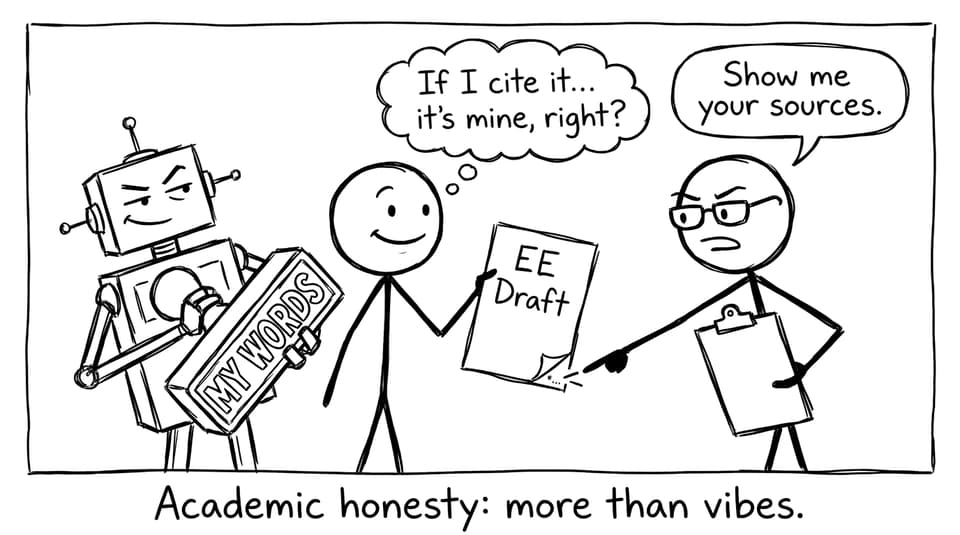
Most IB students don’t plan to cheat on their Extended Essay (EE). What happens instead is quieter: a rushed paraphrase, a borrowed structure that feels “standard,” a friend’s draft that looks a little too helpful, or an AI tool that tidies your voice until it no longer sounds like you.
The IB isn’t asking you to be a perfect scholar. It’s asking you to be an honest one. In the EE, academic honesty is the foundation that makes everything else credible: your argument, your research, your reflections, and ultimately your diploma points.
If you want the big-picture EE hub before we zoom in, start with IB Extended Essay Guides.
Quick checklist: what the IB expects for EE honesty
Use this as your fast self-audit before any supervisor meeting or submission:
-
Your EE writing is authentically yours (voice, structure, phrasing).
-
Every borrowed idea, quote, dataset, image, graph, and definition is cited.
-
Collaboration stays at the “discuss ideas” level, not “share paragraphs.”
-
You do not duplicate work across assessed components.
-
You can explain, out loud, how you produced every key claim.
-
If you used AI meaningfully, you treat it transparently and do not submit AI-written text as your own.
For a deeper habits-based view beyond the EE, see Why Academic Integrity Matters in the IB: Lessons for Life and University.
Authorship: the IB wants your thinking, not a polished mask
At the heart of IB academic honesty is authorship. Your EE must represent your independent intellectual work. That includes your planning choices: what you read, what you ignore, what you decide matters, and how you connect evidence to claims.
This is why the IB draws a clear boundary around “help.” A supervisor can guide your process, ask probing questions, and point out general issues. But they cannot rewrite your paragraphs, restructure the essay for you, or line-edit your draft into something smoother.
If you’re unsure what supervision is allowed, read One Draft Rule for EE: What Supervisors Can't Do. The short version: feedback should feel like questions and direction, not someone else’s sentences.
Plagiarism: it’s not just copy-paste
In IB terms, plagiarism is using someone else’s words or ideas without proper acknowledgment. Students often imagine plagiarism as obvious copying, but EE issues are usually more subtle:
-
Quoting without quotation marks (even if you cited the author).
-
Paraphrasing that keeps the original sentence structure.
-
Using an online exemplar as a template for your argument or section layout.
-
Copying definitions, explanations, or “perfect” background paragraphs from study sites.
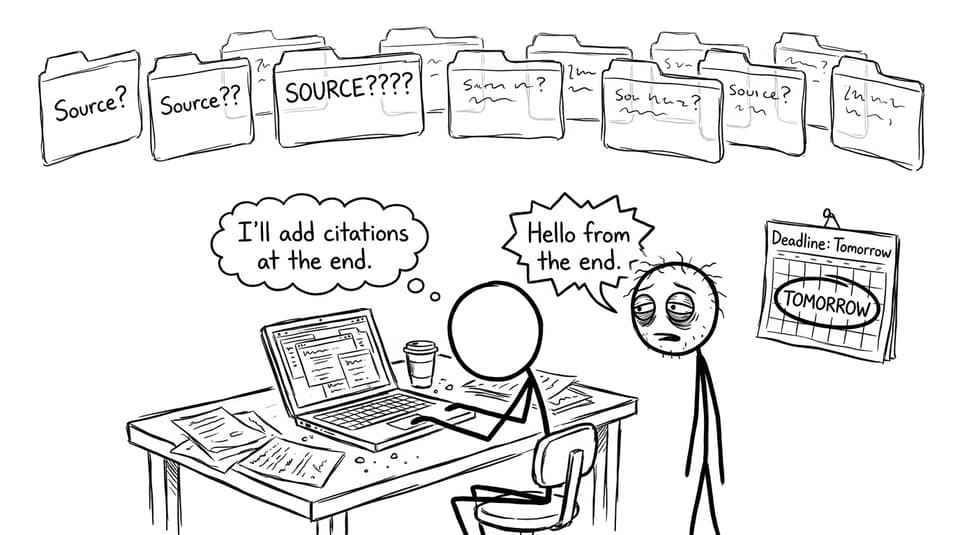
The safest mindset is: cite the idea, not just the quote. And cite it at the moment you use it, not at the end.
If you want a concrete referencing framework, use IA Citations: 10 Best Practices for IB EE and IA and What Are The Common Formatting And Citation Styles Used In IAs?. The EE doesn’t demand one specific style, but it does demand consistency and traceability.
Collusion: collaboration has a line
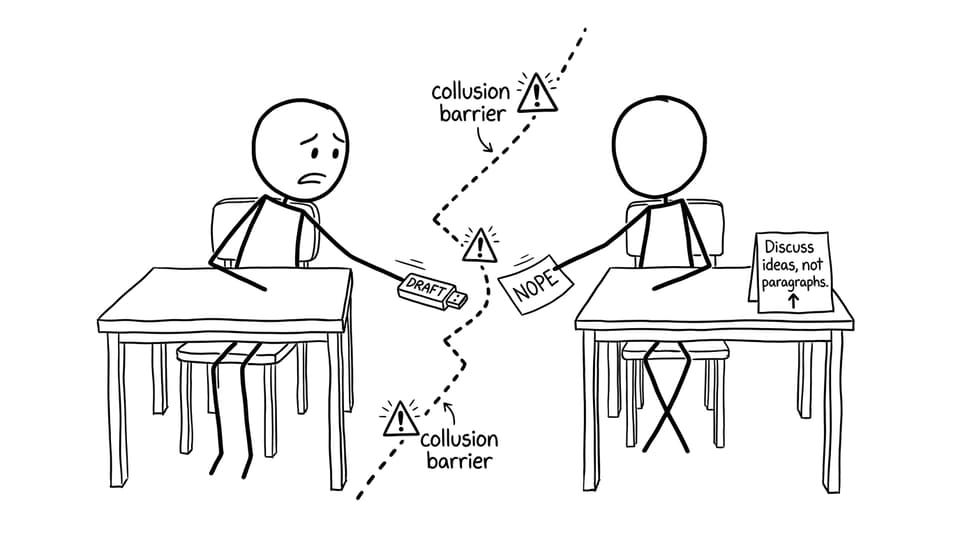
The IB allows learning together. It does not allow producing assessed writing together.
Collusion in the EE is when students share drafts, exchange paragraphs, submit highly similar analysis, or reuse the same dataset in a way that makes authorship unclear. Even if you researched similar topics, you must write, analyze, and present independently.
A useful rule: you can discuss sources, methods, and general arguments. You cannot share wording, polished sections, or final structures.
Duplication: “It’s my work” is not always a defense
Another IB honesty trap is duplication of work across components. Submitting overlapping content between your EE and another assessed task can be treated as misconduct, even if you wrote it originally.
You can often reuse sources across tasks, because real research overlaps. But reusing your writing or repeating the same analysis is where risk climbs.
If this is your situation, read IA Sources for Your EE: What's Allowed in IB?. It breaks down a clean approach: shared research vault, separate outputs, and clearly distinct arguments.
AI tools: IB-safe support vs IB-risk shortcuts
The IB doesn’t “ban AI” in a simple way. It expects transparency and genuine ownership.
A practical way to stay safe:
-
Use AI for brainstorming research questions, clarifying concepts, or testing whether your argument is coherent.
-
Do not paste AI-generated paragraphs into your EE.
-
Do not use AI to rewrite your draft until it becomes “not you.”
-
Keep a brief log of meaningful prompts and outputs, so you can explain your process if asked.
If you want a fuller explanation of disclosure and what counts as meaningful use, see Should I Mention My Use of AI in CAS Reflections or EE Research? and IB-Approved AI Study Resources: What's Actually Safe?.
RevisionDojo is built around this distinction. AI Chat helps you understand and plan, not outsource authorship. The Coursework Grader supports rubric-aligned feedback so you can revise in your own words. The Coursework Library helps you learn patterns without copying. And for exam prep alongside EE stress, the Questionbank, Study Notes, Flashcards, Predicted Papers, and Mock Exams keep your momentum steady.
If you’re polishing drafts and want criterion-based feedback, use IB Coursework Grader.
What happens if the IB flags your EE?
The IB treats academic misconduct seriously because the EE is externally assessed and checked. If significant unattributed material is found, you can lose your EE grade, which can block the award of the diploma. Smaller issues can still trigger investigations, mark reductions, or formal warnings.
The brutal part is timing: problems are often detected late, when you can’t “just fix the citations.” That’s why honesty needs to be designed into your workflow from the first day.
If you want additional EE-specific guidance in one place, browse All IB Extended Essay Posts.
Closing: build an EE that you can defend
The IB Extended Essay is not just 4,000 words. It’s a record of your judgment: what you trusted, what you questioned, and how you made meaning from evidence without hiding the ladder you climbed.
If you want to stay calm and clean, treat academic honesty like an engineering problem: build the system early. Track sources as you research, write in your own voice, keep drafts, and draw a bright line between help and authorship.
When you’re ready to improve without compromising integrity, RevisionDojo is the safest place to do it: use AI Chat to clarify, the Coursework Grader to get rubric feedback, the Coursework Library to learn structure without copying, and the Questionbank plus Mock Exams and Predicted Papers to keep exam preparation moving alongside the EE.