
The Perfect Night-Before Routine for IB Exams
The night before an IB exam is a strange little doorway.
On one side is months of effort: notes, drills, small wins, and the occasional moment of panic that felt like a personality trait. On the other side is a quiet desk, a question booklet, and the reality that your brain will be asked to perform, not just remember.
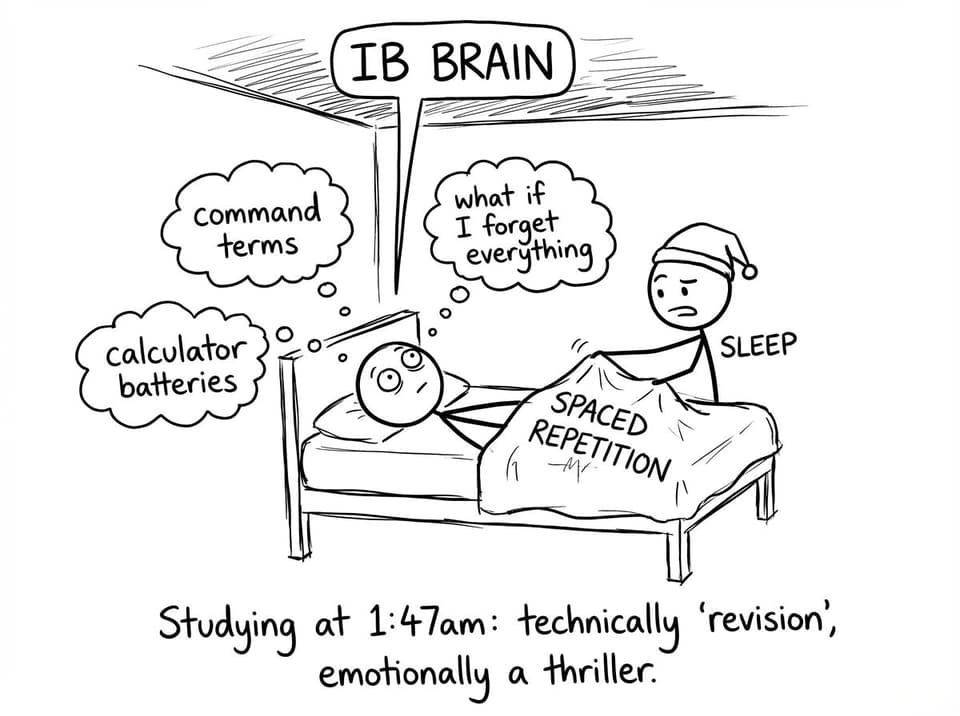
Most IB students spend this night trying to buy certainty. They scroll for "one more resource," rewrite "one more summary," or attempt a heroic late sprint that costs them sleep. But the truth is calmer and more useful: the perfect night-before routine is not about learning more. It's about making tomorrow easier.
This guide gives you a simple IB night-before routine you can repeat for every paper. It's practical, specific, and designed to keep you steady.
The IB night-before checklist (save this)
If you do nothing else tonight, do these seven things.
- Do 30-60 minutes of light, high-yield IB review
- Stop studying at a fixed cutoff time
- Pack your exam kit (then re-check it)
- Set up your morning (alarm, breakfast, route, clothes)
- Eat a steady dinner and hydrate
- Do a 5-10 minute calm-down routine
- Sleep like it's part of your IB strategy
If you want a deeper exam-season plan (not just tonight), keep this nearby: How to Study for IB Exams: Step-by-Step Guide.
Why the night before IB exams feels so intense
The IB is hard partly because it's broad, and partly because it's precise. You don't just need "knowledge." You need the ability to produce the right kind of answer under time pressure.
That's why the night before can feel like the last chance to patch everything. But under stress, your brain gets worse at:
- holding new information
- making good decisions
- staying confident when you meet an unfamiliar question
So the night-before goal is simple: protect memory, mood, and momentum. That is what top scorers do, even if they don't call it that.
For a more detailed night-before framework, you can also read: What to Do the Night Before IB Exams.
The perfect IB routine, hour by hour
Below is a flexible schedule. Adjust the times, but keep the sequence.
Early evening: close the loop, don't open new loops
This is where most IB students sabotage themselves: they start something they can't finish.
Your rule tonight:
- If it's new learning, it's too late.
- If it's reinforcement, it's perfect.
Use one of these light review options:
- Flashcards for definitions, processes, and key comparisons
- A short skim of your weak-topic notes
- 10-20 targeted exam-style questions (not a full timed paper)
RevisionDojo is built for exactly this kind of "reinforcement block." You can:
- skim the right sections quickly with Digital IB Study Notes
- run fast recall with Flashcards
- do a small set from the Questionbank and stop
If you're new to the platform's core tools, start here: Notes + Flashcards + Question Bank (Free).
30-60 minutes of IB review: make it active
Passive review feels soothing. Active recall creates results.
Try this "three-pass" routine:
- Pass 1 (10 min): skim the headings of your notes and predict what you'd be asked
- Pass 2 (20-30 min): flashcards or short-answer recall (no notes open)
- Pass 3 (10-20 min): a tiny set of exam-style questions on your weakest area
If you want a structured approach to practice questions, this is worth bookmarking: Comprehensive IB Question Bank: Thousands of Practice Questions.
Set a hard stop time (and take it seriously)
Pick a cutoff time and treat it like an appointment.
Most IB students do well with a cutoff between 8:30-10:00pm, depending on when you need to wake up. The point isn't moral purity. It's physiology.
When you cut off heavy thinking, your brain gets time to settle. Sleep comes faster. Tomorrow feels cleaner.
If sleep has been an issue during exams, keep this page open: How to Sleep Properly During the IB Exam Period.
The "exam kit" routine: remove all preventable stress
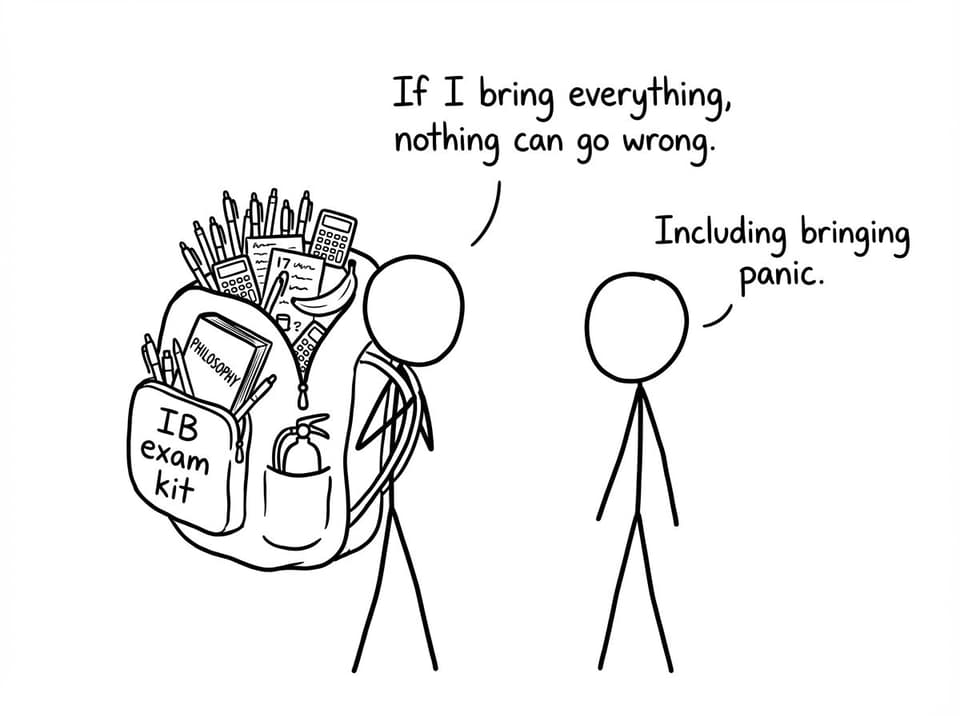
Packing your bag is underrated. It's not about stationery. It's about preventing a cortisol spike at 7:58am.
Pack what you're allowed and what you reliably use:
- pens (at least 2), pencils, eraser, ruler
- calculator (if relevant) and fresh batteries if needed
- ID/exam entry details if your school uses them
- water bottle and a simple snack (if permitted)
Then do something surprisingly powerful: pack it, zip it, and place it by the door. Your morning self should do almost nothing.
Set up your morning like a future-you favor
A calm IB morning is usually built the night before.
Do these four things:
- set two alarms (one backup)
- choose clothes now (remove micro-decisions)
- plan breakfast (simple, familiar)
- confirm the route and timing (especially if it's off-site)
The theme is the same: reduce friction. The fewer decisions you make, the more bandwidth you keep for the exam.
Food, caffeine, and hydration (keep it boring)
Tonight is not the night for experiments.
- Eat a balanced dinner (protein + slow carbs + vegetables works well).
- Hydrate steadily, but don't chug water right before bed.
- Avoid late caffeine. Many IB students can feel it even 6-8 hours later.
Your goal is stable energy, not a dramatic boost.
The calm-down routine: 10 minutes that change the whole night
The best IB students aren't calm because they don't care. They're calm because they have a routine that tells the brain, "We're safe."
Pick one:
- 4-7-8 breathing for 5 rounds
- a short walk (even 8 minutes helps)
- light stretching and a warm shower
- write down worries as a list, then write the first next action for each
If anxiety is loud right now, this article is a good companion: Strategies for Dealing with IB Exam Anxiety.
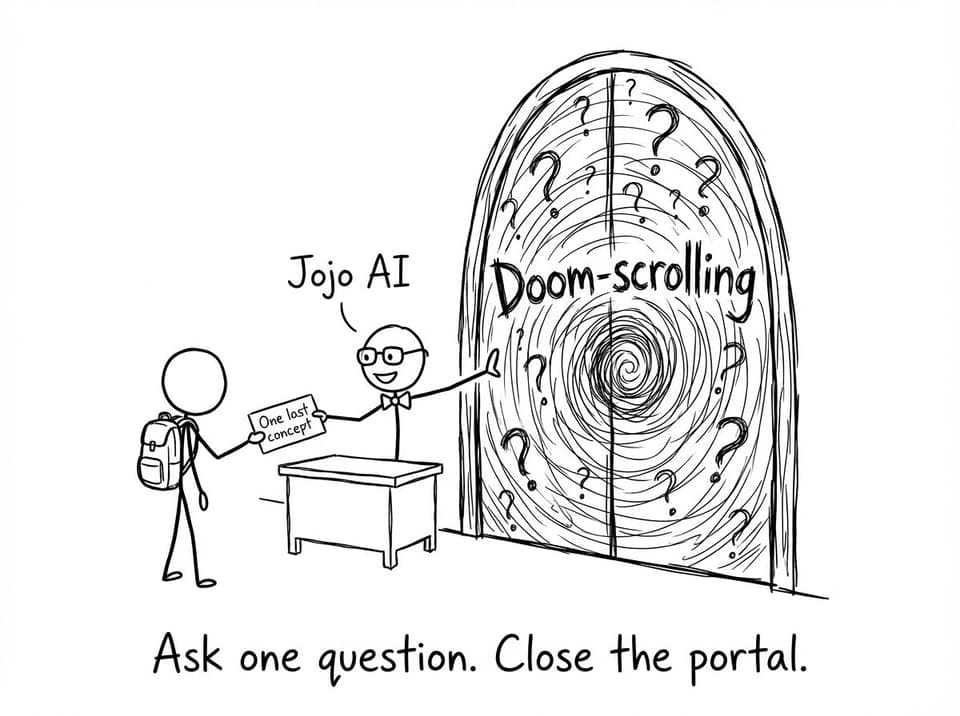
How to use RevisionDojo tonight (without turning it into doom-scrolling)
RevisionDojo can make your IB night-before routine simpler, but only if you use it with boundaries.
A clean "tonight" setup looks like this:
- Study Notes: skim one weak topic to refresh structure and language
- Flashcards: 7-15 minutes of quick recall
- Questionbank: 10-20 targeted questions for confidence and accuracy
- AI Chat: ask one focused question, then close it
If you are tempted to take a full timed mock tonight, don't. Save heavy timing work for earlier in the week using Mock Exams and Exam Mode, when feedback can still shape your next sessions.
And if coursework stress is what's keeping you up (it happens during exam season), park it for tonight and schedule it later with the IB Coursework Grader. Your sleep is worth more than one more tweak.
Common night-before IB mistakes (and better swaps)
Mistake: doing a huge study sprint
A late sprint feels brave, but it often steals sleep and raises anxiety. In the IB, mental sharpness beats raw hours.
Swap it with: one short active recall block and a clear cutoff.
Mistake: collecting resources instead of using one
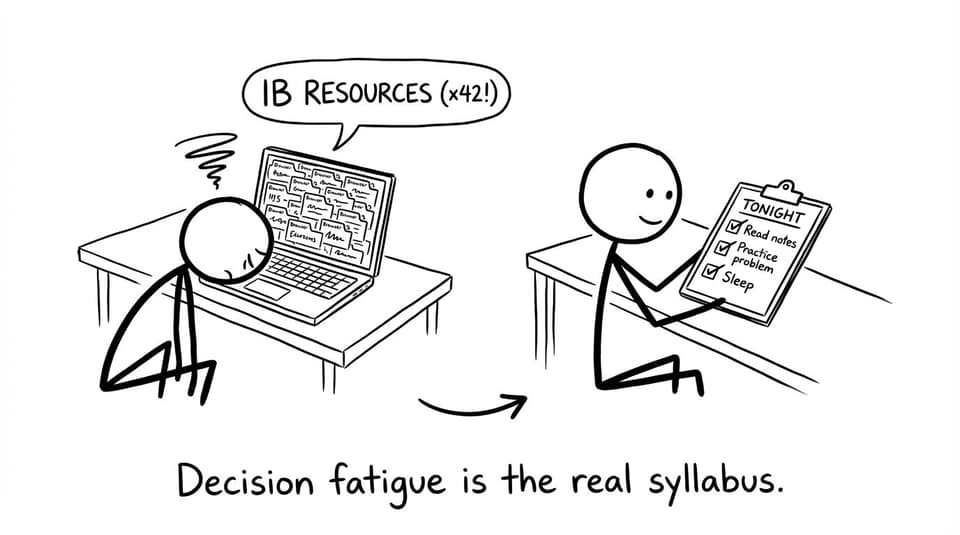
A new video, a new document, a new "ultimate guide" can be comforting. But it's still a decision, and decisions cost energy.
Swap it with: one platform, one plan, one page of targets.
Mistake: rewriting notes to feel productive
Neat notes are not the same as strong recall.
Swap it with: flashcards and a small set of exam-style questions.
Closing: The perfect IB night-before routine is a promise
The perfect IB night-before routine is not a magical set of hacks. It's a promise you make to your future self: I will not trade tomorrow's clarity for tonight's panic.
Do your small active recall block. Pack your kit. Set up the morning. Wind down. Sleep.
And if you want the simplest way to keep the whole exam season calmer, build your system around RevisionDojo: Questionbank for targeted practice, Study Notes for fast clarity, Flashcards for recall, AI Chat for quick explanations, Grading tools for feedback, Predicted Papers and Mock Exams for realistic training, a Coursework Library for exemplars, and Tutors when you need a steady human voice.
Tomorrow, when you open the IB paper and your mind feels clear, you'll understand what tonight was really for.