Join 650k+ students breezing through the IBReady to breeze through the IB?
If you have ever stared at a blank document and felt your IB Extended Essay getting heavier in your chest, you are not alone. The strange part is that the EE rarely feels hard because of one big thing. It feels hard because of a hundred small decisions: what to read first, how to phrase the research question, where to put that quote, whether your analysis is “enough,” and how to fix a draft without rewriting the whole world.
The good news is that the IB Extended Essay is not a mystery. It is a project. And projects become manageable when you turn them into a sequence of repeatable moves.
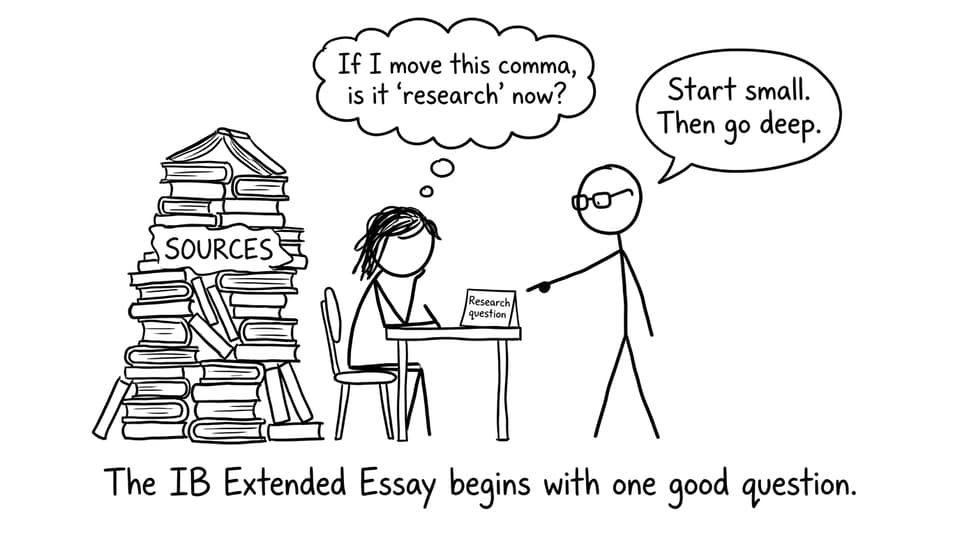
Student vs sources mountain
A quick IB Extended Essay checklist (save this)
Use this IB checklist whenever you feel stuck:
Pick a topic you can live with for months (not days)
Convert it into a narrow research question you can actually answer
Collect a small set of high-quality sources, then expand strategically
Write an outline that forces analysis (not just summary)
Draft quickly, revise slowly, and proofread last
Keep citations running from day one
Get feedback early, then do one focused revision pass per criterion
Choosing a research question that works for IB (and for you)
Most IB EEs go wrong at the beginning, not the end. A topic can be fascinating and still be unscorable because it is too wide, too descriptive, or impossible to evidence.
A reliable test: can you finish this sentence in one breath?
“In this essay, I will argue that __, because __, using evidence from __.”
If you cannot, your scope is probably too broad.
Narrowing your IB research question without killing the idea
Try tightening your idea in three steps:
Zoom in on a place, time, text, or dataset. “Climate change” becomes “coral reef biodiversity in the Great Barrier Reef, 2000-2020.”
Choose a measurable lens. Compare, evaluate, explain, test.
Build in debate. If the answer is obvious, the essay becomes a report.
If you want common traps to avoid, read Mistakes to Avoid in IB Extended Essays. It is the fastest way to catch yourself before you spend weeks building the wrong thing.
Research that actually helps you write the IB Extended Essay
Research feels productive because it looks like effort. But in the IB EE, research only counts when it changes your thinking on the page.
Gather fewer sources, then read them better
Start with a “core set” of 6-10 strong sources. You can expand later, but early overload creates a notes swamp. As you read, keep two columns:
What the source says (one sentence)
What you will do with it (support, challenge, define, compare)
This second column is where an IB essay becomes analytical.
Use exemplars for calibration, not copying
When students say, “I don’t know what a good EE sounds like,” they usually mean they have never studied the shape of one.
Writing the IB Extended Essay without rewriting your life
Drafting is where perfectionism pretends to be “high standards.” The calmer approach is to draft like you are building scaffolding, then improve what holds marks.
A structure that keeps your IB essay coherent
Most IB Extended Essays become clearer when you commit to a simple spine:
Introduction: research question, context, and why the question is worth asking
Method/approach: what counts as evidence in your subject and how you will use it
Body sections: claim -> evidence -> analysis -> mini-conclusion
Conclusion: what you found, limits, and implications
Use longer sentences only when you are explaining reasoning
Define key terms the first time you use them
Let headings do real work (they should reflect your argument)
Revising an IB Extended Essay: the part that moves marks
Revision is where strong EEs separate from “almost.” But the trick is to revise by criteria, not by mood.
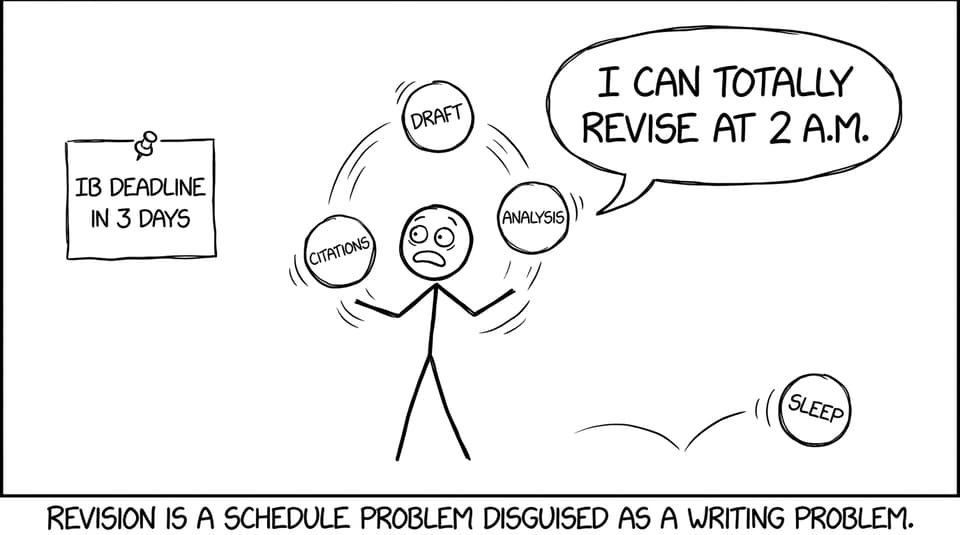
Juggling draft citations analysis sleep
The IB revision loop that saves time
Run this loop for each major section:
Highlight your claim (one sentence)
Underline the evidence (quote, data, example)
Circle your analysis (your reasoning, not the source’s)
If analysis is thin, add one paragraph answering: “So what?”
Then get rubric-aware feedback. RevisionDojo’s Grading tools are designed for coursework: the IB Coursework Grader helps you see what is missing in criterion terms, not vague comments.
The IB Extended Essay becomes manageable when you stop treating it as one giant assignment and start treating it as a chain of simple decisions: one research question, one source, one claim, one revision pass.
If you want a calmer way to run that chain, use RevisionDojo as your home base: build understanding with Study Notes, keep momentum with Flashcards, protect exam performance with the Questionbank, and refine your draft with AI Chat, Grading tools, the Coursework Library, and Tutors. The goal is not to “work harder.” It is to make each hour of IB effort count.