
If you want to study for IB mocks, you're not really trying to "learn the whole syllabus."
You're trying to become the version of yourself who can sit down in silence, see a question you've never seen before, and still produce the right kind of answer on time.
That's a different skill than reading. Different from highlighting. Different from rewriting notes until your hand hurts.
Mocks feel heavy because they reveal reality. But reality is useful. It turns your nervous energy into a plan. And a good plan lets you study with less drama and more direction.
A quick IB mocks study checklist (save this)
Use this checklist anytime you don't know what to do next. It's short on purpose.
- Pick the next paper you're training for (not the whole subject).
- Study one subtopic using concise notes (10-25 minutes).
- Do exam-style questions on that exact subtopic (25-45 minutes).
- Mark, then write a mistake log (10 minutes).
- Turn 1-3 mistakes into flashcards (5-10 minutes).
- Once a week, do a timed mock section or full mock.
On RevisionDojo, this loop becomes easier because the tools connect: Study Notes, Flashcards, Questionbank, AI Chat, Mock Exams, Predicted Papers, Grading tools, the Coursework Library, and Tutors.
If you want a fuller structure, keep this open: How to Study for IB Exams: Step-by-Step Guide.
Why most students study wrong for IB mocks
Most students don't fail mocks because they didn't work.
They fail because their effort wasn't shaped like the exam.
Mock exams reward three things:
- Recall under pressure (you can retrieve key facts fast)
- Application (you can use knowledge, not just repeat it)
- Exam technique (command terms, structure, time decisions)
Passive methods feel productive because they're smooth. You recognize the page. You remember the vibe. But mocks don't grade vibes.
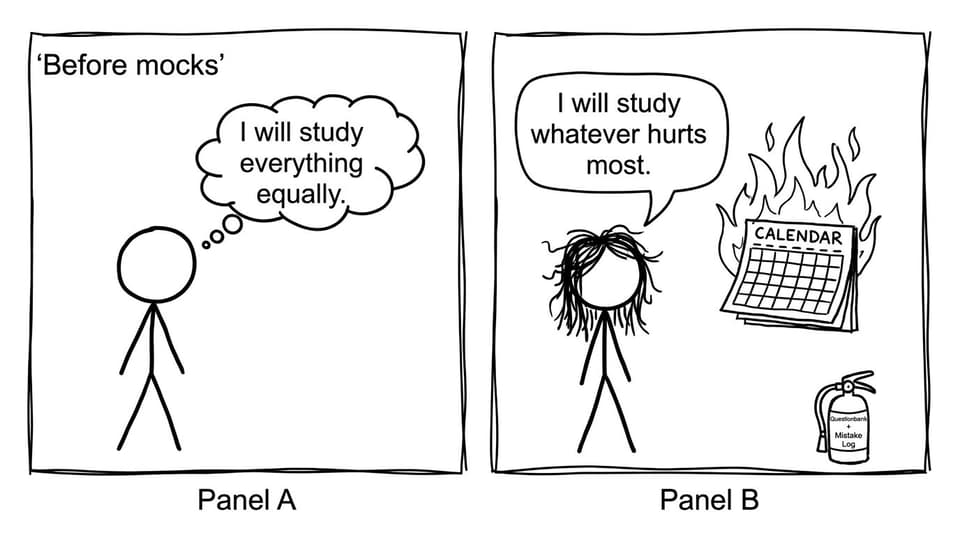
To study for mocks, you need friction. You need moments where you don't know. Those moments are not a sign you're behind. They're the exact data you came for.

How to study for IB mocks with the "tight loop" method
A good mocks plan is boring in the best way. It repeats.
Here's the tight loop:
Learn small
Choose one micro-topic (not "Organic Chemistry," but "nucleophilic substitution," not "Paper 2 History," but "one authoritarian state theme").
Use a resource that doesn't tempt you to over-read. RevisionDojo's notes are built for this kind of focused study: Notes + Flashcards + Question Bank (Free).
Test immediately
Then switch from "understanding" to "proving."
Use the Questionbank to pull exam-style questions by topic and level. The goal is not to feel good. The goal is to surface the exact places you break.
If you want to see how timed practice fits, read: IB Mock Exam Tips: Expert Strategies for Better Performance.
Mark like a scientist
When you mark, you're not judging yourself. You're inspecting a system.
Your mistake log should be simple:
- What went wrong?
- Why did it go wrong?
- What's the smallest fix?
- When will I retest it?
Then retest within 48 hours. That retest is where the grade gains happen.
The 3-week study plan for IB mocks (realistic and sustainable)
This is a flexible template. Adjust for your school's mock schedule.
Week 1: build coverage without panic
Goal: touch the syllabus enough to reduce surprise.
- 4 topic blocks per subject (45-75 minutes)
- Daily flashcards (10 minutes)
- 1 short timed section for one subject
If you're feeling behind, you're not alone. Use this as a stabilizer: How to Study for IB Exams When You Feel Behind.
Week 2: shift from topics to papers
Goal: stop studying "content" and start studying "performance."
- 2 topic blocks per subject (still targeted)
- 2 timed sections across the week (rotate subjects)
- Mistake log after every timed attempt
For timing practice that feels real, RevisionDojo's mock workflow is built for it: Online IB Mock Exams: Practice Anywhere, Anytime.
Week 3: simulate, review, repeat
Goal: convert anxiety into familiarity.
- 2 full timed mocks (or one full + two sections)
- Review days that are as serious as exam days
- Flashcards daily, but shorter and sharper
If your motivation starts wobbling here, it's normal. You don't need a new personality, you need a smaller loop: Why IB Motivation Comes and Goes (And What to Do).
How to study for IB mocks by subject type
Different subjects break students in different ways. Your study should match the failure mode.
Quantitative subjects (Math, Physics, Chemistry)
You're not just memorizing. You're rehearsing steps.
- Do short sets often (10-20 questions)
- Track "where I got stuck" (setup, algebra, interpretation, units)
- Re-do missed questions 2 days later without looking at solutions
If you're a Math student, the mock workflow here is especially useful: How to Use RevisionDojo to Prepare for IB Math Mock Exams.
Essay-heavy subjects (History, English, Economics, Business)
Your risk is not knowledge. It's structure under time.
- Practice introductions and thesis statements as mini-drills
- Build paragraph templates tied to command terms
- Get feedback fast (slow feedback kills momentum)
RevisionDojo's Grading tools help you tighten writing with rubric-aware feedback, and Tutors can diagnose structural issues quickly when you're plateauing.
Content-heavy sciences (Biology, ESS)
Your risk is "I kind of know it" turning into vague answers.
- Convert definitions and processes into flashcards
- Practice data-based questions weekly
- Train mark-scheme language (precise terms)
And yes, the Questionbank approach works across subjects because it forces specificity.
The underrated skill: how you review a mock
Most students treat a mock like a verdict.
Top students treat it like a map.
Here's a simple way to review any mock:
- Circle 5 questions you lost the most marks on.
- Label each mistake:
- knowledge gap
- method gap
- command term mismatch
- time panic
- careless
- Choose one fix per label:
- one note section
- one flashcard set
- one targeted question set
- one timed drill
Then you study the fix and retest. This is the compounding loop.
If you want to make this feel less chaotic, RevisionDojo's connected system helps: Study Notes for clarity, Flashcards for recall, Questionbank for practice, AI Chat for fast explanations, then Mock Exams and Predicted Papers for realistic rehearsal.
Closing: study for mocks like you're building a skill
The point of mocks is not to scare you. It's to show you the path.
When you study for IB mocks with a tight loop, learning small, testing fast, reviewing honestly, and retesting soon, you stop chasing motivation and start building reliability.
If you want that loop in one place, build your plan around RevisionDojo: Study Notes for clarity, Flashcards for daily recall, Questionbank for exam-shaped practice, AI Chat when you get stuck, Mock Exams and Predicted Papers for realism, Grading tools plus the Coursework Library to keep coursework stress contained, and Tutors when you need a human to raise the bar.
Start today with one topic, one timer, one set of questions. Then do it again tomorrow. That's how mocks stop feeling like a cliff and start feeling like training.