
For IB students sitting exams in May 2028 (started DP1 in August 2026).
The best study advice May 2028 IB students can follow is to retrieve knowledge from memory, revisit it at spaced intervals, practise topic questions, respond to feedback, and plan each week before it becomes busy. Start these habits in DP1, match every resource to the syllabus version assessed in May 2028, and let consistent practice do the work that last-minute intensity cannot.
The temptation at the beginning of the Diploma Programme is to believe there will be a cleaner, quieter time to become organised. There rarely is. New content arrives while internal assessments begin, the Extended Essay develops, Theory of Knowledge asks unfamiliar questions, and ordinary life continues around all of it.
The solution is not to study at maximum intensity for two years. It is to build a system that remains useful when motivation changes. A good system tells you what to study, makes you recall it, exposes what you cannot yet do, and brings those weaknesses back before you forget them.
The May 2028 IB study checklist
Use this as the short version of the entire plan:
- Confirm the syllabus and assessment model for every subject.
- Turn each lesson into retrieval questions within 24 hours.
- Review older material every week, not only before tests.
- Complete topic questions as soon as you understand the basics.
- Record errors by cause and revisit them deliberately.
- Plan the coming week around deadlines, weak topics, and recovery.
- Keep coursework moving through small scheduled milestones.
- Use full timed papers only after building topic-level competence.
- Protect sleep, exercise, and realistic breaks.
- Review the system monthly and remove anything that creates work without improving learning.
This is simple advice, but simple is not the same as easy. The challenge is repeating the right actions long enough for them to compound.
First, verify the syllabus you will actually be assessed on
May 2028 students occupy a specific place in the IB curriculum cycle. The IB identifies courses with first teaching in August or September 2026 and first assessment in May 2028, including the redesigned History course. That makes the cohort label more than a date on a calendar. It can determine which guide, assessment structure, prescribed content, and specimen materials are relevant.
For every subject, create a one-page syllabus record containing:
- The official subject name and level
- The guide publication or first-assessment date
- The topics taught at SL and HL
- The assessment components
- The weighting and expected duration of each component
- The internal assessment requirements
- Any teacher-confirmed changes applying to May 2028
Ask your subject teacher or IB coordinator to confirm this record. Do not assume that an older video, shared folder, textbook edition, or online explanation matches your assessment model merely because it says “IB.” Older resources may still teach useful knowledge, but advice about paper structure and coursework criteria can become outdated.
History students must be especially careful because the redesigned course is first assessed in May 2028. RevisionDojo’s May 2028 IB History study advice is written for that cohort rather than quietly carrying forward an earlier assessment model.
The broader rule is durable: begin with the guide, then choose resources. Never choose a convenient resource and assume the guide will agree with it.
Build retrieval practice into every subject
Rereading feels productive because the page becomes familiar. Familiarity, however, is not the same as being able to produce an answer when the page is gone.
Retrieval practice reverses the usual sequence. Instead of looking at information and asking whether it makes sense, close the source and try to reconstruct it. You might answer a question, explain a process aloud, sketch a diagram from memory, write an essay plan, derive a formula, or list the evidence supporting an argument. Only then do you check the source.
A practical retrieval routine after a lesson takes 10-15 minutes:
- Close your notes.
- Write everything important you remember.
- Answer three to five questions without help.
- Check the lesson material.
- Correct omissions in a different colour.
- Turn the most important gap into a Flashcard or future question.
The form of retrieval should match the subject. Biology may require processes, terminology, and data interpretation. History needs accurate evidence placed inside an argument. Languages need vocabulary retrieval, comprehension, and production. Mathematics requires choosing and executing methods without seeing a worked example beside the problem.
That is why May 2028 IB Math AA study advice emphasises repeated independent practice and an error log, while May 2028 IB Psychology study advice focuses on organising concepts, evidence, contexts, and research methods. The principle is shared, but the retrieved knowledge looks different.
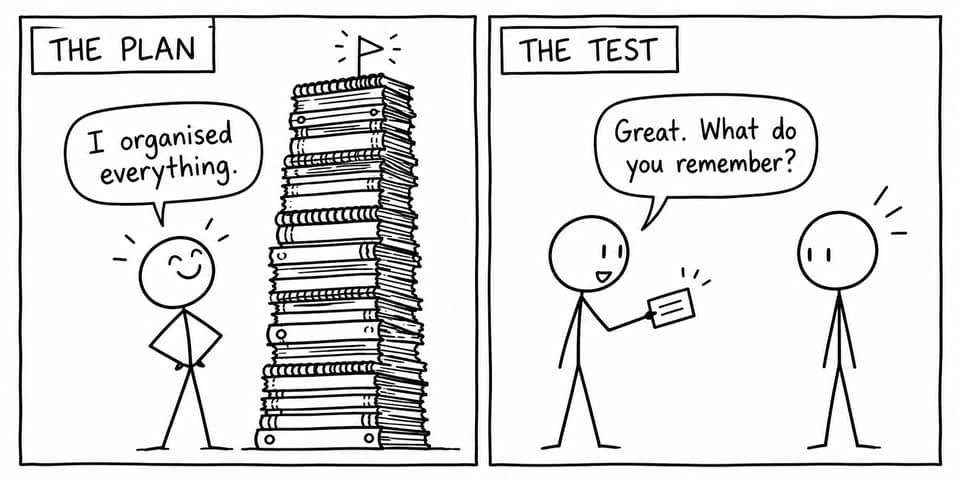
An impressive study system still has to survive the moment when the notes are closed.
Space your review instead of restarting every term
Forgetting is not evidence that you are incapable. It is what memory does when knowledge is not revisited.
Spaced review means returning to material after increasingly wider gaps. There is no universal interval that fits every student and topic, so avoid treating one schedule as a law. A useful starting pattern is:
| Review | Suggested timing | What to do |
|---|---|---|
| First retrieval | Within 24 hours | Recall the lesson and identify gaps |
| Second retrieval | About one week later | Answer short questions without notes |
| Third retrieval | About three weeks later | Mix the topic with related material |
| Later reviews | Every four to eight weeks | Use harder questions or timed tasks |
Adjust the gaps according to performance. If you recall something accurately and apply it well, extend the interval. If you repeatedly miss it, shorten the interval and diagnose whether the problem is knowledge, understanding, or application.
RevisionDojo Flashcards can support quick recall, but Flashcards should not become the whole system. They work well for definitions, formulas, examples, vocabulary, quotations, processes, and other compact knowledge. They are less suited to a complete essay, an unfamiliar data problem, or a multi-stage mathematical argument. A strong approach combines recall with application, as explained in Flashcards versus practice questions for IB revision.
Spacing also reduces an expensive habit: repeatedly beginning from zero. By DP2, your earliest topics should feel older, not abandoned.
Start topic questions earlier than feels necessary
Many students wait until they have “finished learning” before attempting questions. But answering questions is part of learning. It reveals the difference between recognising an explanation and independently producing a defensible answer.
Use topic questions as soon as you understand the basic concept. Begin untimed and with a narrow focus. Then remove support, combine topics, and increase time pressure gradually.
A useful progression is:
- Learn the core idea from class and Study Notes.
- Attempt a small set of straightforward topic questions.
- Check each response against the expected method or criteria.
- Correct the work without copying blindly.
- Attempt a similar question several days later.
- Mix that topic with older material.
- Move to timed sections and Mock Exams once several topics are secure.
For mathematics, do not merely count correct answers. Ask whether you selected the method without a prompt, communicated reasoning clearly, used technology appropriately, and checked whether the result was plausible. The May 2028 IB Math AI study advice explains how weekly question practice and calculator fluency fit the current course.
For Business Management, a memorised tool has limited value until you can select and apply it to an unfamiliar situation. The May 2028 IB Business Management study plan develops that application-first approach.
RevisionDojo’s Questionbank is most useful when treated as a diagnostic instrument, not a scoreboard. A short, carefully reviewed set can teach more than a large set completed quickly and forgotten.
Create a feedback loop, not an error archive
An error log can become another beautiful document that never changes behaviour. The point is not to collect mistakes. The point is to make each mistake less likely to return.
After a test, assignment, Questionbank session, or Grading tool review, classify each important error:
| Error type | What probably happened | Corrective action |
|---|---|---|
| Knowledge gap | A fact, definition, formula, or example was missing | Retrieve it again across several spaced sessions |
| Conceptual gap | The underlying idea was misunderstood | Relearn it, explain it simply, then test it |
| Application gap | Knowledge was available but not transferred | Practise varied questions with less guidance |
| Command-term gap | The response did not perform the requested task | Compare command terms and rewrite the answer |
| Communication gap | Reasoning was incomplete or unclear | Study the expected structure and revise the response |
| Time-management gap | The answer was unfinished or disproportionate | Use short timed sections and decision rules |
| Attention gap | A condition, unit, sign, or instruction was missed | Add a checking routine before moving on |
Then schedule a reattempt. Without the reattempt, feedback remains information. With it, feedback becomes a loop:
Attempt → feedback → diagnosis → correction → delayed reattempt
RevisionDojo’s AI Chat can help clarify why an approach failed, while Grading tools can provide another layer of response-level feedback. Neither should replace the official criteria, teacher judgement, or your own reasoning. Use AI to ask sharper questions, not to avoid thinking.
If feedback exposes a persistent weakness, a Tutor can help diagnose it more directly. This is especially useful when repeated independent study produces the same confusion.
Plan the week before urgency plans it for you
A timetable that assigns every hour usually looks disciplined and behaves badly. One delay can make the entire plan feel broken.
A weekly plan is more resilient. At the same time each weekend, look across all six subjects, the core, coursework, school commitments, and recovery. Decide what matters before the week begins.
Use four categories:
Fixed commitments
Add classes, activities, appointments, sleep, meals, and known deadlines first. These are constraints, not surprises.
High-impact study
Choose the tasks most likely to improve future performance. Examples include revisiting a weak topic, completing a focused question set, rewriting an argument after feedback, or learning content needed for an approaching lesson.
Maintenance review
Keep older material alive through short retrieval sessions. These blocks prevent the syllabus from splitting into “current content” and “everything forgotten.”
Coursework progress
Schedule small, visible outputs. “Work on IA” is too vague. “Revise the method using teacher comments” is actionable.
Limit each week to a few genuine priorities. A plan containing 25 urgent goals is not ambitious. It is undecided.
A sensible weekly rhythm might include three heavier subject sessions, several 20-30 minute retrieval blocks, one coursework milestone, and a short review of errors. The precise pattern depends on your school schedule, health, travel, and subject combination. The aim is not to imitate another student’s calendar. It is to build a calendar you can repeat.
Treat coursework as part of the learning system
Internal assessments and the Extended Essay should not sit outside your study plan as giant separate projects. They require the same habits: clear goals, spaced work, feedback, and revision.
Begin by understanding the current task requirements and school deadlines. Then work backwards through question selection, research or data collection, planning, drafting, feedback, revision, formatting, and final checks. Your school’s internal deadline may arrive well before the external examination session, so use the date your coordinator provides.
The IA advice for May 2028 students explains how to narrow a workable question and use subject criteria throughout the process. For the Extended Essay, follow the revised requirements applicable to your cohort and use the May 2028 Extended Essay guide.
RevisionDojo’s Coursework Library can help you examine how successful academic work is structured. Use examples to notice decisions about focus, evidence, analysis, and organisation. Do not use them as templates to copy. Your work must remain your own and comply with your school’s academic integrity guidance.
A weekly 45-minute coursework block can be more valuable than waiting for a free weekend that never arrives. Small progress protects both quality and attention.
Change the balance from DP1 to May 2028
The five central habits remain stable, but their proportions should change.
Early DP1: build the machinery
Focus on understanding lessons, creating concise retrieval prompts, learning how each subject is assessed, and establishing a weekly review. Begin topic questions early, but do not rush into constant full simulations.
This is also the time to discover what your subjects require. Does a strong response depend mainly on precise knowledge, argument, calculation, evaluation, interpretation, or some combination? Study methods should follow those demands.
Later DP1: connect and diagnose
Mix current topics with older ones. Start using more demanding questions and maintain an error log. Clarify IA directions before time pressure narrows your options. Review your subject choices and workload with teachers if there are genuine concerns.
The DP1 break: consolidate selectively
Do not attempt to restudy every page. Map topics as secure, developing, or weak. Repair the weakest foundations, maintain retrieval for the rest, and complete agreed coursework milestones. Rest should be planned too. Exhaustion is not evidence of seriousness.
Early DP2: integrate knowledge and protect deadlines
Coursework and predicted-grade assessments can compete for attention. Weekly planning becomes essential. Continue spaced review while increasing mixed practice. Use Study Notes for targeted repair rather than repeatedly reading entire units.
Students aiming for a demanding total can use the 40 points for May 2028 two-year plan to think about subject balance, core points, and realistic trade-offs.
Final months: simulate, review, refine
Shift toward timed sections, Mock Exams, and syllabus-matched Predicted Papers. Review each attempt carefully. Full simulations are useful only if they lead to specific changes in knowledge, technique, pacing, or checking.
Do not spend the final weeks proving that you can sit at a desk for a long time. Spend them finding weaknesses while there is still time to repair them.
Subject-specific May 2028 IB tips
General habits need subject-specific expression. Use the available May 2028 guides for the courses you take:
- May 2028 IB History study advice: syllabus-mapped knowledge, source work, argument, and the redesigned assessment model.
- May 2028 IB Business Management study advice: concepts and tools applied to unfamiliar business situations.
- May 2028 IB Psychology study advice: concepts, evidence, contexts, research methods, and structured application.
- May 2028 IB Math AA study advice: conceptual understanding, independent problem solving, and systematic error correction.
- May 2028 IB Math AI study advice: applications, technology, interpretation, and weekly question practice.
The details differ because subjects reward different performances. The underlying loop remains remarkably consistent: retrieve, apply, receive feedback, correct, and return later.
What to avoid during the two-year journey
Some study habits consume time while giving weak evidence of progress.
Avoid rewriting entire notebooks for neatness. Condense only when the act forces you to select, organise, or retrieve knowledge. Avoid highlighting without testing yourself. Avoid watching explanations continuously without attempting the task independently. Avoid collecting resources faster than you use them.
Most importantly, avoid measuring study by hours alone. Two hours of distracted rereading and 35 minutes of focused retrieval are not equivalent. Track outputs such as questions attempted, errors corrected, topics retrieved, essay plans produced, or coursework sections revised.
RevisionDojo is most valuable as an integrated system rather than a pile of features. Study Notes can repair understanding. Flashcards support compact retrieval. The Questionbank develops application. AI Chat helps interrogate confusion. Grading tools strengthen feedback. Predicted Papers and Mock Exams support later simulation. The Coursework Library informs structure, and Tutors provide human guidance when a problem persists.
The order matters. Learn enough to attempt something, attempt it, inspect the result, and decide what comes next.
A calm plan beats a dramatic rescue
The Diploma Programme often feels as if success belongs to students who are always ahead. In reality, being slightly behind for a week matters less than having no reliable way to recover.
Your study system should survive difficult weeks. Keep a minimum version for busy periods: one weekly planning session, short retrieval blocks, one important question set per subject where possible, and a clear next coursework action. When time returns, expand the system rather than rebuilding it.
That is the central lesson for May 2028. You do not need to predict every deadline, test, or difficult topic today. You need habits that convert each new challenge into a manageable next action.
Open RevisionDojo’s Questionbank now, choose one topic taught this week, complete five questions without notes, and schedule every incorrect question for a second attempt seven days from today.