
For IB students sitting exams in May 2028 (started DP1 in August 2026).
The best May 2028 IB chemistry study advice is to learn each concept through retrieval, calculation, and exam-style application rather than repeatedly reading notes. Build concise syllabus-aligned notes now, practise questions every week, and increase mixed timed work gradually through DP2.
Chemistry rewards a particular kind of patience. A weak topic rarely disappears because you highlighted it twice. It becomes manageable when you identify the underlying model, test it with a question, examine the error, and return a few days later.
For this cohort, the safest reference point is the current IB Chemistry course first assessed in 2025. The official IB Chemistry curriculum page and specimen assessments confirm the Structure and Reactivity framework currently in use. However, the IB has not yet published the May 2028 examination schedule, session-specific examination materials, or May 2028 grade boundaries. Your school should communicate any later IB updates that affect your cohort.
Your May 2028 Chemistry checklist
A reliable study system should include:
- Notes organised by the current Structure and Reactivity syllabus
- Weekly calculation practice without copying worked solutions
- Regular retrieval of definitions, trends, conditions, and mechanisms
- Data-based questions involving graphs, uncertainty, conclusions, and evaluation
- An error log that records why each mark was lost
- Mixed-topic practice once several syllabus areas have been taught
- Timed Paper 1 and Paper 2 work during DP2
- Separate attention to additional HL content if you take Higher Level
- Consistent progress on the scientific investigation under teacher guidance
The RevisionDojo IB Chemistry resources bring together Study Notes, Questionbank practice, Flashcards, videos, and topic tools for the current course. That matters because material written for an earlier course may use a different syllabus structure or assessment format.
Confirm what the May 2028 IB Chemistry course includes
Under currently published IB documentation, Chemistry is organised around two broad conceptual themes: Structure and Reactivity. Structure examines what matter is and how its particles are arranged. Reactivity considers why chemical change happens, how far it proceeds, how quickly it occurs, and the mechanisms involved.
The first assessment under this design took place in 2025. Both SL and HL students complete external examinations worth 80% of the subject grade and a scientific investigation worth 20%. Paper 1 contains Paper 1A multiple-choice questions and Paper 1B data-based questions. Paper 2 uses short-answer and extended-response questions.
The current assessment timings are:
- SL Paper 1: 1 hour 30 minutes
- SL Paper 2: 1 hour 30 minutes
- HL Paper 1: 2 hours
- HL Paper 2: 2 hours 30 minutes
The official Chemistry specimen papers show the format introduced for first examinations in 2025. They also show the use of a calculator and a clean Chemistry data booklet, although students should follow their coordinator's current instructions about approved equipment.
Treat these as the current rules, not an irreversible promise about 2028. The IB may publish clarifications before your examinations. As of October 2026, the public IB examination schedule page does not provide a May 2028 timetable.
Make Chemistry notes that produce answers
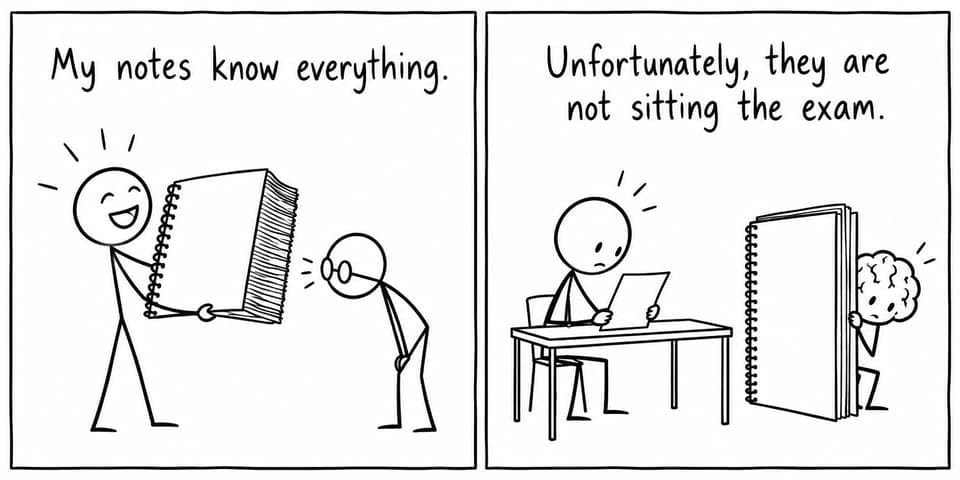
Beautiful notes can create an awkward illusion: because the page looks organised, the knowledge feels organised too. The real test is whether you can reconstruct the idea without looking.
For each syllabus point, keep your notes to four functional layers:
- Core model: Explain the chemical principle in two or three sentences.
- Representations: Include the necessary equation, particle model, mechanism, graph, or Lewis structure.
- Conditions and distinctions: Record catalysts, temperatures, assumptions, state symbols, exceptions, and comparisons.
- Question trigger: Add one prompt that forces you to use the idea.
For equilibrium, for example, do not stop at a definition. Connect the equilibrium constant expression to reaction composition, distinguish a changed position from a changed value of the constant, and practise explaining the effect of temperature using the reaction's energetic direction.
Keep calculations procedural. A useful template is:
- Write the relevant relationship.
- Convert quantities into compatible units.
- Substitute values with visible working.
- Check whether the magnitude is chemically plausible.
- Give units and appropriate significant figures.
Definitions and short factual relationships can become Flashcards. Longer explanations belong in Study Notes and questions. RevisionDojo's IB Chemistry key definitions can help you tighten terminology, while topic pages such as intermolecular forces notes and questions connect explanations directly to practice.
What to practise and how often
During DP1, aim for three deliberate Chemistry sessions each week outside lessons. Two can be 40-45 minute topic sessions, and one can be a 60-minute mixed review. This is a practical recommendation, not an IB requirement, so adapt it around your school's workload.
A productive weekly cycle looks like this:
- Session one: Recall the week's content without notes, then repair gaps.
- Session two: Complete focused calculations and structured questions.
- Session three: Mix the new topic with material studied several weeks earlier.
Revisit difficult material after roughly one day, several days, one week, and then at widening intervals. The intervals do not need to be mechanically perfect. What matters is attempting retrieval before familiarity fades entirely. The RevisionDojo guide to spaced repetition explains how to prioritise examinable facts and recurring misconceptions.
In DP2, move toward four weekly contacts with Chemistry. Include one timed set, one weak-topic repair session, one mixed Questionbank session, and one short recall review. Full Mock Exams should appear later, after you have covered enough of the course for the result to be diagnostic rather than discouraging.
When Predicted Papers become part of your preparation, use them to rehearse format, timing, and topic transfer. They cannot reveal the exact May 2028 questions. Their value lies in requiring you to make decisions under realistic conditions. Use Grading tools to compare your response with expected reasoning, and ask AI Chat to interrogate a misconception rather than merely produce a final answer.
Use materials that match IB Chemistry 2028
A resource matches your course when it uses the current Structure and Reactivity organisation, includes Paper 1A, Paper 1B, and Paper 2 practice, and distinguishes SL content from additional HL content.
Start with the IB guide supplied through your school, the official subject brief, and the official specimen assessments. Then use a current textbook and a syllabus-labelled practice platform. RevisionDojo's guide to Chemistry self-study resources explains how official documents, textbooks, videos, and question banks serve different purposes.
Be cautious with older worksheets. Stoichiometry or bonding questions may remain scientifically useful, but legacy course labels, option topics, or an old paper structure can distort your preparation. If you cannot map a resource to a current syllabus statement, treat it as enrichment rather than core assessment practice.
Within RevisionDojo, you can move from a weak concept to Study Notes, Flashcards, and aligned questions without changing syllabus systems. For example, the covalent model Questionbank provides focused practice tied to that part of the current course.
Common habits that lose Chemistry marks
Most avoidable losses happen at the boundary between knowing Chemistry and communicating it precisely.
Ignoring the command term
A description identifies what happens. An explanation gives chemical reasoning. A comparison needs both sides. Before writing, translate the command term into the task you must perform.
Hiding calculation steps
A correct calculator entry is not a clear chemical argument. Show the relationship, substitution, units, and final value. If an early number is wrong, visible working may still demonstrate a valid method.
Using vague particle language
Statements such as "the molecules move more" are often incomplete. Specify whether collision frequency, collision energy, intermolecular attractions, equilibrium composition, or activation energy is relevant.
Forgetting conditions and conventions
State symbols, charges, electron pairs, equilibrium arrows, axis labels, and reaction conditions are small marks until they accumulate. Build a final checking routine around them.
Treating Paper 1B as ordinary recall
Data-based work asks you to read unfamiliar evidence. Quote relevant values, account for units, distinguish observations from explanations, and avoid claiming more than the data supports. The Paper 1B preparation guide offers a focused routine for trends, calculations, variables, and evaluation.
Keep an error log with four columns: topic, mistake, cause, and corrective action. "Equilibrium wrong" is too broad. "Assumed a catalyst changes the equilibrium constant; review what changes " gives you something repairable.
HL vs SL study advice
SL and HL share the same conceptual architecture, but HL includes additional content, greater depth, and more examination time. The IB recommends 150 teaching hours for SL and 240 for HL across Diploma Programme subjects at those levels.
An SL student should prioritise complete command of SL statements, fluent calculations, and precise application. Do not spend limited time learning additional HL detail unless it genuinely clarifies an SL concept.
An HL student needs the same foundation plus stronger integration. Practise questions that connect energetics, equilibrium, acids and bases, kinetics, redox processes, spectroscopy, bonding, and organic mechanisms. Memorising each chapter independently is not enough when an extended problem crosses several models.
HL students should also schedule longer timed sets earlier in DP2 because stamina becomes part of performance. SL students still need timing practice, but should not mistake shorter papers for easier preparation. Precision matters at both levels.
If feedback remains unclear, RevisionDojo's AI Chat and Grading tools can help identify the gap between an answer and the marking logic. The Coursework Library can clarify how strong scientific investigations are structured, while Tutors can provide human guidance when a misconception survives repeated independent practice. These tools should support your teacher's instructions and academic integrity requirements, not replace them.
Build readiness slowly, then test it honestly
Good IB chemistry study tips are rarely dramatic. They involve returning to a weak calculation, rewriting an imprecise explanation, and attempting a mixed question before confidence arrives. That process can feel slower than rereading, but it produces evidence of what you can actually do.
RevisionDojo works best as the centre of that cycle: learn through Study Notes, retrieve with Flashcards, apply through the Questionbank, diagnose with AI Chat and Grading tools, and later test endurance through Predicted Papers and Mock Exams. The goal is not to use every feature every day. It is to choose the tool that addresses the weakness in front of you.
Your next step: open the RevisionDojo IB Chemistry Questionbank, choose the most recent topic taught in class, and complete ten questions without notes before reviewing every error.