
For IB students sitting exams in May 2028, having started DP1 in August 2026.
The best May 2028 IB Math AA study advice is to learn each concept briefly, practise it repeatedly without prompts, and keep an error log that determines what you study next. Use resources aligned with the current Mathematics: Analysis and Approaches guide, first assessed in 2021, rather than materials made for the revised course first assessed in 2029.
Math AA rewards more than remembering a procedure. You need to recognize structure, choose a method, carry it through accurately, and communicate enough reasoning to earn marks. Those abilities grow through regular contact with unfamiliar questions, not one heroic revision month.
What May 2028 students need to know
As of October 2026, the IB identifies the revised Math AA course as having its first assessment in May 2029. Students sitting in May 2028 should therefore prepare using the existing course guide, whose first assessment was in 2021. The official public IB Mathematics curriculum page distinguishes these versions.
The detailed May 2028 examination timetable, session-specific calculator list, administrative instructions, and grade boundaries have not yet been published. Do not trust a precise date or boundary from an unofficial source. Your school coordinator should confirm session rules when the IB releases them.
For now, use this checklist:
- Study the five current areas: number and algebra, functions, geometry and trigonometry, statistics and probability, and calculus.
- Match every resource to the current guide, not the first-assessment-2029 guide.
- Practise both non-calculator and calculator-enabled mathematics.
- Complete unfamiliar, mixed questions every week.
- Record mathematical errors and presentation errors separately.
- Increase timed practice gradually during DP2.
The RevisionDojo Math AA resource hub is a useful starting point because its Study Notes, questions, videos, and Flashcards are organized around Math AA topics. Always check the displayed course and syllabus labels before beginning a set.
Make notes that lead back to questions
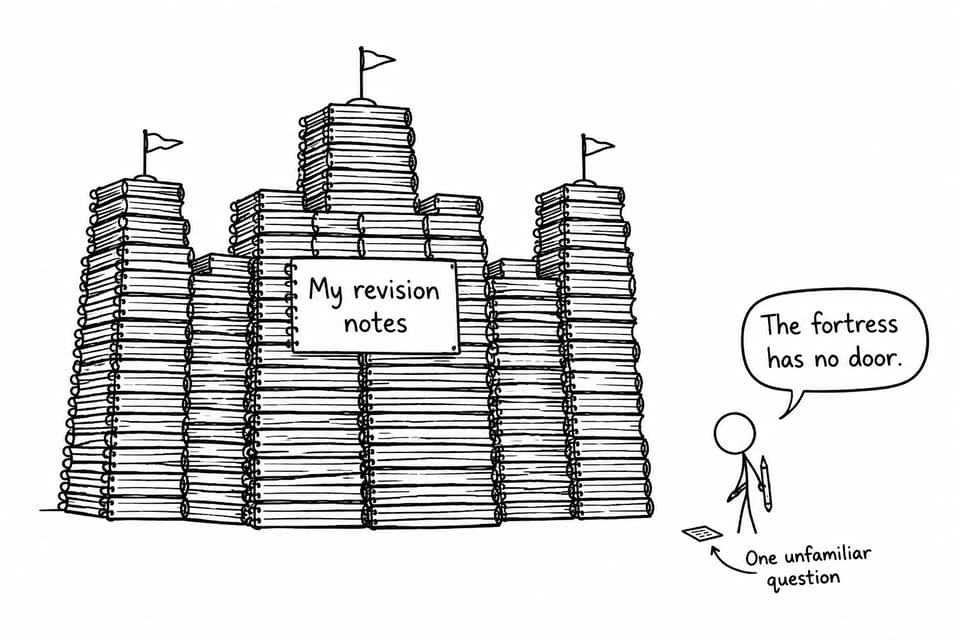
A thick notebook can feel like evidence of progress. Sometimes it is only evidence that a pen moved for several hours.
Useful Math AA notes should help you make a decision. For each method, create a compact entry containing five things:
- Trigger: What clues suggest this method?
- Principle: Why does the method work?
- Process: What are the essential steps?
- Example: Can you complete one representative example cleanly?
- Warning: What mistake are you personally likely to make?
For integration by substitution, do not copy a page of worked solutions. Record how to identify a suitable inner function, how the differential changes, what happens to bounds in a definite integral, and one error such as forgetting to transform those bounds.
Use Math AA Study Notes and self-study resources to repair understanding, then close the explanation and reproduce the method yourself. Flashcards are useful for definitions, conditions, identities, and calculator sequences. They are less useful when they become a substitute for solving complete problems.
Practise often enough to remember, not merely recognize
A sensible DP1 rhythm is three focused Math AA sessions each week outside lessons. Each can last 30-45 minutes: review one concept, solve several questions without notes, and spend the final minutes correcting your work. Consistency matters more than an impressive session followed by ten quiet days.
As DP2 progresses, move toward four sessions each week. In roughly the final 10-12 weeks, many students benefit from five or six short contacts with mathematics per week, including one longer timed session. This is practical guidance, not an IB requirement.
A strong weekly cycle looks like this:
| Session | Main purpose |
|---|---|
| First | Learn or repair one concept |
| Second | Complete targeted questions on that concept |
| Third | Mix it with two older topics |
| Fourth | Attempt timed questions and review every lost mark |
| Optional fifth | Reattempt previous errors without solutions |
Targeted practice builds a method. Mixed practice teaches you when to use it. Timed practice tests whether you can recognize and execute it under pressure. You need all three.
The RevisionDojo Math AA Questionbank supports this progression by letting you work by topic before moving into mixed sets. If your schedule is crowded, adapt the 30-minute IB Math study routine rather than waiting for a free afternoon that may never arrive.
Choose materials that match IB Math AA 2028
Prioritize these sources:
- The current IB formula booklet
- Official specimen materials for the existing course
- Released examination questions from the current syllabus era
- Full Mock Exams and Predicted Papers clearly aligned with the current course
Avoid building your plan around documents labeled first assessment 2029. The revised course may contain familiar mathematics, but its organization and assessment model are not the target for May 2028 students. A question can still be mathematically interesting yet poorly matched to the examination you will sit.
RevisionDojo's Study Notes can establish the idea, while AI Chat can clarify a stuck step without revealing the entire solution immediately. Grading tools can help you inspect working. Later in DP2, Predicted Papers and Mock Exams become more valuable because you have enough syllabus coverage to practise selection, timing, and recovery across a full paper.
Use the IB Math examination study schedule to decide when to shift from topic practice to mixed and timed work. HL students can also follow the more demanding progression in the Math AA HL study plan.
Understand the current assessment structure
Under the current publicly available subject brief, both levels complete externally assessed papers and a mathematical exploration worth 20% of the subject result.
| Level | Current assessment outline |
|---|---|
| SL | Paper 1 without technology, 40%; Paper 2 with technology, 40%; mathematical exploration, 20% |
| HL | Paper 1 without technology, 30%; Paper 2 with technology, 30%; Paper 3 extended problem solving with technology, 20%; mathematical exploration, 20% |
Confirm final durations, permitted calculator models, timetable dates, and examination instructions through your coordinator when session-specific documentation appears.
Your practice should reflect the distinction between papers. Non-calculator sessions should develop algebraic fluency, exact manipulation, sketching, proof, and clear derivations. Calculator-enabled sessions should include efficient graphing, numerical solving, statistical functions, and interpretation. Technology can accelerate a method, but it does not replace the mathematical setup that demonstrates understanding.
Stop giving away avoidable marks
Most avoidable losses are small in isolation. Their power comes from repetition.
Hiding the method
A correct calculator value may not show how you modelled or solved the problem. Write the equation, distribution, derivative, or integral you used before giving the output. Clear working can preserve method marks when arithmetic goes wrong later.
Switching between exact and approximate values
Keep exact values when appropriate, especially in non-calculator work. Store full calculator precision and round only when the question or current instructions require it.
Ignoring restrictions
Check domains, excluded values, intervals, units, and whether an answer makes sense in context. Squaring an equation can introduce an extraneous solution. A logarithm requires a positive argument. A probability must lie between 0 and 1.
Using the wrong angle mode
Degree and radian errors can survive several lines of otherwise competent work. Write the intended mode at the top of relevant calculator practice until checking it becomes automatic.
Reviewing solutions instead of errors
Reading a polished solution produces recognition, which feels close to mastery. Reattempt the question 48-72 hours later without help. If you cannot identify the opening step, the concept is not secure.
An error log should record the topic, precise mistake, corrected principle, and a date for reattempting the question. The goal is not to collect mistakes. It is to retire them.
Adjust the plan for HL and SL
SL and HL share the central Math AA identity, but HL studies greater breadth and depth. Paper 3 also requires sustained work on extended problems.
For SL students
Build reliable command of the SL syllabus before borrowing harder HL questions. SL marks are not improved by practising advanced content while routine algebra, graph transformations, probability notation, or calculus interpretation remains fragile. Use SL-tagged sets and the Math AA SL resource guide to keep your practice relevant.
For HL students
Allocate additional weekly time to unfamiliar multi-step problems, proof, complex numbers, vectors, and deeper calculus. Ask whether you can connect several ideas when the route is not announced.
HL students should begin extended problem-solving practice well before the final revision period. The Math AA HL self-study resources can combine concise learning with demanding Questionbank work. When a persistent conceptual gap remains, RevisionDojo Tutors can provide direct support before one misunderstanding spreads into later topics.
At both levels, use the Coursework Library to study how mathematical explorations are structured and communicated, never to imitate another student's investigation. Your exploration must remain your own work and follow your school's academic integrity guidance.
Build a system that becomes calmer over time
Good preparation rarely feels dramatic. It looks like a student solving a few questions on an ordinary Tuesday, noticing a recurring sign error, and returning two days later to prove that the error has been fixed.
RevisionDojo brings that cycle into one place: Study Notes for understanding, Flashcards for retrieval, AI Chat for focused clarification, the Questionbank for application, grading tools for feedback, and Mock Exams or Predicted Papers for later-stage rehearsal. The value is not having more material. It is choosing the next useful task.
Your next step is to open the RevisionDojo Math AA Questionbank, select one current-syllabus topic taught this week, complete five questions without notes, and record every error to reattempt in 48-72 hours.