
For IB students sitting exams in May 2028, including those who started DP1 in August 2026.
The best IA advice for May 2028 is to choose a narrow, genuinely investigable question, work from the correct subject criteria, and allow time for feedback, revision, and source checks. Several updated IB courses have their first assessment in May 2028, so your current subject guide and school instructions should remain the authority.
An internal assessment rarely becomes difficult because a student has no ideas. More often, the idea is too broad, the method cannot answer the question, or the criteria are considered only after the first draft. A strong IA is usually a controlled investigation: one focused question, an appropriate method, relevant evidence, careful analysis, and an honest evaluation.
A May 2028 IA checklist
Before committing to a topic, check that you can:
- State one focused research question or purpose.
- Identify the correct subject guide, course level, and assessment criteria.
- Complete the investigation with the available time, equipment, data, and sources.
- Explain why your method or evidence answers the question.
- Use feedback without allowing another person or tool to write the work.
- Cite every source, image, dataset, quotation, and adapted idea.
- Reserve time to revise the analysis, evaluation, structure, and presentation.
These principles do not replace a subject-specific rubric. Biology, History, Mathematics, and Language A tasks can reward different forms of evidence and reasoning.
Start with a focused research question
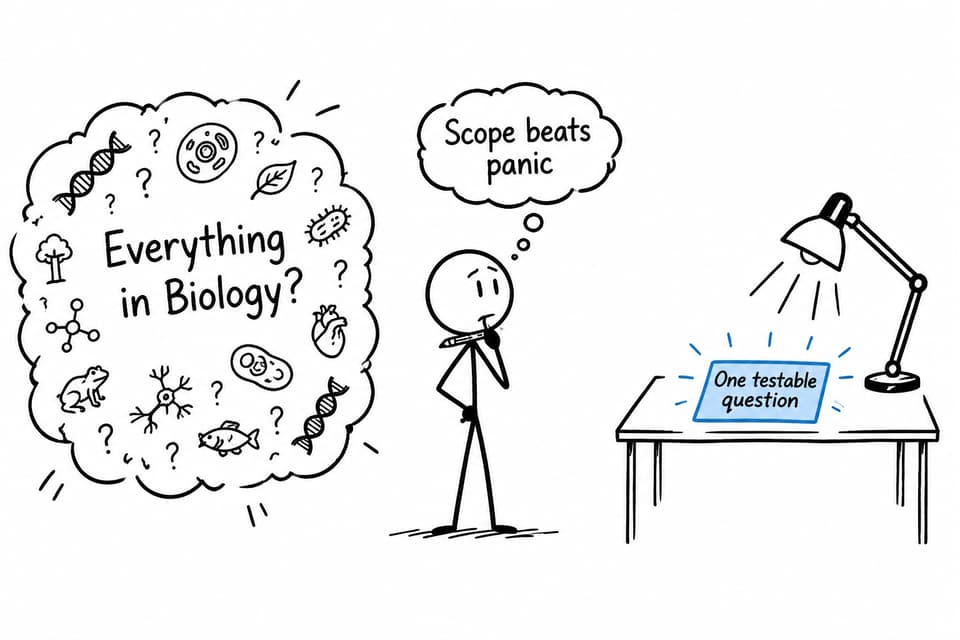
The question determines the shape of the IA. If it is vague, the research, method, and conclusion tend to become vague as well.
A workable question establishes boundaries. Depending on the subject, it may define a variable, relationship, population, text, period, location, or dataset. It should also suggest an appropriate form of analysis. “How does social media affect teenagers?” is a topic, not yet an investigation. A better question would identify a specific feature, group, measurable outcome, and context, provided those choices fit the subject requirements.
Test a proposed question before researching deeply:
- What evidence would count as an answer?
- Can I obtain that evidence ethically and reliably?
- What analysis will I perform?
- What happens if the result is inconclusive?
- Is the scope realistic for the permitted length and available time?
A smaller investigation often creates more room for interpretation and evaluation. A huge topic can produce pages of summary because there is too little space to examine any part properly.
RevisionDojo’s Coursework Library can show how different coursework tasks are structured. Treat examples as evidence of what is possible, not as templates to imitate. Your question should emerge from your interests, accessible evidence, and approved course requirements.
Verify the May 2028 requirements
May 2028 falls within a period of IB curriculum change. The IB’s latest curriculum updates identify subjects with updated assessment schedules, while the Diploma Programme curriculum page provides public subject information. Your school should have access to the complete guide relevant to your course.
Before drafting, confirm:
- The exact subject name and level.
- The guide version and first assessment session.
- The task type and maximum permitted length.
- The criteria and mark allocation.
- Any required reflections, appendices, or presentation conventions.
- Your school’s checkpoints and final submission date.
Do not assume that a rubric from an older cohort remains unchanged. Similar course names can hide important differences in task design or assessment language.
The public IB examination schedule is separate from internal school deadlines. Even if a complete May 2028 timetable is not yet available publicly, your school can still establish IA milestones and upload dates. Record the dates supplied by your teacher or DP coordinator rather than relying on unofficial countdowns.
Plan the investigation backwards
Begin by imagining the conclusion you could responsibly make. Then work backwards to identify the evidence required, the analysis needed to interpret it, and the method needed to collect or select it.
A compact planning document can contain five elements:
- Research question or purpose.
- Required evidence or data.
- Method and justification.
- Planned analysis or interpretation.
- Limitations, risks, and ethical checks.
This exposes weak links while they are still easy to repair. If you cannot explain how the evidence could answer the question, changing the writing style will not solve the underlying problem.
Set separate deadlines for question approval, evidence collection, analysis, and the full draft. Keep a short decision log explaining changes to variables, sources, samples, or procedures. Those notes can later support precise reflection and evaluation without forcing you to reconstruct the process from memory.
Write with the criteria in view
Criteria are not phrases to paste into the introduction. They describe qualities that should influence decisions throughout the investigation.
Translate each criterion into a practical revision question. If it concerns analysis, ask whether important evidence is interpreted rather than displayed. For evaluation, identify how each limitation affected the result and propose a realistic improvement. For communication, check whether definitions, units, citations, calculations, and links between sections are clear.
Presence is not the same as quality. Mentioning a limitation does not evaluate it. Including a graph does not analyse its pattern. Citing a source does not establish its reliability or relevance.
RevisionDojo’s explanation of how IA grading criteria are applied can help turn rubric language into useful revision questions. Use it with the official guide, which takes priority whenever advice appears inconsistent.
Use feedback without outsourcing authorship
Feedback has the greatest value when it arrives early enough to change the investigation. Ask about the question and method before completing the entire draft. Later, seek comments on the relationship between evidence and conclusion, the depth of analysis, or the treatment of limitations.
Specific questions are more useful than asking whether the work is simply good. Ask whether the method can answer the research question, where analysis becomes description, or which claim lacks adequate support.
Your teacher can explain requirements and identify weaknesses, but the intellectual decisions and final language must remain yours. RevisionDojo’s guide to consistent internal assessment review can help you think in criterion-based terms, while your school determines the permitted feedback process.
Use AI tools with the same boundary. A grading tool may identify a weak connection or missing explanation, but it cannot prove that a source is reliable or that data was collected honestly. Keep drafts, raw data, notes, and source records. Follow your school’s rules and the IB’s academic integrity guidance, including any requirement to acknowledge AI assistance.
Protect academic integrity throughout
Academic integrity works best as a process, not a final inspection. Save the original source for each important claim and record page numbers or timestamps during research. Clearly distinguish your calculations, direct quotations, adapted figures, and externally sourced data.
Do not borrow a successful-looking question, structure, dataset, or chain of analysis from an online example. Changing the wording does not necessarily make the underlying intellectual work your own. The path from question to conclusion should remain traceable.
Before submission, complete a source audit. Check every factual claim, citation, reference, graph, table, image, and appendix. If you collect information from people, follow your school’s requirements for consent, privacy, and safeguarding.
Build a RevisionDojo revision loop
RevisionDojo is most useful as part of a repeatable process rather than as a final verdict. RevisionDojo Study Notes, Flashcards, Questionbank practice, AI Chat, and Grading tools can strengthen the subject knowledge supporting your investigation. The Coursework Grader can then help you review whether the visible reasoning matches the selected rubric.
A practical revision loop is:
- Upload a complete or substantial draft using the correct task, subject, and level.
- Identify the two most consequential criterion-level weaknesses.
- Revise the underlying reasoning rather than inserting rubric vocabulary.
- Verify every methodological, factual, and citation-related change.
- Ask your teacher about feedback that conflicts with the official guide.
The AI-powered coursework grading guide explains why automated comments should be treated as revision signals, not guaranteed marks. The AI grader accuracy review also shows why selecting the correct rubric and applying human subject knowledge remain important.
The wider RevisionDojo platform can support the rest of your May 2028 workload. Questionbank practice reveals conceptual gaps, while Flashcards and Study Notes consolidate definitions and methods. Predicted Papers and Mock Exams can help keep exam preparation from overwhelming your IA schedule. Tutors provide human guidance when a research or methodological decision remains uncertain.
Make the argument traceable
A strong IA is not necessarily the one with the most complicated topic. It is the one in which the question, method, evidence, analysis, conclusion, and evaluation belong to the same argument.
For May 2028, ground each decision in the current subject guide, your school’s written instructions, and published academic integrity expectations. Specifications and schedules can change, so verify important details through your teacher or coordinator and retain evidence of how your work developed.
Your next step can be simple: upload your current draft, or an early question-and-method plan, to RevisionDojo’s Coursework Grader. Select the exact subject and level, then turn the first two useful criterion comments into a focused revision checklist.