
For IB students sitting exams in May 2028 (started DP1 in August 2026).
The best EE advice May 2028 students can follow is to use the revised Extended Essay guide for first assessment in 2027, narrow the research question early, and make every research decision serve a sustained argument. Plan your three formal reflection sessions around genuine decision points, follow your school's internal timeline, and remember that the IB has not yet published a universal public submission date specifically for May 2028 students.
The Extended Essay can initially feel like an invitation to investigate everything interesting about a subject. It is not. It is a structured investigation in which the quality of your choices matters more than the apparent size of your topic.
That distinction is reassuring. You do not need to know everything. You need to ask one manageable question, use methods appropriate to the chosen subject or interdisciplinary pathway, and build an evidence-based answer within the required framework.
The May 2028 EE checklist
Before committing to a plan, confirm that you can answer yes to these questions:
- Are you using the Extended Essay guide marked first assessment 2027?
- Does your topic fit an available subject-focused or interdisciplinary pathway?
- Can your research question produce analysis rather than description?
- Do you have access to enough credible and relevant evidence?
- Can you explain why your proposed method suits the question?
- Have you scheduled research, drafting, reflection and revision separately?
- Do you know your school's internal deadlines?
- Have you checked the version of the subject guide applying to your May 2028 examinations?
The first point matters because the redesigned EE assessment model begins with first assessment in May 2027. May 2028 students therefore use that revised model, not the earlier criteria still discussed in some older resources. RevisionDojo's guide to what changed in the 2027 Extended Essay offers a useful comparison.
As of October 2026, the IB has published the revised EE guide and assessment framework. It has not published a separate May 2028 EE guide or a universal public student submission deadline for that cohort. The IB communicates its submission date to schools, while schools normally set earlier internal deadlines. Your coordinator's calendar is therefore the operational deadline you must follow.
Understand the revised EE before choosing a topic
The revised Extended Essay remains an independent research project representing approximately 40 hours of student work. The essay itself has a 4,000-word limit, while reflection is assessed separately through the Reflection and Progress Form.
The revised assessment model is worth understanding before you research because it tells you what the finished work must accomplish.
| Criterion | Maximum marks | Central concern |
|---|---|---|
| A: Framework for the essay | 6 | Whether the question, methods and structure create an effective framework |
| B: Knowledge and understanding | 6 | Whether relevant subject knowledge, concepts and terminology are understood |
| C: Analysis and line of argument | 6 | Whether evidence is analysed and developed into a coherent argument |
| D: Discussion and evaluation | 8 | Whether findings are discussed and the investigation is evaluated |
| E: Reflection | 4 | Whether the learning experience and growth are evaluated |
This 30-mark structure rewards something more demanding than collecting information. Your question, method, evidence, analysis and evaluation must work as one system. For a closer criterion-by-criterion explanation, use RevisionDojo's guide to the revised EE assessment criteria.
Choose a topic that can survive contact with evidence
A promising topic sits where three things overlap: genuine curiosity, appropriate disciplinary methods and accessible evidence. Curiosity alone is insufficient. A fascinating question becomes a weak EE if the necessary data, texts, archives, experiments or scholarly sources are unavailable.
Begin with an area, not a polished title. Write down what you want to understand, what material you can realistically access and which concepts from the relevant subject could help you interpret that material. Then test several narrower possibilities with your supervisor.
For example, “the effects of social media” is an area of interest, not a workable topic. A better direction identifies a defined context, population, platform, period and analytical lens. The exact form must still match the rules and methods of the registered EE subject.
The revised framework permits subject-focused and interdisciplinary approaches. Do not choose an interdisciplinary pathway merely because the topic sounds sophisticated. It is worthwhile only when bringing together two DP subjects creates insight that one disciplinary perspective could not provide adequately.
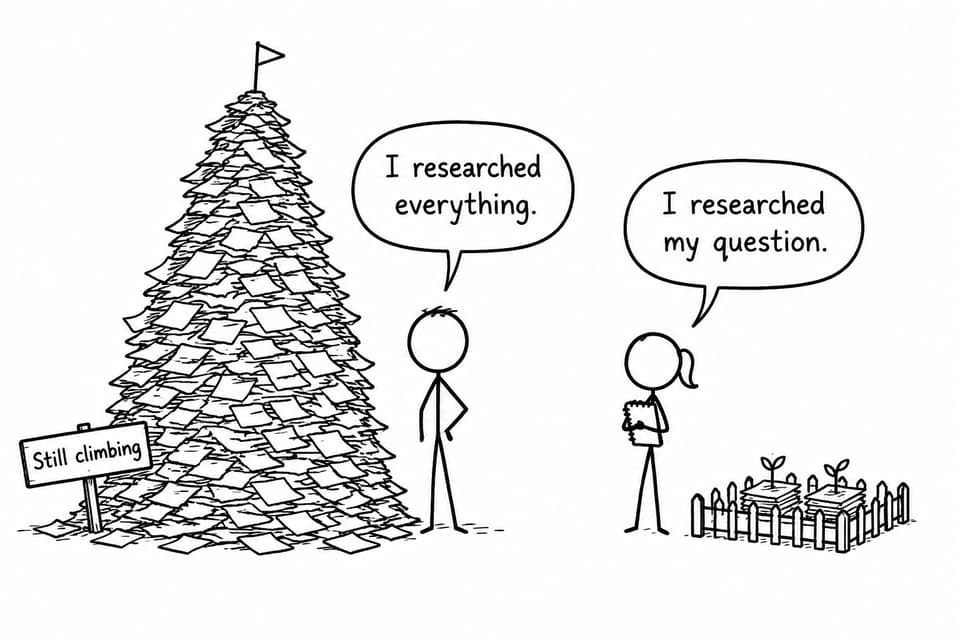
A student discovers that researching a precise question is more useful than researching everything.
Turn the topic into a researchable question
A strong research question is focused enough to answer within 4,000 words but open enough to require an argument. If it can be answered with a definition, a list or a simple yes or no, it probably needs revision.
Test a proposed question in five ways:
- Scope: Can it be answered convincingly within the word limit and available time?
- Evidence: Are suitable primary or secondary sources accessible?
- Method: Is there a defensible way to collect, select or analyse evidence?
- Concepts: Does the question allow meaningful use of subject knowledge?
- Debate: Could reasonable interpretations of the evidence differ?
A question often improves when you define the object of study, context, period and relationship being investigated. Avoid adding restrictions mechanically, however. Each boundary should make the investigation more coherent, not merely make the title longer.
Treat the question as provisionally stable rather than permanently fixed. Early research may expose weak assumptions or missing evidence. A sensible adjustment is not failure. It is evidence that research is shaping your thinking. Keep a decision log recording what changed, why it changed and what effect the change had on your method or argument. That record will later support more specific reflection.
Use supervisor meetings as decision checkpoints
The revised EE still involves three formal reflection sessions with the supervisor: an initial session, an interim session and a concluding viva voce. Your school will determine the precise scheduling and documentation process.
The supervisor guides rather than co-writes. Arriving with “What should I do?” transfers responsibility in the wrong direction. Arriving with a proposed decision, evidence and a focused question creates a productive conversation.
Initial reflection session
Bring two or three possible research questions, an initial source scan and a short explanation of the method each question would require. Ask whether the proposed investigation fits the registered subject and whether its scope is realistic.
Interim reflection session
Bring an updated question, working outline, preliminary findings and one difficulty that requires a decision. This is the moment to identify whether your evidence actually supports analysis or whether you have been accumulating information without building an argument.
Concluding viva voce
Be ready to explain major choices, limitations, discoveries and changes in perspective. This is not simply a celebration after uploading the essay. It helps authenticate the work and provides material for evaluating what the research experience changed in you as a learner.
RevisionDojo's guide to EE reflection sessions can help you prepare useful evidence and questions before each conversation.
Write reflections about decisions, not diary entries
Reflection is not a chronological summary of tasks. “I found sources, wrote an outline and completed my draft” describes activity but reveals little about learning.
Stronger reflection identifies a specific challenge or discovery, explains the decision that followed, evaluates its effect and considers what the experience taught you. The revised criterion explicitly values evaluation, growth and the transfer of learning.
A useful reflective sequence is:
- What assumption, obstacle or evidence changed my thinking?
- What decision did I make because of it?
- How did that decision affect the investigation?
- What did I learn about research or about myself as a learner?
- Where could I apply that learning again?
Keep brief notes throughout the process. Do not manufacture insight shortly before submission. Genuine reflection becomes easier when you have a record of abandoned questions, methodological changes, contradictory evidence and feedback you acted upon.
For additional support, RevisionDojo's EE feedback tool guide explains how to connect revision and reflection to individual criteria.
Build a timeline with room for discovery
A useful timeline separates exploration from drafting. Students often begin writing polished paragraphs too early, then become reluctant to change a weak question because they have already invested time in the prose.
| Stage | Suggested window | Main outcome |
|---|---|---|
| Explore | August-October 2026 | Subject pathway, feasible area and source scan |
| Focus | November 2026-January 2027 | Working research question and proposed method |
| Investigate | February-May 2027 | Organised evidence, research notes and decision log |
| Structure | June-August 2027 | Refined question, argument map and detailed outline |
| Draft | September-November 2027 | Complete working draft with citations |
| Revise | December 2027 onward | Criterion-based revision, proofreading and submission preparation |
This is a planning model, not an IB calendar. School schedules vary, and your school's dates override it. Some schools will require topic approval or a full draft considerably earlier.
Protect revision time. A complete draft is only the point at which you can see whether the argument works across the whole essay. RevisionDojo's guide to improving an EE draft through expert feedback can help you distinguish structural problems from sentence-level polishing.
Use tools without surrendering authorship
RevisionDojo can support the full journey through its Coursework Library, Study Notes, AI Chat and Tutors. Exemplars can reveal how successful investigations are structured, while AI Chat can help you clarify terminology or generate questions to discuss with a supervisor. A tutor can challenge an argument without taking ownership of it.
The boundary matters. Your EE must remain your work, and any use of artificial intelligence must follow your school's academic integrity instructions and the current IB guidance. Never submit generated analysis as your own or use a tool to conceal the origin of ideas.
The most useful technology does not replace judgement. It makes weaknesses easier to notice. The RevisionDojo Extended Essay Grader for first assessment 2027 uses the revised rubric, helping you examine the framework, knowledge, argument, evaluation and reflection separately.
The EE becomes manageable when you stop treating it as one enormous assignment. It is a sequence of smaller decisions, each recorded, tested and improved. Choose one current section of your draft today, upload it to RevisionDojo's Coursework Grader under the first-assessment-2027 EE rubric, and turn the lowest-rated criterion into your next revision task.