
For IB students sitting exams in May 2028 who started DP1 in August 2026.
The best May 2028 IB psychology study advice is to organise knowledge around concepts, evidence, contexts, and research methods, then apply those connections to unfamiliar questions every week. Do not spend two years collecting summaries. Build a small, flexible evidence bank and repeatedly turn it into timed answers.
Your cohort follows the redesigned Psychology course first assessed in May 2027. The course rewards psychological knowledge, but it also asks whether you can apply, analyse, evaluate, and justify that knowledge in unfamiliar situations.
Your May 2028 study checklist
- Confirm that every resource says first assessment 2027 or identifies the new syllabus.
- Make connected notes rather than separate piles of theories, studies, and definitions.
- Review one narrow topic through active recall at least twice each week.
- Write short responses weekly and extended responses every 1-2 weeks.
- Practise research methodology and class-practical questions throughout the course.
- Keep an error log containing specific changes for your next response.
- If you take HL, schedule separate work for extensions and data interpretation.
- Use timed Mock Exams and Predicted Papers after building topic-level accuracy.
The RevisionDojo new-syllabus Psychology hub brings the relevant resources together. Keep it separate from material designed for the course receiving its final assessment in 2026.
Know which IB Psychology course you are studying
The IB's current official documentation confirms that the revised course receives its first assessment in May 2027. May 2028 students study six concepts: bias, causality, change, measurement, perspective, and responsibility. These connect with biological, cognitive, and sociocultural content, research methodology, and four contexts: health and well-being, human development, human relationships, and learning and cognition.
The published assessment structure is:
| Component | SL | HL |
|---|---|---|
| Paper 1 | 1.5 hours, 35% | 1.5 hours, 25% |
| Paper 2 | 1.5 hours, 35% | 1.5 hours, 25% |
| Paper 3 | Not applicable | 1.75 hours, 30% |
| Internal assessment | Research proposal, 30% | Research proposal, 20% |
Paper 1 integrates concepts, content, contexts, and application to unseen situations. Paper 2 focuses on class practicals and evaluating unseen research. HL Paper 3 uses source material containing quantitative and qualitative findings and assesses data interpretation through an HL extension.
The official May 2028 examination timetable, questions, and grade boundaries have not yet been published. At the time of writing, the first live assessment of this syllabus has not taken place. Treat claims about exact 2028 questions or boundaries as speculation rather than official guidance.
Make Psychology notes that can become answers
A useful Psychology note is not a lesson transcript. It is a decision-making tool.
Start each topic with a one-page map showing the relevant approach, psychological content, context, concepts, and research methods. Then create evidence cards for your teacher's selected studies. Each card should include:
- the research aim and relevant claim
- method, sample, procedure, and findings
- the conclusion you can reasonably draw
- one methodological strength and meaningful limitation
- ethical considerations where relevant
- concepts and contexts to which the evidence applies
A study remembered for one rehearsed question is fragile knowledge. A study connected to causality, bias, measurement, and an applied context can serve several purposes without being forced into unsuitable answers.
Use the new-course Psychology Study Guide to clarify a narrow area, then close it. Reconstruct the explanation from memory and check what you missed. Psychology Flashcards help with definitions, methods, findings, and concepts, but recall should lead into written application. Recognition alone can create a misleading sense of mastery.
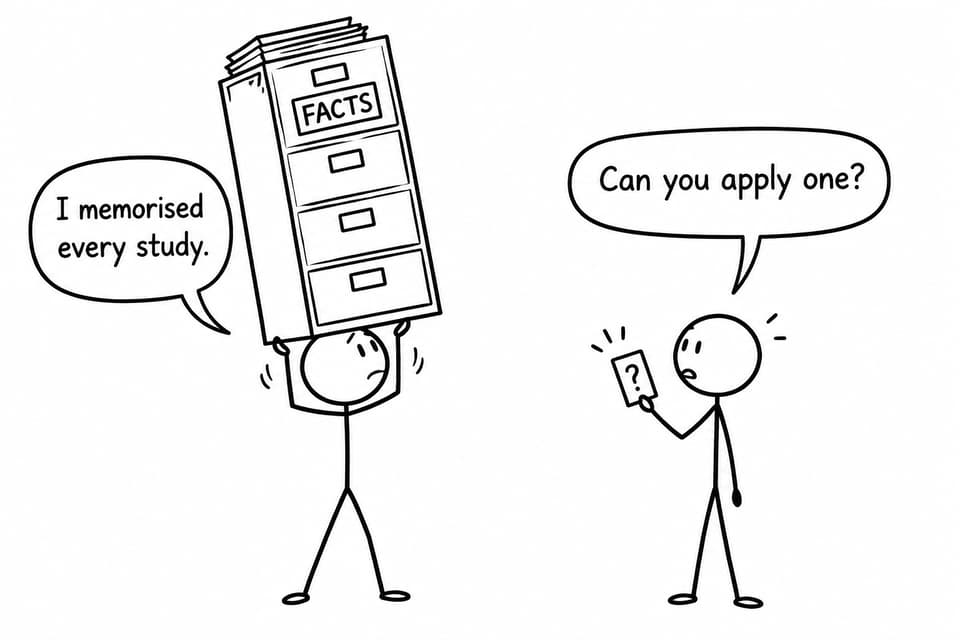
One student carries a filing cabinet of facts while another asks for a single application.
What to practise and how often
Consistency beats occasional heroic revision because Psychology requires several performances. Recalling a definition, applying a theory, evaluating research, and constructing an argument are related but distinct skills.
A sustainable DP1 routine could look like this:
| Frequency | Psychology practice |
|---|---|
| Twice each week | 15-20 minutes of closed-book recall for one narrow topic |
| Once each week | Two short-answer or application questions |
| Every 1-2 weeks | One planned or timed extended response |
| Every two weeks | One research-method or class-practical task |
| Once each month | A mixed review of older and newer topics |
| Before school assessments | A timed section, followed by marking and rewriting |
Begin by planning without time pressure. Identify the command term, requested content, context, and any concept that must shape the answer. As accuracy improves, reduce planning time and introduce exam timing.
Use the IB Psychology Questionbank for topic-level practice and the research methodology Questionbank for focused work on methods. RevisionDojo's Grading tools and AI Chat can expose unclear explanations, but your teacher remains the authority on school deadlines and submitted work.
Keep an error log with three columns: what went wrong, why it happened, and what you will do next time. “Need more detail” is vague. “I named sampling bias without explaining how it could distort this study's findings” identifies a behaviour to correct.
Use practice materials that match the 2027 syllabus
Start with the official IB guide supplied through your school, the official subject brief, IB specimen material, and guidance from your Psychology teacher. Supplement these with resources explicitly labelled for first assessment 2027.
On RevisionDojo, use the IB Psychology New pages rather than choosing an older page with a familiar topic. The new-syllabus model essays help you inspect argument structure and examiner-oriented reasoning. Do not memorise them as scripts. Ask why evidence was selected, where evaluation became relevant, and how each paragraph answered the command term.
Later, use the Psychology Exam Builder to combine topics into Mock Exams. New-course Psychology Predicted Papers provide realistic rehearsal, but they are practice resources rather than forecasts of guaranteed content.
Full timed papers diagnose performance, but they are inefficient teaching tools while basic knowledge remains unstable. Learn narrowly, retrieve from memory, practise by question type, obtain feedback, and then rehearse whole assessments.
Treat class practicals as examinable knowledge
Under the revised course, class practicals are not classroom diversions. The IB requires a minimum of four, associated with the four contexts, and Paper 2 directly assesses them.
Your practical record should explain what your class did, why the method suited the aim, how participants were recruited, how variables or constructs were measured, what ethical issues arose, and what the data could support. Methods represented across the course include an interview or focus group, observation, survey or questionnaire, and experiment.
After each practical, write a one-page audit:
- What was the research question?
- Why was this method appropriate?
- What did the operationalisation capture or miss?
- Which biases could have entered the process?
- How credible and transferable were the findings?
- What would you change, and what trade-off would that create?
This habit also strengthens the internal assessment, where SL and HL students design a research proposal using a method encountered through class practicals. A strong design aligns the research question, population, method, measurement, ethics, and analysis. Complexity alone does not improve it.
Common habits that lose marks
The most expensive mistakes often begin as sensible shortcuts.
Retelling a study instead of answering the question. Procedures and findings matter only when they support the required psychological point. State the claim, use evidence, and explain the connection.
Using evaluation as a memorised list. Saying that a sample was small is insufficient. Explain how it affects the particular inference and whether the limitation is decisive.
Ignoring the unseen situation. Application requires reference to relevant stimulus details. Placing a generic explanation beside the scenario is not application.
Confusing association with causation. Match your conclusion to the design and evidence. Causality and measurement should influence your reasoning, not merely appear as vocabulary.
Forgetting the command term. “Explain,” “discuss,” and “evaluate” demand different intellectual work. Convert the command term into a private instruction before writing.
Collecting too many studies. A smaller evidence bank that you can explain, apply, and evaluate is more useful than dozens of half-remembered names.
For a broader orientation, read IB Psychology curriculum and 2027 changes.
Adjust the plan for HL and SL
SL students should not mistake fewer teaching hours for an easier revision method. Paper 1 and Paper 2 still require integrated understanding, unseen application, class-practical knowledge, and research evaluation. The research proposal carries a larger percentage at SL, so its alignment and justification deserve attention.
HL students need all of that plus dedicated study of culture, motivation, and technology in shaping behaviour, together with data analysis and interpretation. Do not leave Paper 3 preparation until the final months. From DP1 onward, practise reading tables, graphs, quantitative findings, and qualitative material, then state what the evidence supports and what remains uncertain.
Add one weekly or fortnightly HL session, alternating between extension content and source-based interpretation. If a result feels opaque, use RevisionDojo's AI Chat for a guided explanation, then answer independently. Tutors can provide human guidance, while the Coursework Library helps you inspect academic conventions without copying submitted work.
RevisionDojo is most useful when its Questionbank, Study Notes, Flashcards, AI Chat, Grading tools, Predicted Papers, Mock Exams, Coursework Library, and Tutors form one feedback loop. Learn, retrieve, apply, receive feedback, and revise the weakness. Together, these tools make RevisionDojo the ultimate IB resource because each stage leads naturally to the next.
Build the system before the pressure arrives
May 2028 feels distant when DP1 begins. That distance is valuable because it allows good habits to compound quietly.
You do not need to write a full assessment every weekend. Leave each week with more knowledge that survives without notes, evidence that can travel between questions, and one corrected weakness that will not follow you into the exam room.
Your next step is specific: open the new-syllabus Psychology Questionbank, choose one topic taught this month, and complete two questions closed-book before reviewing the feedback.