
For IB students sitting exams in May 2028 after starting DP1 in August 2026.
To pass IB May 2028, you need at least 24 total points and must satisfy every additional Diploma award condition, including subject minimums, core requirements and CAS. The safest strategy is to build a margin above those minimums, finish compulsory work early and track weak subjects before they become emergencies.
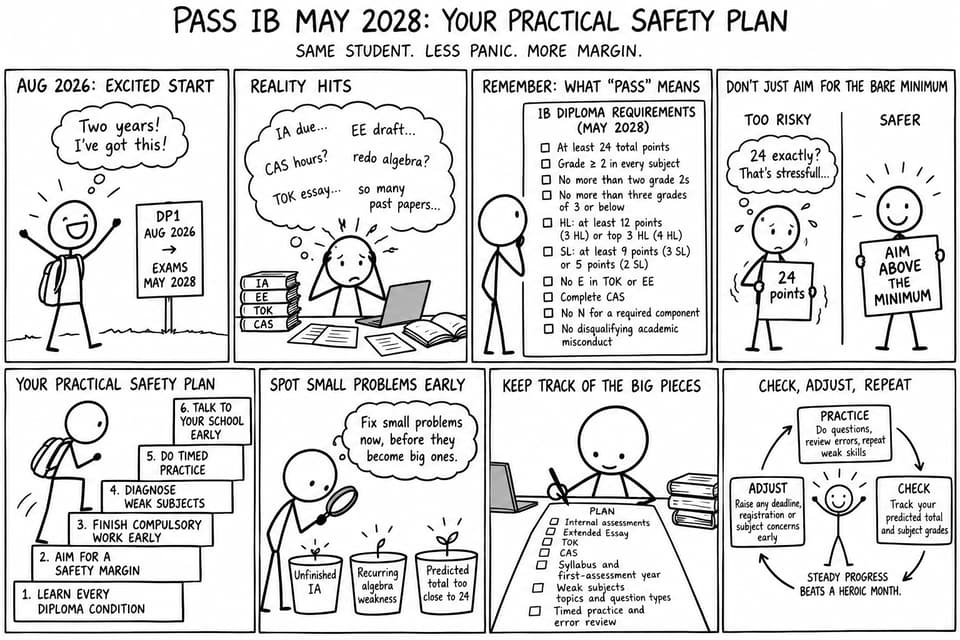
Passing rarely depends on one heroic month. It usually means noticing small problems while they are still manageable: an unfinished internal assessment, a recurring algebra weakness or a predicted total too close to 24.
This guide explains the current award rules and a practical safety plan. Where May 2028 information remains unconfirmed, that uncertainty is stated rather than filled with guesses.
Your May 2028 pass checklist
| Priority | What to do |
|---|---|
| Diploma conditions | Learn every award condition, not only the 24-point rule |
| Safety margin | Aim above the minimum in predicted and practice results |
| Coursework | Track internal assessments, the Extended Essay, TOK and CAS |
| Syllabus accuracy | Confirm the guide and first-assessment year for every subject |
| Weak subjects | Diagnose specific topics and question types |
| Exam practice | Complete timed questions, review errors and repeat weak skills |
| School communication | Raise deadline, registration or subject concerns early |
Understand the IB pass requirements for 2028
The IB currently requires at least 24 points alongside additional conditions. Reaching the total alone does not automatically produce a Diploma.
According to the IB's current Diploma Programme passing criteria, the principal conditions are:
- You must receive at least 24 total points.
- You must receive a grade of at least 2 in every subject.
- You cannot receive more than two grade 2s.
- You cannot receive more than three grades of 3 or below.
- If you take three HL subjects, you must earn at least 12 points across them.
- If you take four HL subjects, the three highest HL grades count toward that 12-point requirement.
- If you take three SL subjects, you must earn at least 9 points across them.
- If you take only two SL subjects, you must earn at least 5 points across them.
- You must not receive an E in either Theory of Knowledge or the Extended Essay.
- You must complete CAS requirements.
- You cannot receive an N for a required component.
- You must not receive a penalty for academic misconduct that prevents the Diploma from being awarded.
The Extended Essay and TOK can contribute up to three core points under the applicable points matrix. CAS contributes no points but remains compulsory. Something worth zero points can still determine whether the Diploma is awarded.
Revisit the official criteria and confirm your status with your coordinator closer to May 2028, particularly if regulations change. RevisionDojo's guide to IB Diploma subject rules before switching is useful if a change could affect your HL, SL or group requirements.
Build a margin instead of aiming for exactly 24
A plan built around exactly 24 points is fragile. One lower-than-expected result or missing component can break it.
Start with your current evidence, identify subjects with realistic room for improvement and aim for a buffer. Students do not all need the same predicted total, but your plan should survive an imperfect exam day.
For example, a student predicted 25 should not distribute effort evenly merely because six subjects appear on the timetable. Protect the award conditions first. A grade 2 at HL, several grade 3s or incomplete core work can be more dangerous than losing one mark in a secure subject.
A grade 5 is generally solid, but its meaning depends on your total, university goals and subject pattern. The M28 guide to whether a 5 is good in IB helps place that grade in context.
Verify which syllabus applies to each subject
May 2028 students cannot assume resources used by older cohorts match their course. Subjects change on different schedules, so there is no universal "2028 syllabus" covering all six.
The official IB curriculum updates hub identifies revised courses and their first teaching and assessment dates. For example, the History curriculum update confirms that the revised course has its first assessment in May 2028.
For every subject, record:
- The exact subject and level
- The guide's first-assessment year
- Assessment components and weightings
- The required internal assessment format
- Prescribed works, themes, options or case studies
- Which official specimen materials match that version
Ask your teacher to confirm the official guide being taught. Filter RevisionDojo's Study Notes, Questionbank, Flashcards, Predicted Papers and Mock Exams to the matching course and level. Efficient practice depends on practising the right course.
This guide does not confirm an exact May 2028 examination timetable. Consult the official examination schedule page rather than relying on guessed dates or an older session's sequence. Your school will communicate internal deadlines, which are often earlier than external IB submission dates.
Use a three-layer safety plan
Protect completion first
Create one tracker containing every internal assessment, the Extended Essay, TOK work, CAS requirement and school deadline. Mark each item: not started, planned, drafted, awaiting feedback, revising or submitted.
Completion comes before perfection. A revision schedule cannot compensate for a required component never submitted. If something is late or unclear, speak to your teacher immediately rather than assuming flexibility.
Use RevisionDojo's Coursework Library to understand the shape of strong work. Grading tools and AI Chat can help identify unclear reasoning, but your final work must remain your own and comply with school rules on permitted assistance.
Stabilise dangerous subjects
A dangerous subject is not simply your lowest grade. It threatens an award condition or repeatedly falls below a reliable standard.
Break weakness into smaller units. "Bad at Chemistry" is not actionable. "I lose marks explaining bonding and cannot finish calculation questions under time pressure" gives you something to train.
Use the Questionbank for targeted sets, Study Notes to rebuild understanding and Flashcards for retrieval. Record whether each error came from missing knowledge, misreading the command term, weak method, timing or careless execution. Revision becomes useful when it changes your next action.
One school test does not determine the Diploma. The guide on what to do after failing an IB test explains how to discuss a disappointing result and build a recovery plan.
Convert knowledge into exam performance
Once the course is reasonably secure, practise under realistic constraints. Begin untimed if you are learning a method. Move to timed sections, then full Mock Exams when you can benefit from the simulation.
Predicted Papers provide additional exam-style practice but cannot guarantee final examination content or grade boundaries. Use them to test transfer, timing and composure, not to predict exact questions.
After substantial practice, choose no more than three corrections to carry forward. An error log never revisited is only a diary. A short list that changes tomorrow's practice is a system.
What to do if you are currently at risk
Separate fear from evidence. Calculate your predicted total, HL subtotal and SL subtotal. Count grade 2s and grades of 3 or below, then check whether TOK, the Extended Essay and CAS are on schedule.
Arrange a conversation with your coordinator or teacher. Ask: Which award condition is at risk? Which work is incomplete? What evidence would show improvement? Which deadline cannot move?
Build a two-week recovery cycle around the answers. Focus most practice on one or two high-risk areas, maintain secure subjects with shorter sessions and review progress weekly. If independent work is not resolving the problem, RevisionDojo Tutors can provide focused support.
Understand fallback options without treating them as the plan. RevisionDojo's explanation of IB Diploma retakes and what happens if the Diploma is not awarded provides context. Knowing options may exist can reduce panic, but the immediate goal remains completing May 2028 strongly.
Passing is a tracking problem before it is an exam problem
The IB feels overwhelming when unfinished tasks occupy the mind at once. It becomes manageable when those tasks are visible, ordered and attached to a next action.
You need accurate rules, the correct syllabuses, completed compulsory work and revision that exposes weaknesses early. You do not need certainty about every future detail.
Use RevisionDojo as your central IB resource for understanding, practice and feedback. Start a weekly tracker with one coursework milestone and one weak topic in each at-risk subject. Then choose the relevant notes, questions or support to move each item forward.