
For IB students sitting exams in May 2028 (started DP1 in August 2026).
The best May 2028 IB business management study advice is to learn each topic as a decision-making tool, then practise applying it to unfamiliar business evidence every week. Build concise notes, retrieve concepts without looking, complete quantitative and extended-response questions regularly, and review every lost mark.
Business Management can initially feel like a subject built around remembering definitions. It is not. Definitions open the door, but application, analysis and evaluation are what carry an answer through it.
That distinction matters for the May 2028 cohort. You have enough time to build skill gradually rather than attempting to transform two years of content into memory during the final months. The calmest preparation is rarely the easiest preparation. It is the preparation that makes difficult thinking familiar.
The short study checklist
Use this as your recurring plan throughout the course:
- Make one compact decision sheet for each syllabus subtopic.
- Complete two short retrieval sessions each week.
- Practise one applied written response and one quantitative set weekly.
- Track mistakes by cause, not merely by topic.
- Use timed paper sections monthly, then increase frequency near exams.
- Learn the differences between describing, explaining, analysing and evaluating.
- Keep SL and HL requirements separate in your revision tracker.
- Treat the internal assessment as assessed business reasoning, not a long company profile.
The RevisionDojo IB Business Management resource hub brings these stages together through Study Notes, Flashcards, the Questionbank and other syllabus-focused tools.
Which syllabus applies to IB Business Management 2028?
As checked in October 2026, the official IB Business Management subject briefs publicly available for SL and HL are labelled first assessment 2024. No replacement Business Management guide specifically identified as first assessment May 2028 was found on the official IB curriculum pages. Students sitting in May 2028 should therefore work from the current 2024 assessment model unless their coordinator receives a later official update.
The current course has five units:
- Introduction to business management
- Human resource management
- Finance and accounts
- Marketing
- Operations management
It is also organized around four key concepts: change, creativity, ethics and sustainability. These concepts are not decorative labels. They give you lenses through which to judge decisions, consequences and stakeholder tensions.
The exact May 2028 Business Management examination dates, session times and examination materials have not yet been published on the IB's public examination schedule. The May 2028 Paper 1 pre-released statement is also not available. Do not build a revision plan around unofficial dates or supposed Paper 1 details.
How to make Business Management notes that remain useful
Long notes often feel productive because they preserve everything. Their weakness is precisely the same: they preserve everything. When every sentence appears important, revision becomes rereading rather than choosing.
Create one decision sheet for each subtopic. A strong sheet should contain:
- A precise definition of the central concept
- The business situations in which it matters
- Relevant stakeholders and possible conflicts
- One suitable business tool or theory
- Necessary formulae and calculation steps
- Advantages, limitations and conditions
- A short real-world example, where helpful
- Two likely command-term questions
For SWOT analysis, for example, do not stop after defining strengths, weaknesses, opportunities and threats. Record when SWOT is useful, why classification can be subjective, how findings might influence strategy, and what additional evidence a manager would need before deciding.
Use the IB Business Management Study Notes to check syllabus coverage, then close them and reproduce the logic from memory. Follow this with Business Management Flashcards for definitions, formulas and distinctions. Flashcards are effective for retrieval, but they cannot replace applied writing.
What to practise and how often
A sustainable weekly routine beats an ambitious plan that survives for nine days. During most of DP1 and early DP2, aim for the following rhythm:
| Practice | Suggested frequency | Main purpose |
|---|---|---|
| Closed-book retrieval | Twice weekly for 20-25 minutes | Secure concepts, formulas and terminology |
| Applied written response | Once weekly for 30-45 minutes | Connect theory to stimulus evidence |
| Quantitative practice | Once weekly for 20-30 minutes | Improve method, accuracy and interpretation |
| Error-log review | Once weekly for 15 minutes | Prevent repeated mark loss |
| Timed paper section | Once monthly | Develop selection and pacing |
In the final 10-12 weeks, move from isolated questions toward complete timed sections and full-format Mock Exams. Maintain targeted topic work alongside them. A complete paper can reveal that timing is weak, but a focused question set is usually better for repairing the underlying weakness.
The IB Business Management Questionbank lets you select questions by topic, which is useful after finishing a unit. Grading tools can then help identify missing application or shallow evaluation, while AI Chat can clarify feedback after you have attempted the answer independently.
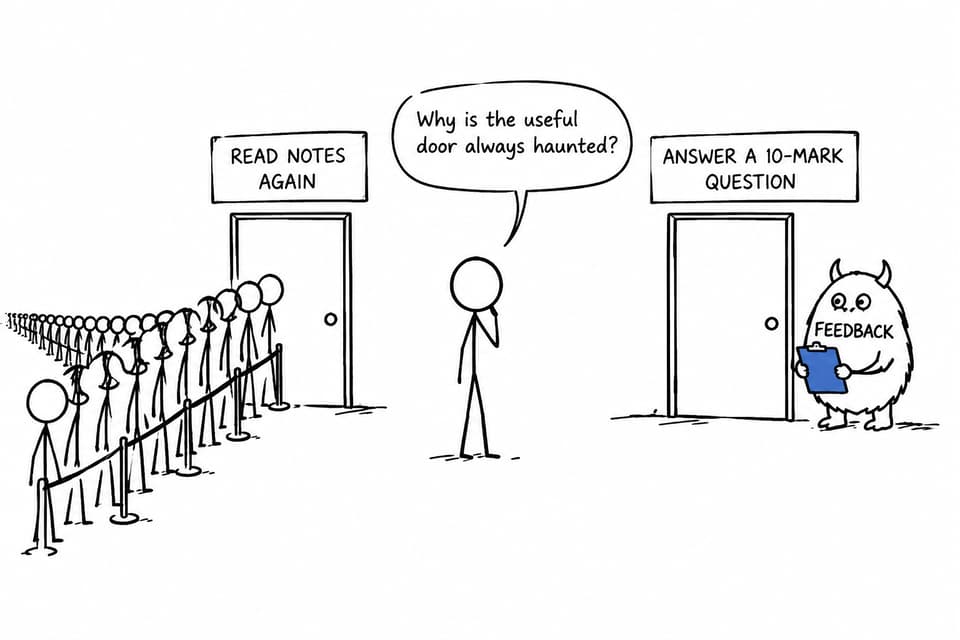
The uncomfortable door is often the useful one. Reading a model answer can create recognition. Writing your own answer under pressure creates evidence of what you can actually do.
Which practice materials match the current syllabus?
Use materials explicitly aligned with the guide first assessed in 2024. Older questions may still contain valuable business concepts, but their structure, terminology or assessment demands may not match the current course. They should be treated as supplementary topic practice, not exact models of May 2028 papers.
Your core material should include:
- Current-guide exam-style questions
- Official specimen materials supplied through your school
- Current markschemes and assessment criteria
- Unfamiliar case studies and stimulus sets
- The approved formula and reference material for the course
- Timed Predicted Papers and Mock Exams aligned with the current format
Use the Business Management data booklet guide while practising calculations. Having formulas available does not remove the need to recognize which formula fits, substitute values accurately, show working and interpret the result in context.
For broader examination planning, the guide to earning a 7 in IB Business Management explains command terms, paper strategy and an eight-week revision structure. RevisionDojo Predicted Papers can later help simulate unfamiliar material, but no predicted resource can guarantee the content of an actual examination.
The current SL and HL assessment differences
SL and HL share the course foundation, four concepts and five units. HL adds extension material, greater quantitative depth and Paper 3.
| Component | SL | HL |
|---|---|---|
| Paper 1 | 1 hour 30 minutes, 35% | 1 hour 30 minutes, 25% |
| Paper 2 | 1 hour 30 minutes, 35% | 1 hour 45 minutes, 30% |
| Paper 3 | Not taken | 1 hour 15 minutes, 25% |
| Internal assessment | 30% | 20% |
Under the current guide, Paper 1 uses a pre-released statement that provides context for an unseen case study. Paper 2 uses unseen stimulus material and has a quantitative focus. HL Paper 3 concerns a social enterprise and asks students to work with supplied resources, identify needs and challenges, and develop a reasoned recommendation.
HL students should therefore add a weekly HL-extension block. Rotate between advanced finance, operations, analytical tools and social-enterprise decisions. Practise integrating several resources into one argument rather than discussing each source separately.
SL students should not mistake fewer papers for lower analytical expectations. Evaluation, contextual application and accurate quantitative work still matter. Because the internal assessment carries 30% at SL, steady coursework progress is particularly important.
The current internal assessment requirements are the same at SL and HL: an individual business research project about a real issue or problem facing a particular organization, using a conceptual lens. The maximum is 1,800 words. The Business Management IA criteria guide and Business Management Coursework Library can help you understand structure and criterion expectations. Examples should guide your judgment, never replace your own research or writing.
Common habits that lose marks
Most lost marks are not caused by knowing nothing. They come from knowing something but failing to shape it around the question.
Writing generic answers
A response about a named business should repeatedly use the stimulus. Refer to its product, scale, finances, workforce, objectives and constraints. Simply inserting the company name into a memorized paragraph is not application.
Ignoring the command term
A definition cannot satisfy an evaluation. Before writing, translate the command term into an action. For evaluate, weigh strengths and limitations, consider context, and reach a supported judgment.
Naming a tool without using it
Writing “the business could use a SWOT analysis” adds little by itself. Apply relevant elements, explain what they reveal and connect that insight to a decision.
Producing one-sided evaluation
Business decisions involve trade-offs. Consider time, cost, risk, stakeholder effects and short-term versus long-term consequences. Then state which factor matters most under the circumstances given.
Hiding calculation work
Show the formula, substitution and answer with suitable units. Follow the number with interpretation. A ratio is not a conclusion until you explain what it suggests about the business.
Overpreparing Paper 1 predictions
Research the themes in the pre-released statement when it becomes officially available, but do not write an imagined case in advance. The assessed case study is unseen. Prepare adaptable knowledge rather than a script.
Reviewing only the score
After each task, label errors as knowledge, application, analysis, evaluation, calculation, command term or timing problems. RevisionDojo's grading tools, Study Notes and Tutors can help diagnose the gap, but the important step is rewriting the weak paragraph yourself.
Build a system before you need a rescue plan
Good Business Management revision moves through a loop: learn, retrieve, apply, receive feedback and retry. RevisionDojo supports the whole loop through Study Notes, Flashcards, Questionbank practice, AI Chat, Grading tools, Predicted Papers, Mock Exams, the Coursework Library and Tutors. The value lies not in opening every feature at once, but in choosing the right tool for the weakness in front of you.
Your specific next step is to open the IB Business Management Questionbank, select the most recently completed topic, answer one applied question without notes, and record exactly why each lost mark was lost.