
For IB students sitting exams in May 2028, most of whom started DP1 in August or September 2026, earning 40 points IB May 2028 requires a strong subject average, deliberate attention to the DP core, and two years of feedback-led practice. A realistic target is usually six subject grades adding up to 37-39 points, plus 1-3 points from Theory of Knowledge and the Extended Essay.
The number 40 can feel like a finish line. In practice, it is more useful as a planning equation. It shows that every subject matters, but not every subject must be a 7. It also reminds you that the Extended Essay and TOK are part of the total, not decorative extras to finish at the last minute.
The 40-point checklist
Before building a timetable, make sure your plan includes:
- A target profile for all six subjects, separated into HL and SL goals.
- A current syllabus or subject brief for every May 2028 course.
- Weekly practice that produces evidence, not merely completed hours.
- An early plan for the Extended Essay, TOK, and CAS requirements.
- An error log organised by topic, command term, and assessment skill.
- Regular teacher feedback and timed exam-style work.
- Protection for sleep, coursework deadlines, and recovery.
The Diploma Programme includes six subject groups and the DP core. Students take at least three and no more than four subjects at higher level. HL courses normally represent 240 teaching hours and SL courses 150. The official DP curriculum overview is the right starting point for confirming your programme structure.
What a 40-point profile usually looks like
There is no single grade combination that produces 40. Six subject grades can contribute up to 42 points, while TOK and the Extended Essay can contribute up to three additional points. CAS is compulsory but does not add points.
| Subject profile | Subject points | Core points | Total |
|---|---|---|---|
| 7, 7, 7, 6, 6, 6 | 39 | 2 | 41 |
| 7, 7, 6, 6, 6, 6 | 38 | 2 | 40 |
| 7, 6, 6, 6, 6, 6 | 37 | 3 | 40 |
These are planning examples, not predictions. The IB explanation of DP assessment confirms that TOK and the Extended Essay are combined for a maximum of three core points.
The important idea is distribution. You do not need to chase perfection in every class. You do need to identify where a 7 is realistic, where a secure 6 is sensible, and which weaker subject could quietly reduce the total.
Early diagnosis therefore matters. A 5 in an HL subject may demand conceptual rebuilding and sustained practice. A 6 in an SL subject might require narrower improvements in command-term accuracy, evaluation, or time management. The numbers may look close, but the appropriate interventions can be very different.
Check the May 2028 rules carefully
May 2028 students are among the first cohorts assessed under several updated courses. The IB's curriculum updates page identifies August or September 2026 as the first teaching period and May 2028 as the first assessment period for relevant updates.
Resources created for an older assessment model may therefore be incomplete. Check the exact subject brief, assessment components, internal assessment requirements, and command terms applying to your course.
History has its first assessment under an updated course in May 2028. Psychology and the Extended Essay have first assessment in May 2027, so May 2028 students should already use the revised guidance. Mathematics needs particular care. The current IB mathematics information says the existing Mathematics: Analysis and Approaches and Mathematics: Applications and Interpretation courses have final assessment in November 2028. A new curriculum begins teaching in 2027 with first assessment in 2029. May 2028 students should confirm the applicable course guide with their school.
The official May 2028 timetable and some detailed session information may not yet be available. Do not copy dates from an unofficial calendar or assume an earlier schedule will be repeated. Check the official IB examination schedule when your coordinator confirms that the relevant timetable has been published.
RevisionDojo's IB syllabus changes tracker can help you monitor developments, but current IB documentation and your coordinator remain the final references for registration, assessment, and coursework rules.
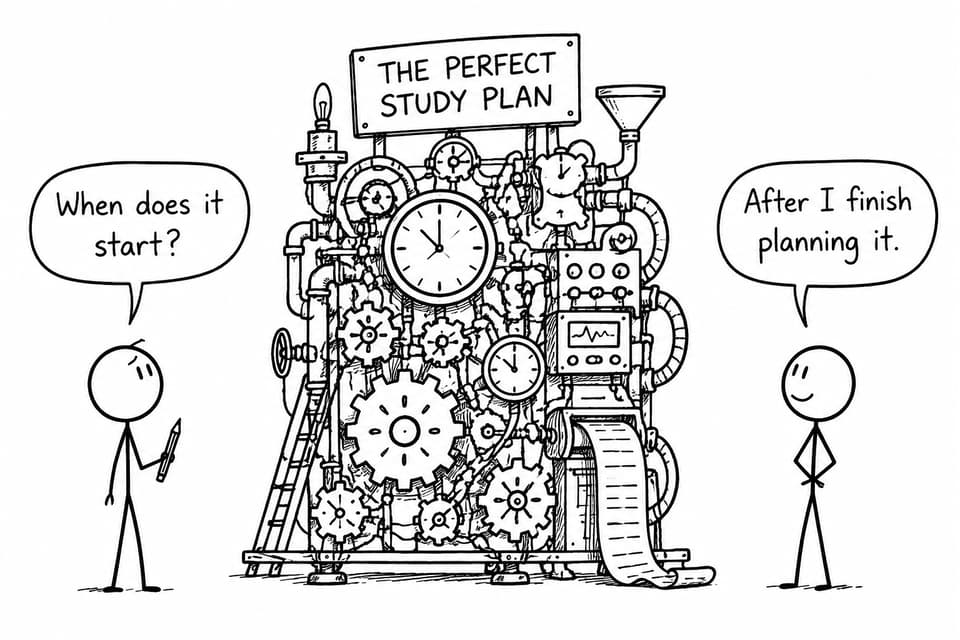
Sometimes the plan becomes so detailed that studying never begins. A two-year strategy works only when it produces the next useful action.
Year one: build the base
The first year is not a waiting room before real revision. It decides whether DP2 will be spent learning forgotten content or refining performance.
Establish a baseline
During the first term, record your current level in every subject using teacher assessments, class tests, short timed responses, and targeted questions. Do not treat one difficult test as your permanent grade. Look for patterns across several pieces of evidence.
For each subject, identify:
- Topics you cannot explain without notes.
- Knowledge you cannot apply under time pressure.
- Assessment formats that repeatedly cost marks.
- Coursework requirements that remain unclear.
- Transferable weaknesses, such as data analysis or essay structure.
This turns “I need to revise Biology” into “I can recall the process, but I lose marks when interpreting unfamiliar data.” Only the second statement tells you what to practise.
RevisionDojo's IB subject resources help connect diagnosis with action. Study Notes and Flashcards support learning and retrieval, while the Questionbank tests whether that knowledge survives exam-style application. The useful sequence is simple: learn, retrieve, apply, review.
Protect the core early
Choose an Extended Essay question narrow enough to answer and interesting enough to sustain. Broad topics often produce shallow analysis and an unmanageable research process. Meet your supervisor, record important decisions, and use each draft to test whether the argument remains coherent.
For TOK, practise explaining claims, counterclaims, assumptions, and implications instead of collecting impressive quotations. The official Extended Essay update confirms that the revised component was first assessed in May 2027, so use the applicable updated guide.
CAS does not add points, but postponing its evidence and reflections can create avoidable pressure. Keep records current while each experience is still fresh.
Build a sustainable weekly rhythm
A reliable week might include content retrieval, targeted questions, one longer response, and an error review. It does not need to consume every evening. Consistency is more valuable than an ambitious schedule that collapses after two weeks.
Use active-recall Flashcards for definitions, processes, vocabulary, and formulas. Use AI Chat to investigate a mistake, then verify the explanation against teacher materials and the subject guide. The purpose is not to outsource thinking. It is to turn vague confusion into a precise question.
Year two: convert knowledge into marks
At the start of DP2, your plan should become more diagnostic. Stop asking only what you have covered. Ask what prevents an answer from receiving the next mark.
Move from topic practice to mixed practice
Continue targeted work on weak areas, then introduce mixed sets that make you choose the method, evidence, model, or structure without being told the topic. That decision-making is closer to examination conditions.
| What happened | Why it happened | Correction | Next check |
|---|---|---|---|
| Missed a command term | Described instead of evaluated | Add judgement and consequence | Complete one timed evaluation |
| Chose the wrong formula | Variables were not identified | Write known values first | Repeat a mixed calculation set |
| Used vague evidence | Example was not linked to the claim | Explain the mechanism | Rewrite one paragraph |
Review the log weekly. Repeating a question achieves little if you repeat the same mistake with greater confidence.
The RevisionDojo Questionbank guide recommends filtering by topic, using timed sets, reviewing markschemes, and tracking errors. Practice should not merely confirm what you know. It should reveal what to do next.
Treat coursework as part of the score
Internal assessments, oral work, the Extended Essay, and TOK compete with revision for attention. Set personal deadlines before the school's final deadlines so that feedback can still change the work.
Use the Coursework Library to examine structure and interpretation of criteria, never to imitate language or ideas. RevisionDojo's coursework grading tools can help you interrogate a draft, but automated feedback is not a final mark. Check every suggestion against the criteria and teacher guidance.
By the middle of DP2, aim to settle major coursework decisions. A late change of question or method can consume the same weeks needed for subject revision.
Practise under realistic constraints
Once most content is secure, use timed tests and full mock exams. Their purpose is to expose pacing problems, weak transitions, missing units, careless calculations, and topics you tend to avoid.
RevisionDojo's test builder and Mock Exam tools can create short diagnostic tests before longer sessions. Predicted Papers provide current-syllabus practice, but they cannot guarantee what will appear in the final examination.
After each mock, analyse the script carefully. Categorise lost marks as knowledge, application, communication, timing, or carelessness, then schedule a correction. A completed mock without analysis is largely a measurement. Analysis turns it into training.
How to get 40 in IB without burning out
A 40-point target is demanding, but it should not depend on maximum effort every day. Protect sleep, use focused sessions, and preserve a lighter period each week. Fatigue weakens recall and judgement, especially in extended writing and multi-step reasoning.
Ask for help when the same error survives several attempts. A teacher, RevisionDojo Tutor, or focused AI explanation can help determine whether the problem is conceptual, strategic, or caused by insufficient practice. Identifying the category early prevents you from repeatedly applying the wrong remedy.
High scorers are not always the students who study longest. They are often the students who understand what their work is telling them. A mark is not only a result. It is evidence for the next decision.
Closing: make the next decision measurable
For May 2028 students, the useful question is not whether 40 points is possible in the abstract. It is which subject points, core points, and assessment skills your current evidence supports, and what could move each one forward.
Check the official syllabus version for every course, keep the core moving alongside your subjects, and turn errors into specific tasks. RevisionDojo brings that process together through Study Notes, Flashcards, Questionbank practice, AI Chat, Grading tools, Mock Exams, Predicted Papers, Coursework Library resources, and Tutors.
Start with one measurable action. Choose a weak topic, complete a short untimed diagnostic set in the RevisionDojo Questionbank, and record each missed question with the reason it was missed. Two years of small, accurate decisions can build a far stronger result than one perfect timetable.