
For IB students sitting exams in May 2028 (started DP1 in August 2026).
The best May 2028 IB biology study advice is to learn each syllabus statement through active recall, then practise applying it to unfamiliar data and exam-style questions every week. Build concise notes from the current guide, use the new Biology data booklet from the beginning, and keep an error log that determines what you revise next.
Why the May 2028 cohort needs a precise plan
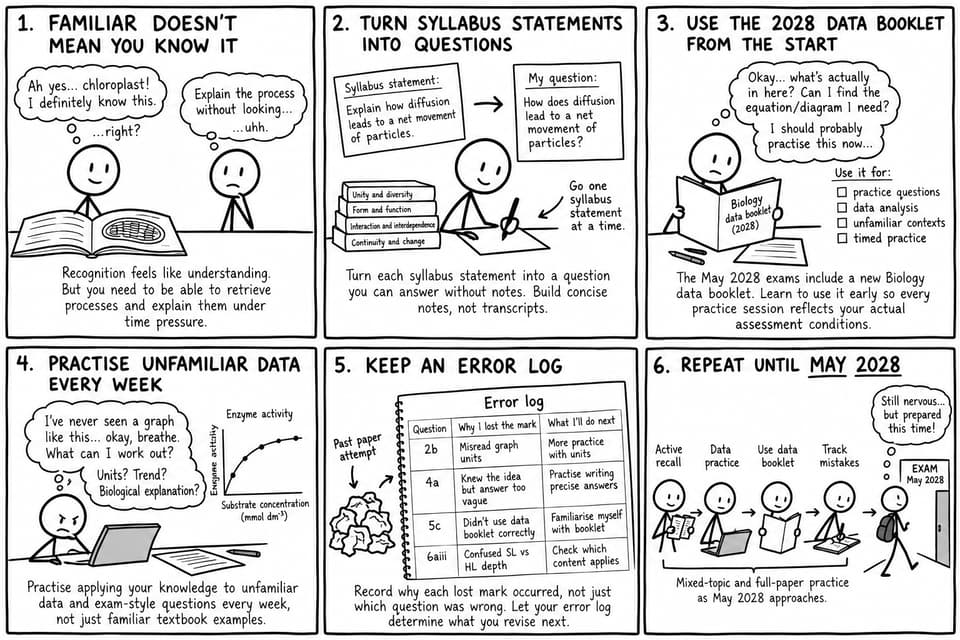
Biology can create a dangerous feeling of familiarity. A diagram looks recognisable. An explanation sounds sensible. Yet recognition is not the same as being able to retrieve a process, interpret evidence, or construct a precise answer under time pressure.
The May 2028 cohort also needs to distinguish between two related developments. The current DP Biology course was first assessed in 2025 and is organised through four broad themes: unity and diversity, form and function, interaction and interdependence, and continuity and change. For students first assessed in 2028, the IB has introduced a new Biology data booklet containing selected biological information, diagrams, equations, and reference material.
That booklet changes what will be available in the examination room. It does not remove the need to understand the biology behind the material. Use the RevisionDojo guide to the 2028 Biology data booklet alongside the booklet provided by your school so that every practice session reflects your actual assessment conditions.
At the time of writing, the May 2028 examination timetable, session-specific examination materials, and May 2028 grade boundaries have not yet been published. Do not plan around unofficial boundary predictions or assume that earlier session boundaries will be repeated.
Your IB Biology 2028 checklist
- Match every resource to the Biology guide applicable to first assessment in 2028.
- Turn each syllabus statement into a question you can answer without notes.
- Practise data analysis and unfamiliar contexts every week.
- Learn to use the new data booklet before timed examinations begin.
- Separate SL content from additional HL depth.
- Record why each lost mark occurred, not merely which question was wrong.
- Complete mixed-topic and full-paper practice as May 2028 approaches.
- Confirm current assessment instructions with your IB Biology teacher and official school documents.
The RevisionDojo IB Biology resource hub provides a practical starting point, bringing together syllabus-aligned Study Notes, Flashcards, Questionbank practice, AI feedback, and exam-building tools.
How to make Biology notes that remain useful
Good Biology notes are not transcripts. They are compressed models of understanding.
Start with one syllabus statement rather than an entire chapter. Write the statement as a question at the top of the page. Beneath it, create a short answer using only the essential terminology, sequence, relationships, and examples required to explain it. Add a labelled diagram only when the spatial relationship matters.
A useful note page should contain four elements:
| Element | What to include |
|---|---|
| Core idea | A 2-4 sentence explanation in your own words |
| Required language | Terms that must be used precisely |
| Visual model | A small labelled diagram, pathway, or comparison |
| Retrieval prompts | 3-5 questions answerable without viewing the page |
After making the page, close it. Explain the idea aloud or reconstruct it on blank paper. If you cannot reproduce it, revising the design of the notes will not solve the problem. Retrieval will.
For processes such as DNA replication, distinguish what happens, where it happens, why each stage matters, and how evidence could be presented in a question. The DNA replication Study Notes show how a syllabus topic can be divided into manageable ideas.
Flashcards are strongest for definitions, structures, sequences, comparisons, and cause-effect relationships. They are weaker for long explanations unless those explanations are divided into smaller prompts. RevisionDojo’s Flashcards can support spaced retrieval, while AI Chat can clarify a concept after you have made a genuine attempt to explain it yourself.
What to practise and how often
Biology preparation works better as a rhythm than as an emergency. During DP1, your priority is to connect each taught topic with retrieval and short question sets. During DP2, mixed practice becomes increasingly important because examinations do not arrive in chapter order.
A sustainable weekly pattern looks like this:
| Frequency | Practice task |
|---|---|
| After each lesson | Spend 10-15 minutes retrieving the main ideas and correcting notes |
| Twice each week | Complete 10-20 focused questions from recently taught topics |
| Once each week | Revisit an older topic using flashcards and blank-page recall |
| Every 2-3 weeks | Complete a mixed set combining knowledge, data, and explanation |
| During the final months | Add timed papers and full Mock Exams under realistic conditions |
The important step is correction. For every lost mark, label the cause: missing knowledge, misunderstood command term, imprecise terminology, weak data interpretation, incomplete working, or poor timing. Then assign a response. A knowledge gap returns to Study Notes and Flashcards. An application gap needs more questions. A communication gap needs rewritten answers and comparison with the expected marking points.
Use the IB Biology Questionbank to select work by topic and difficulty. RevisionDojo’s grading tools can provide rapid feedback, but your teacher remains the best person to resolve uncertainty about official expectations or a nuanced extended response.
Practise using the new Biology data booklet
The new booklet should become familiar enough that locating information feels routine. Waiting until 2028 to open it would turn a helpful resource into another source of cognitive load.
Begin by scanning its structure and making a simple index of what it contains. When studying a diagram, equation, or biological relationship that appears in the booklet, practise finding it rather than reproducing the page from memory. Then explain what the information means and how it might support an answer.
Use three kinds of booklet practice:
- Navigation: locate a specified item quickly.
- Interpretation: explain the meaning of a diagram, constant, or relationship.
- Application: combine booklet information with biological knowledge to solve an unfamiliar problem.
The booklet is a reference, not an answer bank. It cannot decide which information matters, interpret a trend, justify a conclusion, or replace terminology that the question requires.
Choose materials that match the 2028 syllabus
Resource age matters less than syllabus alignment. A beautiful textbook can still waste time if its structure, examples, or assessment format belongs to an older course.
Prioritise the official guide and data booklet supplied through your school, current-syllabus textbooks, official specimen material, and question sets explicitly labelled for the 2025-onward course or first assessment 2028. The complete guide to IB Biology explains the current course structure, while the guide to the 2025-onward syllabus provides further context on the assessment model.
RevisionDojo’s Study Notes and Questionbank are organised around the current course. Predicted Papers and Mock Exams become more valuable after substantial syllabus coverage, when you can practise selection, timing, and endurance rather than isolated recall. The Coursework Library can help you inspect how scientific investigations are structured, while Tutors can offer targeted support when repeated independent practice is not resolving a weakness.
Before committing to any resource, ask:
- Does it identify the correct Biology guide?
- Does it separate SL and HL material clearly?
- Does it reflect the current paper structure?
- Does it incorporate the booklet used for first assessment in 2028?
- Does it provide answers or feedback detailed enough to diagnose mistakes?
The broader May 2028 IB resources guide can help you apply the same checks across your other subjects.
Common habits that lose Biology marks
The first common problem is answering the topic rather than the question. A student sees “membrane transport” and writes everything remembered about membranes, even when the command term asks for a comparison. Read the command term, identify the subject, and note any limit such as a named organism, condition, or number of differences.
The second is vague biological language. Words such as “thing,” “amount,” “it goes,” and “helps” often conceal missing understanding. Replace them with the molecule, structure, direction, process, or consequence you mean. Reviewing membranes and membrane transport, for example, should include practising the distinction between concentration, concentration gradient, diffusion, facilitated diffusion, and active transport.
Other frequent weaknesses include:
- describing a graph without quoting relevant values or trends;
- claiming that correlation proves causation;
- giving a conclusion without connecting it to the data;
- drawing an unlabelled diagram when labels carry the explanation;
- ignoring units, uncertainty, or anomalous results;
- memorising model answers without understanding how the context could change;
- leaving extended responses unstructured;
- practising untimed work exclusively.
A useful correction habit is to rewrite only the weakest answer after reviewing feedback. This is small enough to do consistently and specific enough to teach precision.
HL vs SL study priorities
SL and HL students share the conceptual architecture of the course, but HL includes additional content and expects greater depth. HL students therefore need more time for multi-step explanations, connections across organisational levels, and unfamiliar applications. Topics explicitly marked HL should be tracked separately so they cannot disappear inside a general revision list.
SL students should not mistake a smaller syllabus for an easier standard of accuracy. Strong performance still requires confident data analysis, precise terminology, and the ability to apply familiar biology in an unfamiliar setting.
| SL priority | HL priority |
|---|---|
| Secure every shared syllabus statement | Secure shared content plus all HL-only statements |
| Build concise explanations and data skills | Build deeper, connected, multi-step explanations |
| Use mixed practice once topics are secure | Introduce mixed and synoptic practice earlier |
| Protect accuracy under time pressure | Protect accuracy and depth under greater content load |
Under the current assessment model, external examinations contribute 80% and the scientific investigation contributes 20% at both levels. Paper 1 contains multiple-choice and data-based work, while Paper 2 includes data-based, short-answer, and extended-response work. HL papers are longer and assess the additional HL material. Always follow the latest official documents provided by your school if the IB publishes further amendments before May 2028.
Build a system that becomes calmer over time
The purpose of a revision system is not to make every evening feel productive. It is to make your weaknesses visible while there is still time to address them.
RevisionDojo works as the central system rather than another folder of disconnected resources. Study Notes and Flashcards establish knowledge. AI Chat helps unpack difficult relationships. The Questionbank and grading tools turn understanding into measurable practice. Predicted Papers and Mock Exams then test whether that understanding survives mixed topics, timing, and pressure. When coursework or conceptual gaps need human judgement, the Coursework Library and Tutors provide another layer of support.
Your next step: Open the RevisionDojo IB Biology Questionbank today, choose one topic already taught, complete 15 questions under timed conditions, and turn every error into one flashcard.