
For IB students sitting exams in May 2028 (started DP1 in August 2026).
The best May 2028 IB math AI study advice is to follow the current syllabus, practise small sets of questions every week, and treat calculator fluency, written working, and interpretation as connected skills. Do not use materials designed for first assessment in 2029, because your cohort completes the version of Mathematics: Applications and Interpretation first assessed in 2021.
Math AI rewards something more subtle than memorizing procedures. You need to recognize a mathematical model inside an unfamiliar context, choose an appropriate method, use technology accurately, and explain what the result means. Revision therefore works best when learning and application happen close together.
Your May 2028 study checklist
- Follow the current Math AI guide, not the redesigned 2029 course.
- Build short, usable notes around decisions and methods.
- Practise mathematics at least three times each week.
- Learn calculator workflows before attempting fully timed work.
- Record why marks were lost, not merely which answers were wrong.
- Match every resource to your level, syllabus topic, and assessment format.
- Begin mixed and timed practice gradually during DP2.
- Treat the mathematical exploration as part of the course, not an interruption to it.
The RevisionDojo IB Math AI resource hub brings together syllabus-organized Study Notes, Questionbank practice, videos, and Flashcards for both SL and HL.
Which syllabus applies to IB Math AI 2028?
This distinction matters because two versions of Math AI will soon exist side by side.
The IB states that the current Mathematics: Applications and Interpretation course has its final assessment in November 2028. The redesigned course begins teaching in August or September 2027 and has its first assessment in May 2029. A student who began DP1 in August 2026 and sits examinations in May 2028 should therefore study the current guide, whose first assessments were held in 2021.
Under that current guide, both SL and HL cover five broad areas:
- number and algebra
- functions
- geometry and trigonometry
- statistics and probability
- calculus
The course emphasizes mathematics in context, modelling, statistics, technology, communication, and interpretation. Those priorities should shape your revision. A resource is not suitable merely because it says “Math AI” on the cover. Check that it is labeled for the current course and that its topic breakdown matches what your teacher is teaching.
The exact May 2028 examination timetable has not yet been published by the IB at the time of writing. Session-specific grade boundaries, the final questions, and the approved calculator policy applying in 2028 are also not yet available. Use the current rules for preparation, but ask your coordinator to confirm the timetable, authorized calculator models, required calculator settings, and any updated examination instructions once the IB releases them.
How to make Math AI notes that remain useful
Long notes can feel productive because they leave visible evidence of work. Mathematics is less impressed by evidence of effort than by evidence of retrieval.
For each subtopic, create a compact page with five elements:
- Recognition cue: What wording or data suggests this method?
- Core idea: What relationship are you using?
- Calculator route: Which menus, commands, or graph settings are required?
- Worked example: Show substitutions, intermediate values, and interpretation.
- Common trap: Record the mistake you are personally likely to repeat.
For a regression model, for example, your notes should not stop at entering data and obtaining an equation. Include how to identify explanatory and response variables, interpret parameters in context, assess whether interpolation is reasonable, and retain sufficient calculator precision before rounding the final answer.
Keep a separate one-page calculator index. It might list workflows for solving equations, graph intersections, regression, numerical integration, distributions, matrices, or other syllabus-relevant operations. Exact menus vary between approved models, so write the sequence for the calculator you actually use.
Use Math AI Study Notes and topic resources to clarify concepts, then close the explanation and reconstruct the method yourself. Flashcards are valuable for notation, conditions, vocabulary, and recognition cues. They cannot replace solving complete problems.
What to practise and how often
Consistency matters because mathematical forgetting is quiet. A method can look familiar on Monday and disappear when hidden inside a new context on Friday.
During DP1, aim for three focused sessions each week:
| Session | Suggested work | Purpose |
|---|---|---|
| Session 1 | 25-35 minutes of one current topic | Build procedural accuracy |
| Session 2 | 25-35 minutes of mixed questions | Practise method selection |
| Session 3 | 20-30 minutes of error correction and calculator rehearsal | Prevent repeated losses |
After each major unit, complete a longer mixed set. In DP2, gradually add timed sections and then full Mock Exams. Do not begin by timing everything. Speed built on uncertain methods usually produces faster mistakes.
A useful question cycle is:
- attempt without viewing help
- mark using the supplied reasoning
- classify the error
- rewrite the missing step
- retry a similar question several days later
This is where a filtered Questionbank becomes more useful than a random pile of exercises. RevisionDojo’s guide to targeted Math AI Questionbank revision explains how to isolate a weakness, practise it, review the error, and retest it. Students studying independently can also compare Math AI SL self-study resources or Math AI HL self-study resources.
Choose practice materials that match the assessment
For May 2028, prioritize resources aligned with the current 2021 course. Good practice should cover all five syllabus areas, separate SL from HL content, require appropriate technology, and include both short-response and extended-response work.
Under the current assessment model, SL students complete two technology-enabled written papers, each worth 40% of the final grade. HL students complete Papers 1 and 2, each worth 30%, plus Paper 3, worth 20%. The mathematical exploration contributes 20% at both levels. The current subject brief gives SL three hours of external assessment and HL five hours.
Paper 1 focuses on compulsory short-response questions, while Paper 2 uses compulsory extended-response questions. HL Paper 3 contains two compulsory extended-response problem-solving questions. Because technology is used throughout Math AI assessment, practise with the calculator that you expect to use, subject to the IB’s final approved-model policy.
RevisionDojo provides current SL and HL Math AI coverage, alongside Predicted Papers and Mock Exams for realistic sequencing and stamina. Predicted Papers are practice tools, not forecasts of exact May 2028 questions. Official specimen materials, your school textbook, teacher assignments, and current-guide question sets should remain part of a balanced resource mix.
Common habits that lose marks
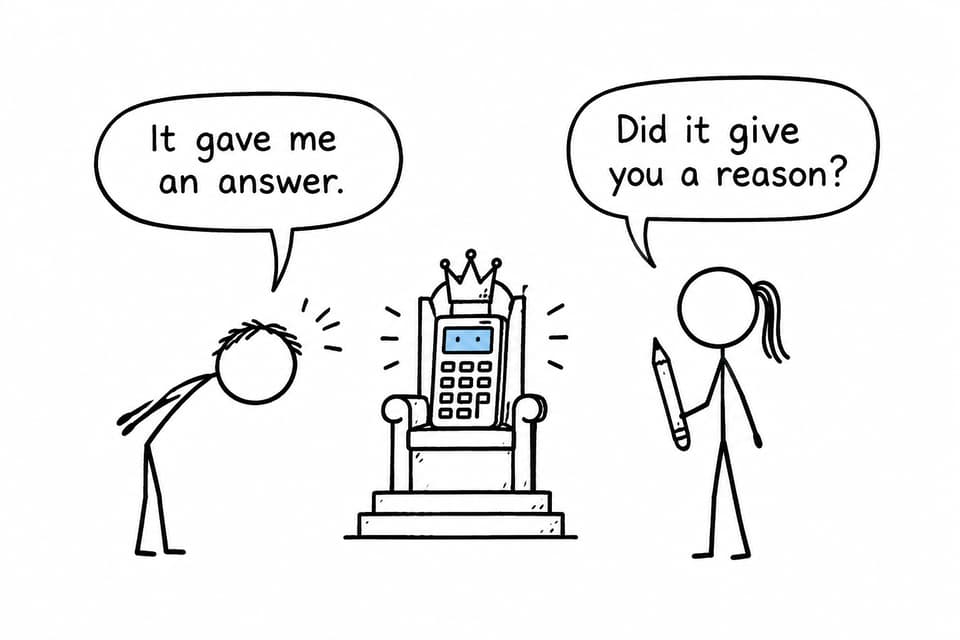
The calculator may produce an answer, but the examiner still needs to see mathematical communication. The most common avoidable losses usually come from habits rather than impossibly difficult concepts.
Giving an unexplained calculator result
Record the equation, model, distribution, matrix, or other mathematical object being used. Include meaningful intermediate work. A correct decimal without a visible method may not demonstrate enough reasoning for every available mark.
Rounding too early
Keep full calculator precision in intermediate steps and round at the end. Current official specimen instructions commonly request exact answers or answers correct to three significant figures unless another accuracy is stated. Always follow the directions printed on the actual paper.
Ignoring the context
If a question asks for interpretation, answer in the language of the situation. State what a parameter, probability, derivative, or solution means, including relevant units. Reject mathematically valid values when they are impossible in context.
Trusting the calculator without checking
A graphing window, degree-radian setting, mistyped list, or unsuitable model can create a polished but meaningless answer. Estimate the expected scale first and ask whether the result is reasonable afterward.
Reviewing answers instead of errors
Label each loss as conceptual, procedural, technological, interpretive, notation-related, or caused by time. RevisionDojo’s AI Chat can explain an unfamiliar step, while AI Grading tools can help you inspect working. Compare all feedback with teacher guidance and official expectations rather than accepting any automated response uncritically.
HL vs SL study advice
SL students need breadth, reliable calculator operation, and clear interpretation across the common course. Their best use of time is usually repeated practice on syllabus-sized questions, followed by mixed extended problems that connect topics.
HL demands greater depth and additional content, with the IB recommending 240 teaching hours compared with 150 at SL. HL students also face Paper 3, where unfamiliar extended problems test sustained reasoning. A calculator shortcut alone is rarely enough. You must decide how to begin, connect multiple ideas, test an approach, and communicate a coherent solution.
An HL routine should therefore include one unfamiliar investigation-style problem each week once sufficient content has been learned. Spend time planning before calculating. Afterward, write down which observation unlocked the problem and where an alternative approach failed.
Students can explore Math AI HL resources for independent study, while those adjusting to the course may benefit from guidance on common first-term Math AI struggles. If a weakness remains resistant after several careful attempts, Tutors can provide focused diagnosis rather than another generic explanation.
Build a system that can survive DP2
The point of a study system is not to create perfect weeks. It is to make restarting easy after coursework deadlines, illness, or an overloaded timetable.
Use RevisionDojo as a connected workspace: Study Notes for clarification, Flashcards for retrieval, Questionbank sets for application, AI Chat for targeted explanations, Grading tools for feedback, and Predicted Papers or Mock Exams for timed preparation. The Coursework Library can help you understand the form of mathematical exploration, but your own exploration must remain original and follow your school’s academic-integrity guidance.
Your preparation for IB Math AI 2028 should become steadily more realistic, not suddenly more intense. Learn the idea. Apply it. Inspect the error. Return later. That quiet cycle is what turns a calculator command into mathematical judgment.
Your next step: open the RevisionDojo Math AI Questionbank, choose one current-syllabus topic taught this week, and complete five questions without notes before classifying every lost mark.