
For IB students sitting exams in May 2028 (started DP1 in August 2026).
Use examination papers written for the syllabus version and assessment model that applies in May 2028, not simply the newest files you can find. For most subjects, recent papers remain useful, but History students should use the first-assessment-2028 specimen papers for complete, format-accurate practice because no real examination under the new course will exist before their session.
That distinction matters. An exam paper can look familiar while testing different content, command terms or paper structures. Practice is only useful when you know what it is practising.
The short answer
Before attempting any paper, check four things:
- First assessment year: Find this on the official IB subject brief or syllabus guide used by your school.
- Paper structure: Confirm the number of sections, questions, marks and permitted choices.
- Content overlap: Remove questions based on topics that are not in your course.
- Assessment relevance: Treat older questions as skill drills unless they precisely match the May 2028 model.
The safest approach is to organise resources into three folders: exact match, adaptable questions and not relevant. RevisionDojo's guide to the best IB resources for May 2028 students applies the same principle to notes, videos, textbooks and digital study tools.
Which syllabus applies to May 2028?
May 2028 students began the Diploma Programme in August or September 2026. The important date, however, is not when the cohort started. It is the first assessment date printed on each subject guide.
A course first assessed in May 2028 applies to this cohort immediately. A replacement course first assessed in May 2029 does not. This is particularly important for Mathematics: Analysis and Approaches, Mathematics: Applications and Interpretation, and Language B. The IB has announced revised versions for first assessment in May 2029, so May 2028 candidates remain on the preceding versions.
The following table gives a practical subject-family map based on official IB curriculum information available in October 2026. Schools should still confirm the exact guide for each subject and language.
| Subject or subject family | Version relevant to May 2028 | Best examination practice |
|---|---|---|
| History SL and HL | New course, first assessment May 2028 | Use official 2028 specimen papers for complete simulations; adapt older source and essay questions only for isolated skills |
| Computer Science SL and HL | Updated course taught from August 2026 for the May 2028 cohort | Prioritise the new guide and specimen material; use earlier questions only after mapping their content and format |
| Psychology SL and HL | New course, first assessment 2027 | Use specimens initially; use 2027 papers when legitimately available through your school and confirmed against the guide |
| Visual Arts SL and HL | New course, first assessment 2027 | Follow the new assessment requirements; older assessed work may illustrate artistic thinking but not every current requirement |
| Biology, Chemistry and Physics | Courses first assessed in 2025 | Use 2025 and later papers as exact-version practice; extract overlapping questions from earlier years cautiously |
| Environmental Systems and Societies | Updated course, first assessment 2026 | Use 2026 and later papers when available, alongside the relevant specimens |
| Sports, Exercise and Health Science | Updated course, first assessment 2026 | Prioritise 2026 and later material, then use mapped questions from the preceding course |
| Global Politics | Updated assessment model, first assessment 2026 | Use 2026 and later papers, especially for the revised paper structure and HL components |
| Business Management | Current course first assessed in 2024 | Use 2024 and later papers for the closest match |
| Digital Society | Current course first assessed in 2024 | Use 2024 and later papers, plus official specimens where more practice is needed |
| Economics | Current course first assessed in 2022 | Prioritise 2022 and later papers |
| Mathematics AA and AI | Existing courses first assessed in 2021; announced revisions begin in 2029 | Use papers for the existing AA or AI course, not material created for the 2029 revision |
| Language A subjects | Use the guide and paper structure confirmed by your school | Select papers carrying the same course name, level and assessment model |
This is a selection rule, not a claim that every listed paper is publicly available. Access to official examination materials is controlled, and students should use resources supplied legitimately by their school or authorised platforms.
Why History is the special case
History is the clearest exception for May 2028. The IB launched the updated course in February 2026 for first teaching in August 2026 and first assessment in May 2028. Therefore, the cohort taking that first assessment cannot practise with a completed examination from the same syllabus.
The change is more than a renamed topic list. Paper 1 remains source-based, but it is organised around a framing inquiry question and asks students to identify information, analyse source context and examine perspectives. Paper 2 now includes conceptual, short-response and essay work. At HL, Paper 3 requires two essays selected from different regional in-depth topics rather than the three essays required under the preceding model.
That is why official specimen papers are the only reliable option for a complete History simulation in the correct 2028 format. Older questions can still teach source reading, evidence selection and argument construction, but an entire old paper should not be timed as though it reproduces the new assessment.
RevisionDojo's guide to the new IB History course explains the wider change. Students can then develop the four ideas behind the course with IB History concepts for 2028 and practise the new demands through the dedicated IB History resources.
How to adapt old exam papers for 2028
Old exam papers are not automatically useless. Their value simply becomes narrower.
Build a syllabus map first
Place the current subject guide beside the paper. Label every question:
- Green: Content and format both match.
- Amber: Content overlaps, but the mark allocation or response style differs.
- Red: Topic, option or assessment demand is no longer part of your course.
Answer green questions under current timing. Rewrite amber questions into the current format or use them without assigning a predicted mark. Ignore red questions.
For science, this might mean retaining a calculation while rejecting an obsolete option topic. For economics, it may mean using a diagram question as a short drill rather than treating an older paper as a precise rehearsal. For Mathematics, always separate AA from AI and SL from HL before considering the year.
Convert papers into question sets
A complete paper creates the feeling of an exam. A targeted set fixes a weakness. During DP1, the second purpose is often more valuable because much of the syllabus has not been taught.
RevisionDojo's guide to using an IB Questionbank effectively recommends filtering by topic, creating timed sets and reviewing errors rather than collecting marks without diagnosis. Its combination of Questionbank practice, Study Notes, Flashcards, AI Chat and grading tools lets students move from a missed question to the underlying concept without changing study systems.
Later, Predicted Papers and Mock Exams can provide full-session practice aligned to the current course. The Coursework Library and Tutors support the assessed work that a written paper cannot cover.
Preserve current timing and command terms
If a usable old question was worth 10 marks but the closest current task is worth 6, do not keep the old time allowance and call the result predictive. Use the question to practise reasoning, then assess the response against the current expectations provided by your teacher or official materials.
The same applies to command terms. A strong answer to an obsolete question may demonstrate knowledge without reproducing what the current paper rewards. The question is a training tool, not a forecast.
What has not been published yet
As of October 2026, several things do not yet exist:
- Real May 2028 examination papers
- May 2028 grade boundaries
- A final May 2028 examination timetable available through the current official schedule page
- Real 2027 papers, because the 2027 examination sessions have not yet occurred
- A completed first-assessment-2028 History examination
No website can legitimately provide genuine May 2028 questions in advance. A predicted paper is an independently created practice resource, not an official paper or a promise about what the IB will ask.
Availability can also change during a two-year course. Check the official subject brief at the start of DP1, again before your first mocks and again when beginning final revision. Your coordinator and subject teacher should be the final authority on the guide your school is delivering.
Choose relevance over volume
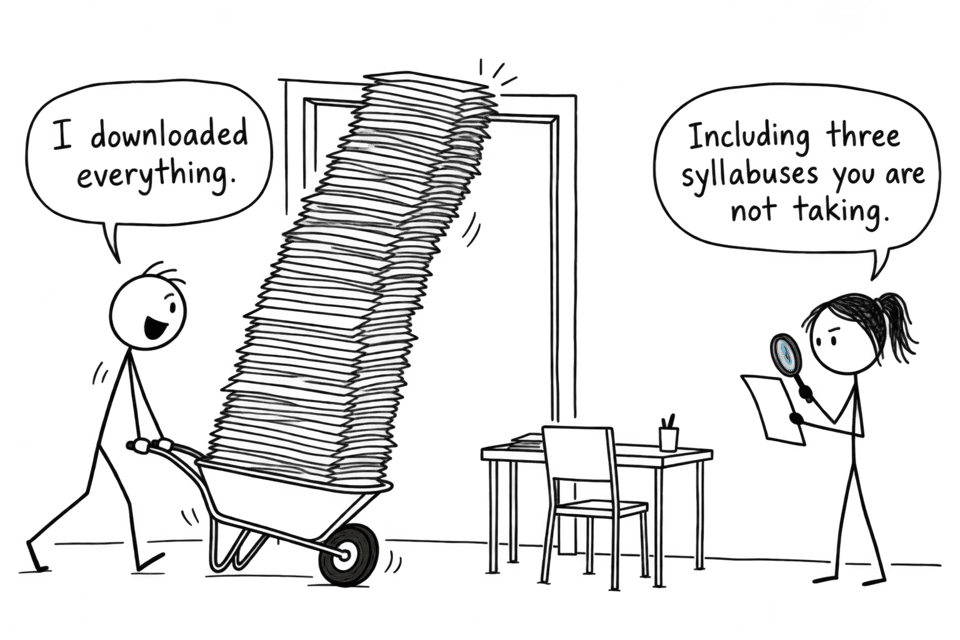
A folder containing 20 mismatched papers feels productive because it is heavy. A set of 20 carefully selected questions is more useful because each one has a job.
The best May 2028 preparation follows a simple sequence: identify the correct syllabus, learn the content, practise one current demand at a time, obtain feedback, and only then complete full timed simulations. RevisionDojo supports that sequence in one place, from Study Notes and Flashcards to AI Chat, grading tools, Predicted Papers, Mock Exams, the Coursework Library and Tutors.
Your specific next step is to open RevisionDojo's Questionbank today, select one subject and level, filter for the topic you studied most recently, and complete a timed set of five syllabus-aligned questions.