If you have ever wondered why your friend got “great analysis” on an answer that earned you “too descriptive,” you have already met the hidden problem of inconsistent assessment.
In the IB, that inconsistency is not just annoying. It is expensive. It costs time, confidence, and revision energy because you start studying your teacher instead of studying the criteria.
The good news is that when a department aligns assessments with IB criteria, students feel it immediately: feedback becomes predictable, improvement becomes repeatable, and revision becomes calmer.
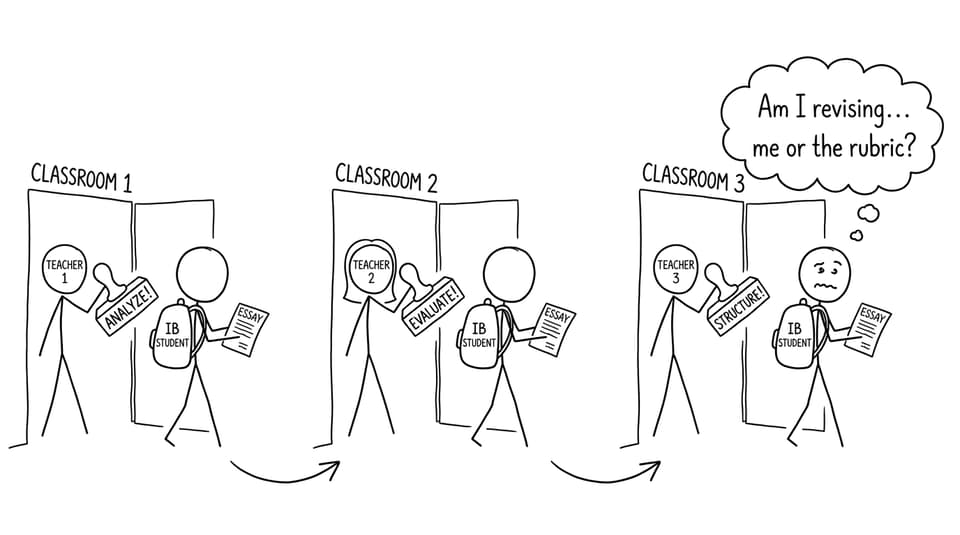
Same essay, three rubrics: the student experience
What it means to align department assessments with IB criteria
Alignment is a simple promise: a “good response” stays good no matter which classroom you are in.
In practice, aligning departmental assessments with IB criteria means:
Your rubrics reflect the language of IB markbands (not a mystery “teacher rubric”).
Command terms are treated as skills, not vibes.
Two teachers can justify the same mark for the same reasons.
Feedback helps you improve the next task, not just explain the last one.
Quick student checklist: signs your IB assessments are aligned
4.9
X
Share on WhatsApp
Share on LinkedIn
Share on Facebook
From a student seat, alignment looks less like policy and more like a feeling: “I know what they want, and I can train it.”
Check for these signals:
Rubrics mention IB criteria strands and use familiar descriptors.
Teachers use the same command-term meanings (analyze vs evaluate vs discuss).
Grade decisions come with evidence (“This is Level 5 because…”) not just impressions.
Exemplars exist, and teachers refer to them.
Your improvement targets repeat across units (because the skills repeat in the IB).
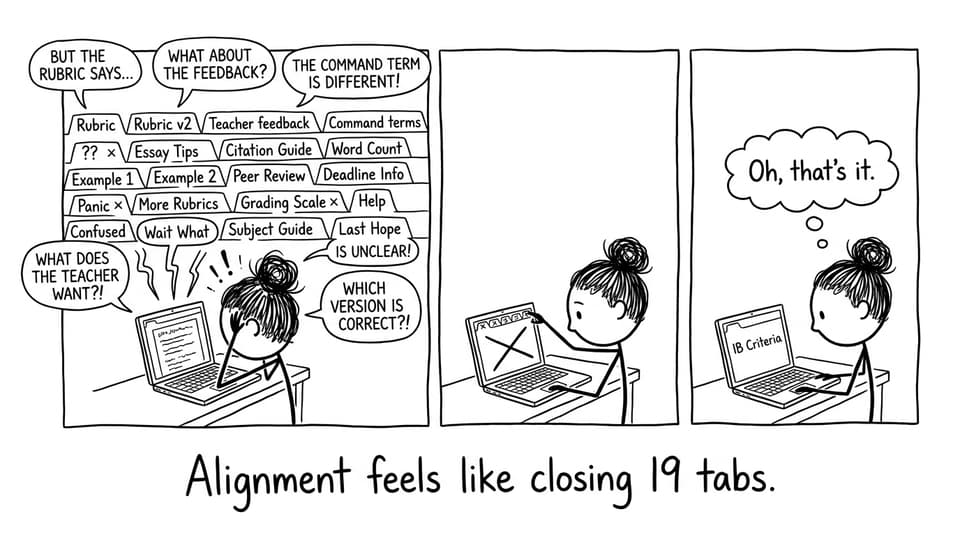
When those signals are missing, students often build revision habits around guesswork. That is the opposite of what the IB rewards.
Why this matters for IB exam preparation (even if it feels “teacher stuff”)
The IB is not primarily testing whether you were present in class. It is testing whether you can perform thinking under constraints: select evidence, structure reasoning, communicate clearly, and make justified judgments.
When departmental assessments drift away from IB criteria, you can work hard and still train the wrong muscle.
Consistency reduces stress and increases speed
Stress often comes from uncertainty, not difficulty.
If your department is aligned to IB criteria, you spend less time decoding preferences and more time practicing a stable set of skills. That stability is a revision advantage because you can iterate faster: attempt, receive feedback, adjust, repeat.
Feedback becomes reusable across subjects
In a well-aligned IB program, “more analysis” means the same thing in History, English, and the sciences: make a claim, justify it, and show the implications.
This is why consistency in grading is not only “fair.” It is efficient.
Progress feels like a staircase, not a roulette wheel
Aligned IB assessments create a sense of progression. You can feel yourself becoming the kind of student who earns marks, because the criteria remain stable while the tasks get harder.
Misalignment feels like switching sports mid-season and still being surprised you are sore.
Start with IB criteria, then design the assessment
A common reason departments drift is harmless: a teacher designs an engaging task first, then adds a rubric later.
But IB alignment works best in reverse:
Identify the IB criteria strands you are actually assessing.
Choose the command terms that will produce visible evidence.
Design the task so students cannot avoid those skills.
This matters for you because a criteria-first task is easier to revise for. You can practice the skill directly.
Use shared templates that keep creativity but remove chaos
Departments sometimes hear “alignment” and imagine identical worksheets.
Good alignment is more like guardrails: you can still drive your own route, but everyone is using the same road rules.
A strong IB-aligned assessment template often includes:
Named criteria strands (explicit and visible)
Student-friendly success indicators tied to markbands
A short “what this looks like” section (mini exemplars or annotated snippets)
A reflection prompt linked to criteria (“Which strand held you back most, and what will you do next time?”)
Templates reduce the cognitive load of starting every task from scratch. When structure is familiar, your brain has more room for analysis and evaluation.
Calibration sessions: where IB alignment becomes real
You cannot align assessment through documents alone. Alignment lives in the moment two teachers look at the same paragraph and argue -- respectfully -- about what the markband language really means.
A simple calibration cycle looks like this:
Choose 3 anonymized samples (low, middle, high)
Everyone marks independently using IB criteria
Compare marks and (more importantly) reasons
Agree on which phrases best match the markband descriptors
Save those samples as department exemplars
This is not about forcing identical marks forever. It is about making differences principled instead of accidental.
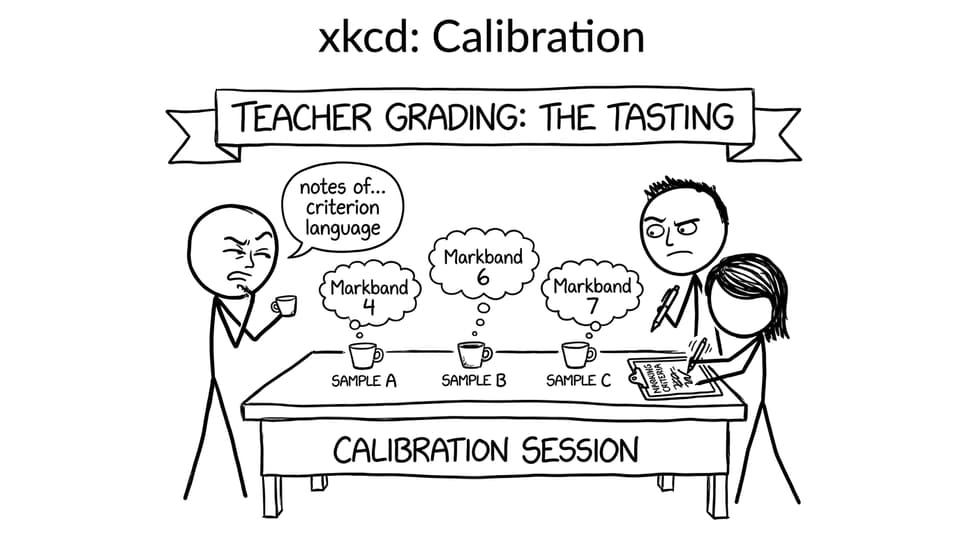
Calibration session as “markband tasting”
Students benefit because calibrated marking produces calibrated feedback, and calibrated feedback produces targeted revision.
Vertical alignment means the same criteria get more demanding over time.
In the IB, that is how vague labels become real skills. “Evaluation” becomes: compare interpretations, acknowledge limitations, and justify a conclusion with evidence.
How you can use alignment even if you cannot control it
You cannot run department meetings. But you can still revise like a student in an aligned IB program.
Translate feedback into criteria language
When you get a comment like “too narrative” or “needs depth,” ask yourself:
Which criterion strand is this referring to?
Which command term did I fail to satisfy?
What would a one-markband improvement look like?
If you cannot answer, ask your teacher a criteria-based question: “Which criterion does this comment connect to?”
Build a personal “criteria checklist”
Keep a living document of recurring feedback patterns. In the IB, the same errors repeat:
describing instead of analyzing
claims without evidence
evidence without explanation
evaluation without criteria
weak structure under time pressure
Your goal is to turn feedback into a reusable checklist that travels across tasks.
Practice under stable conditions
Even in a misaligned environment, you can practice in a way that mirrors IB marking.
That is where RevisionDojo becomes useful as a consistent second opinion.
How RevisionDojo supports IB-aligned assessment and exam prep
RevisionDojo is designed to feel like the stable part of your week: the place where the language of the IB stays consistent even when classroom expectations wobble.
Here is how students typically use it when trying to align their work with IB criteria:
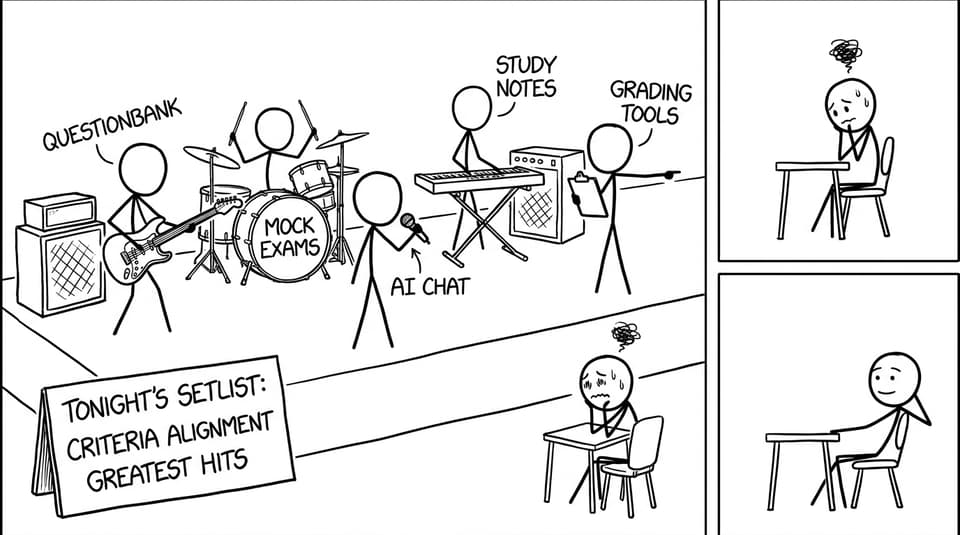
Questionbank for repeatable, criteria-aware practice that makes command terms feel concrete.
Study Notes to rebuild content fast when feedback shows knowledge gaps.
Flashcards to automate definitions and processes, so your writing focuses on analysis.
AI Chat to translate vague comments into specific next steps and generate targeted drills.
Grading tools to get criterion-by-criterion feedback that is easier to act on.
Predicted Papers and Mock Exams to rehearse timing and pressure while staying aligned to the IB skill profile.
Coursework Library to internalize what strong work looks like, not just what it says.
Tutors when you need a human to spot your pattern quickly and rebuild your approach.
For students, two particularly relevant reads are:
Closing: In the IB, consistency is a study advantage
The quiet advantage of a great IB department is not strictness. It is consistency.
When departmental assessments align with IB criteria, you stop chasing hints and start building skills that transfer -- from unit to unit, teacher to teacher, and finally into the exam hall.
If you want your revision to feel more predictable, use tools that speak the same criteria language every time. RevisionDojo supports IB students with Questionbank, Study Notes, Flashcards, AI Chat, Grading tools, Predicted Papers, Mock Exams, Coursework Library, and Tutors -- so your effort compounds the way IB success is supposed to.
Nathan holds an MA in Philosophy from Trinity College Dublin and has taught IB Theory of Knowledge and Philosophy for 20 years, including a decade as TOK coordinator. His focus is the IB TOK essay and exhibition, giving students a repeatable way to unpack knowledge questions in a subject with no fixed answers.