

If you have ever compared IA feedback with a friend in the same IB year group and felt like you were living in two different universes, you are not imagining it. One teacher circles every missing citation. Another writes, “Good effort” and moves on. A third gives the same mark but for completely different reasons.
In the IB, that inconsistency is not just annoying. It is stressful, because internal assessment is supposed to be criterion-based, predictable, and fair. When marking varies across teachers or departments, students start studying the teacher instead of the rubric. And that is the fastest way to lose confidence right when you need it most.
RevisionDojo helps schools make internal assessment feel like what the IB intended: one shared standard, applied consistently, with evidence students can actually use.
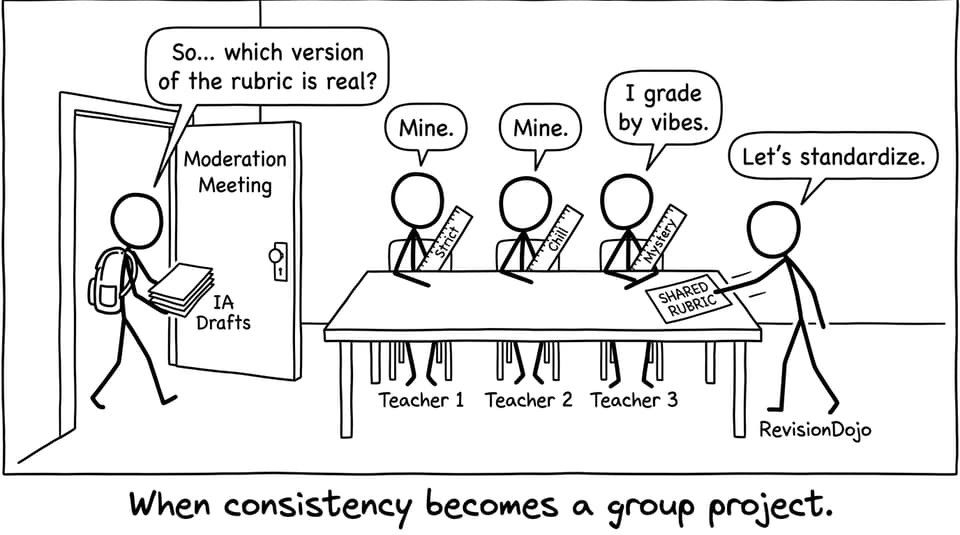
A quick checklist for standardizing IB internal assessment
If your school wants more consistent IB IA outcomes, this is the simplest playbook:
-
Use one shared, criterion-aligned rubric framework across the department
-
Calibrate marking with a small set of anchor samples
-
Standardize feedback language so it maps to criteria (not vibes)
-
Track marking patterns across classes to spot drift early
-
Store evidence for moderation and internal review in one place
RevisionDojo supports all of these steps through RevisionDojo for Schools, plus student-facing tools that make the process feel transparent rather than mysterious.
Why IB IA standardization matters (to students, not just coordinators)
The IB talks a lot about validity and reliability, but students feel it in a more human way: “Will I be graded fairly?”
When departments are not aligned, three things happen:
First, feedback stops being actionable. If one teacher rewards “evaluation” as reflection and another treats it as statistical uncertainty, students cannot build a repeatable skill.
Second, predicted outcomes become noisy. Even when teachers are doing their best, inconsistent interpretation makes grades harder to compare across classes.
Third, motivation suffers. People work harder when the path is legible. The IB rubric is meant to be that path.
A school that standardizes IAs gives students something rare: the sense that effort will translate into marks in a predictable way.
How RevisionDojo creates a shared IB standard across departments
Schools often try to solve inconsistency with more meetings. The problem is that meetings do not scale, and memory is not a system. RevisionDojo turns standardization into a workflow.
A centralized rubric and grading framework
RevisionDojo’s grading tools are built to keep marking anchored to criteria. When teachers and students use the same criterion language, “good” becomes less subjective.
For students, this matters because your improvement becomes mechanical in the best way: you can take criterion feedback and turn it into the next draft plan.
If you want to see how rubric-aware grading works on the student side, the IB Coursework Grader is the clearest example: it breaks feedback down by criterion so you can revise with intent, not hope.
Department-level calibration that is actually repeatable
A strong IB department usually has at least one “anchor script” conversation: teachers look at the same sample, discuss borderline decisions, and align.
RevisionDojo makes that alignment easier to sustain because work, comments, and criteria live in one place. Instead of searching email threads or shared drives, departments can review anonymized samples inside a consistent structure.
For the school-wide perspective on how moderation becomes simpler, see Simplifying IB Marking and Moderation Across Departments.
Analytics that catch inconsistency early
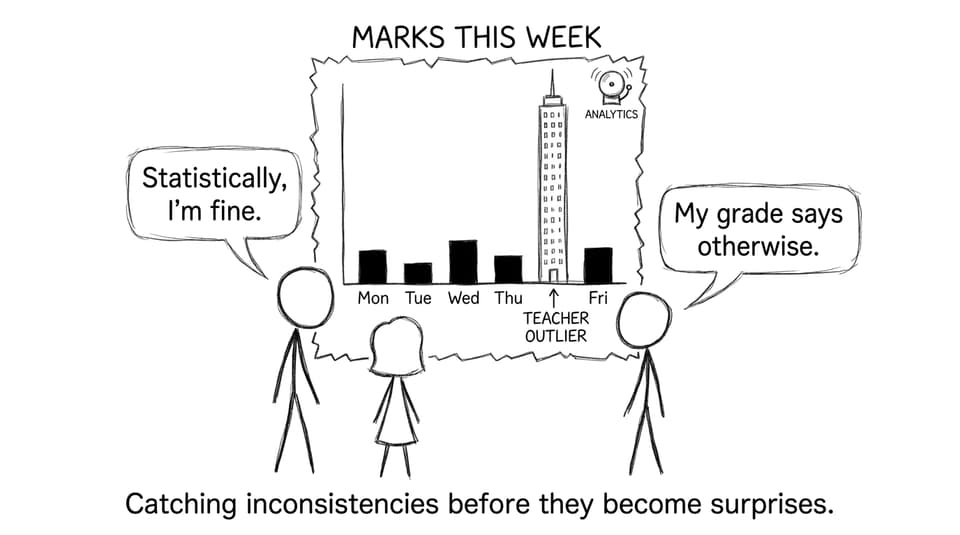
Most inconsistency is not dramatic. It is slow drift: one class trends stricter on Criterion B, another gives unusually high bands for the same evidence quality.
RevisionDojo surfaces those patterns with analytics so coordinators can ask better questions earlier. The goal is not to “police” teachers. It is to protect students from random variation.
Shared feedback standards students can understand
In the IB, students do not need more feedback. They need more consistent feedback.
RevisionDojo helps schools standardize the shape of comments: feedback that points to criteria, highlights evidence, and offers one next-step action. That consistency is a quiet advantage in exam season, because it trains students to think the way examiners reward.
If you want a student-friendly view of why feedback quality matters, IB Internal Assessment Feedback: Detailed Comments and Suggestions is a useful companion.
What this means for IB students preparing for exams
You might be thinking, “This sounds like a school problem.” But standardization changes how you should study.
When your department uses a consistent rubric approach, you can prepare like an engineer:
-
Learn the concept (content)
-
Practice the skill (exam-style responses)
-
Review mistakes (criteria-based)
-
Repeat until it is boring
RevisionDojo is built around that loop. Students move between Study Notes, Flashcards, the Questionbank, AI Chat, Mock Exams, Predicted Papers, Grading tools, the Coursework Library, and Tutors without losing the thread.
A practical starting point is the system described in RevisionDojo App: The Smarter Way to Prep for IB Exams, then adding coursework support when IA pressure rises.
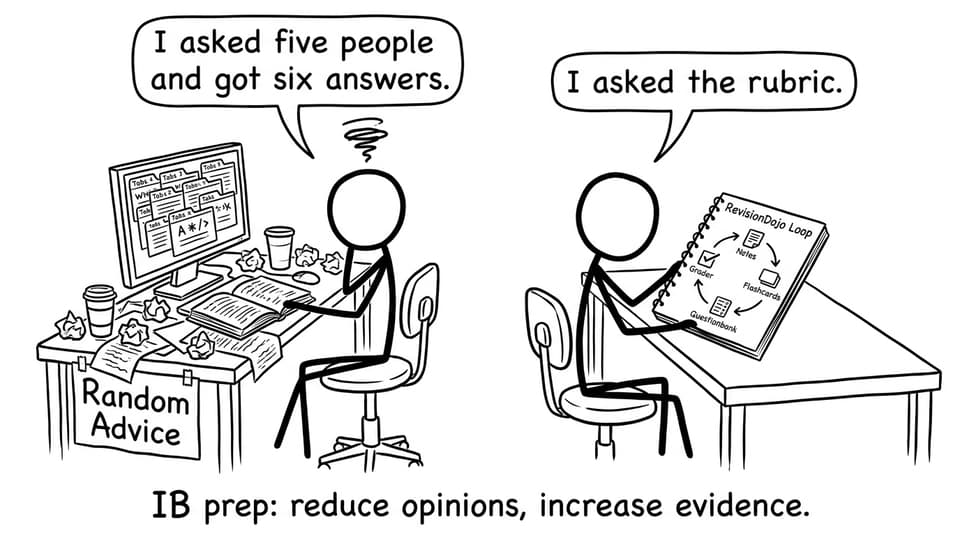
Use rubric consistency to make exam practice more efficient
When your IA marking is standardized, you can transfer that clarity to exams:
-
Use Study Notes to get the clean version of what matters
-
Convert weak points into recall using IB Cheatsheets and Flashcards
-
Drill the same skill with the Questionbank feature
-
Ask AI Chat to explain why your answer loses marks, not just what the right answer is
-
Run timed practice with Mock Exams and Predicted Papers to build stamina
If you are close to mocks, How to Study for IB Mocks (Without Burning Out) pairs well with this approach.
Practical ways students can benefit from departmental standardization
Even if you are not a coordinator, you can use the existence of a shared standard to your advantage.
Ask for criterion-based clarity (politely, specifically)
Instead of “How can I improve?”, ask: “Which criterion is currently limiting my mark, and what evidence would move it up one band?” In a standardized department, teachers can answer that quickly because everyone is speaking the same language.
Build a personal archive of patterns
When feedback is consistent, you can keep an error log by criterion. That turns IA improvement into exam improvement, because the IB rewards repeatable skills: analysis, evaluation, structure, and precision.
Use exemplars and guides without guessing what matters
RevisionDojo’s Coursework Library and grading tools make exemplars useful in a non-superficial way: you can compare what high-scoring work does against what the rubric demands.
For deeper IA guidance across subjects, the tag hub All IA Posts helps you find focused help without spiraling.
Closing: turning IB internal assessment into something you can trust
In the IB, stress often comes from uncertainty, not workload. When internal assessments feel inconsistent, students spend energy decoding expectations instead of improving their work.
RevisionDojo helps schools standardize internal assessments across departments so the rubric becomes real: shared criteria, clearer feedback, and analytics that catch drift before it becomes unfairness. And for students preparing for exams, that consistency becomes a study advantage: fewer opinions, more evidence, and a repeatable path to better marks.
If your school is ready to make IA marking more consistent and student-friendly, explore RevisionDojo for Schools. Your future self in exam season will feel the difference.