

If you have ever opened the IB timetable and felt a small wave of injustice, you are not alone.
English on one day. French on another. Spanish somewhere else.
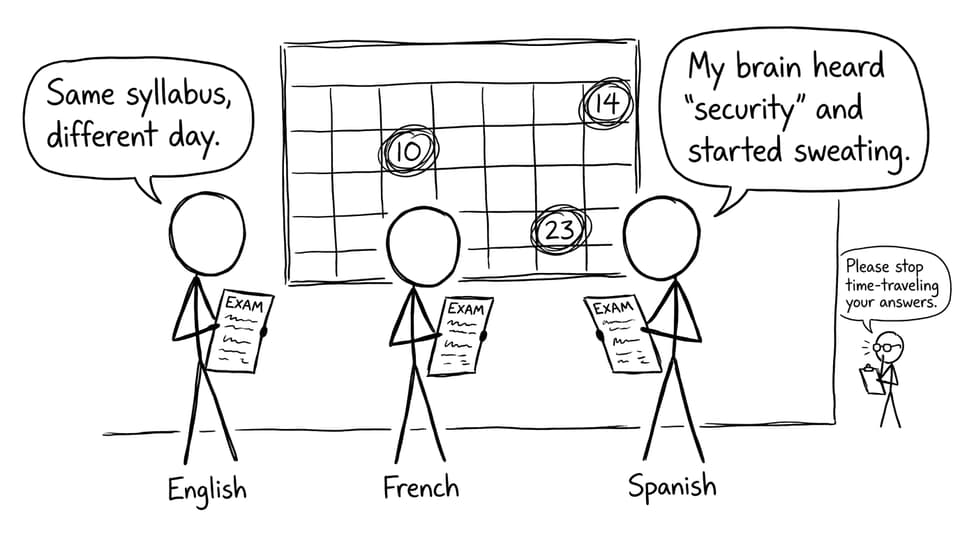
At first glance it looks arbitrary, like someone at the IB office spun a wheel. But the truth is calmer (and more practical): the IB schedules English, French, and Spanish exams on separate dates to protect exam integrity, reduce clashes, and manage a huge global operation across time zones.
This matters because once you understand the “why,” you stop wasting energy comparing dates and start using the timetable as a planning tool. And in IB, the students who plan early tend to feel strangely lucky later.
IB language exam dates: the quick checklist
Before we go deeper, here is the fast version of why IB language exams are spread out:
-
Clash prevention: many IB students take two languages (or two language-based subjects).
-
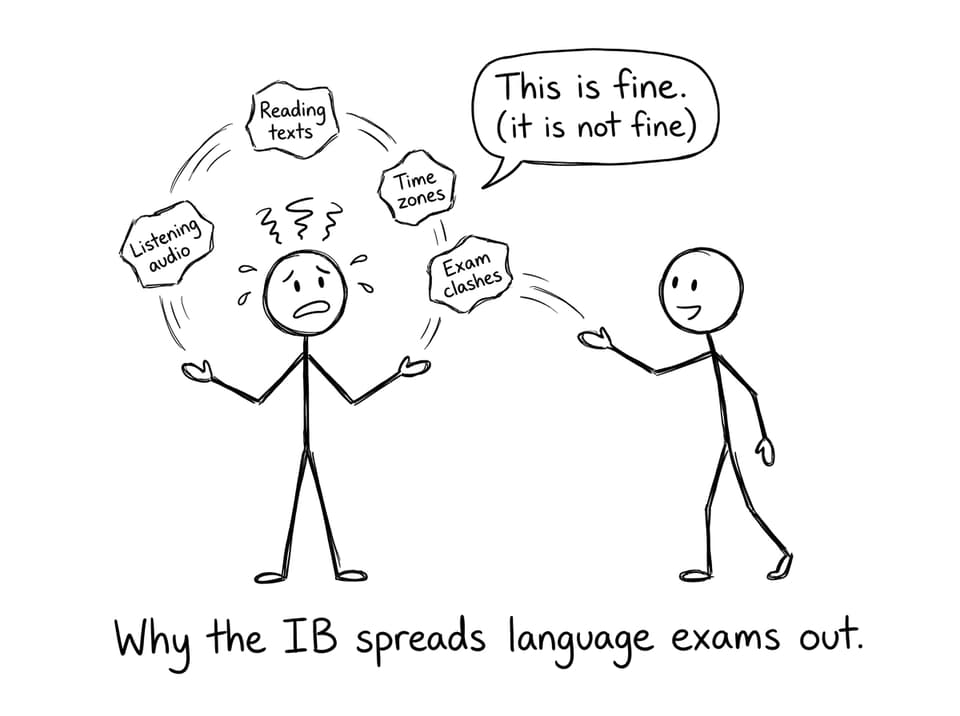
Security: language papers often include listening audio and unique texts that cannot leak.
-
Global logistics: massive candidate numbers and multiple time zones require staggering.
-
Marking and administration: spreading exams helps manage printing, distribution, and the examiner workload.
If you want a bigger picture view of how the timetable becomes a revision tool, start with How to Plan Final IB Revision Using the Official Timetable.
The real scale of IB language exams (it is bigger than it feels)
In your classroom, IB can feel like a small universe: a few dozen students, a couple of teachers, the same corridor every morning. The timetable feels personal.
But IB language exams are among the highest-entry subjects worldwide. English typically has the largest candidate pool, while French and Spanish also have major global uptake. That means an enormous amount of printed material, audio content, logistics coordination, and script processing.
When the candidate pool is that large, scheduling stops being about convenience. It becomes about risk management.
This is why the IB often spreads high-entry subjects across the session: to keep the system stable. If you want to understand how the broader exam window gets structured, see IB May 2026 Exam Schedule: Full Timetable, Dates, and Planning Guide.
Why IB cannot schedule all language exams together
In a perfect world, the IB could place “all languages” neatly on the same day. In the real IB world, that creates chaos.
Many students take:
-
English A plus a Language B
-
Two languages across Group 1 and Group 2
-
A bilingual diploma pathway
If English, French, and Spanish sat on the same day, the IB would trigger widespread exam clashes. Not just inconvenient ones, but impossible ones: students physically cannot sit two full papers at the same time.
There is also the stamina factor. Even if clashes could be “solved” by moving students between rooms, languages are often writing-heavy. Stacking multiple language papers back-to-back would punish students for their subject combination rather than assess their skills.
The IB’s job is not to make the timetable aesthetically pleasing. It is to make it survivable.
If you are building a personal strategy around spacing and workload, Best Revision Order Based on the IB Exam Schedule is a useful companion.
Exam security: why language papers are especially sensitive in IB
If you have ever done listening practice, you already know the problem: audio cannot “half leak.” If it gets out, it spreads fast.
Language exams are security-sensitive because they rely on content that must stay confidential:
-
Listening audio (especially vulnerable to sharing)
-
Reading passages (can’t be reused once exposed)
-
Prompts and tasks that, if leaked early, would advantage huge numbers of candidates
Now add time zones. The IB runs exams globally, and even with timezone scheduling, security is a constant pressure. Separating English, French, and Spanish helps reduce the chance that one language paper becomes a single point of failure.
In other words: the separate IB exam dates are not about ranking languages. They are about limiting risk.
Candidate numbers and logistics: the unglamorous reason that matters most
English often has the biggest entry numbers. That means:
-
more scripts
-
more exam packets to distribute securely
-
more coordination for schools and exam officers
French and Spanish can have different regional concentrations, which also affects distribution and administration. Spreading language exams gives the IB flexibility to manage printing, shipping, secure storage, and the smooth running of exam days.
If you have ever wondered why the schedule feels like it was designed for “the system,” not for you, that is exactly the point. The system has to work for everyone.
For a survival mindset during the exam window, keep IB Exam Week-by-Week Survival Guide bookmarked.
Does a later IB language exam mean it is harder?
No. And this myth is surprisingly sticky.
A later date in the IB schedule does not signal a harder paper, a stricter examiner, or a different grading standard. IB assessments are designed to the same specification, and grade boundaries are applied globally for a session.
What changes with timing is not the difficulty of the language. It is your energy.
If your Spanish or French exam lands later, you might walk into it carrying the weight of earlier papers. That can make the exam feel heavier. But “feels harder” and “is harder” are different things.
If you are in the final stretch and want a reality-based approach, read IB: The Last 2 Weeks Before Exams (What Matters).
How to plan revision when IB languages are staggered
Staggered IB language dates create a trap: students go hard early, then stop.
Languages punish that approach because they decay quietly. Vocabulary slips. Listening feels faster. Writing becomes less automatic.
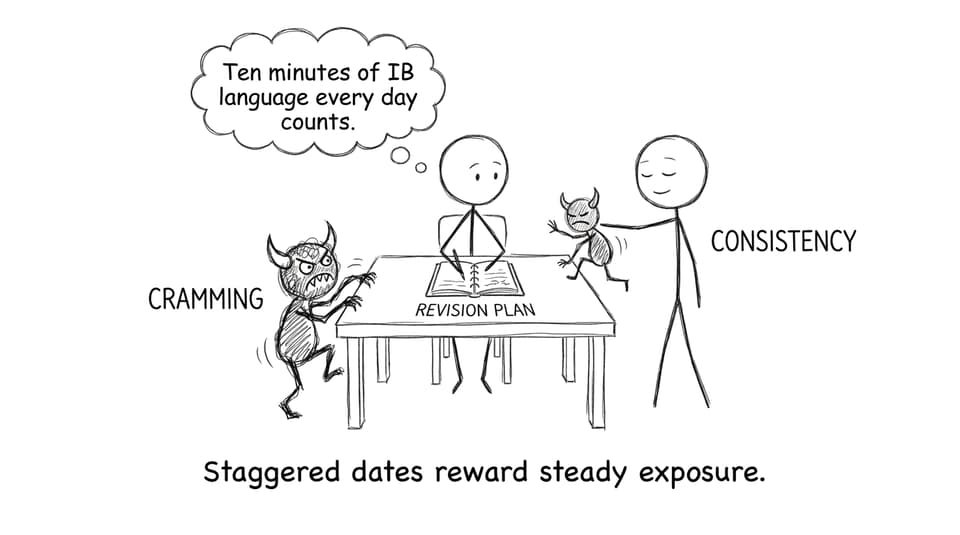
A better plan is “maintenance mode”:
-
Keep short daily exposure (10-20 minutes)
-
Mix skills: quick listening one day, a short writing task the next
-
Use spaced repetition for vocabulary and structures
-
Add timed practice closer to the exam for stamina
RevisionDojo makes this easier because the tools connect. You can do targeted drills in the Questionbank, keep daily momentum with Flashcards, patch gaps with Study Notes, and use AI Chat when a grammar point won’t stick. When you are ready for pressure, Mock Exams and Predicted Papers help you rehearse timing and calm. If you want feedback on writing, RevisionDojo’s Grading tools can turn a vague “good effort” into actionable next steps. And when you want examples of high-quality work, the Coursework Library plus Tutors can remove weeks of guesswork.
To build an overall routine around all subjects (not just languages), use How to Create a Balanced IB Study Schedule.
Use the timetable properly: plan backwards, not emotionally
A quiet skill in IB is planning without drama.
Instead of thinking, “My English exam is early so I’m doomed,” think:
-
What skills must be automatic by that date?
-
What is my minimum daily language maintenance until the exam?
-
Where are my high-fatigue days across the timetable?
A practical way to do this is to map your schedule in the RevisionDojo Study Planner, then layer in:
-
weekly timed writing blocks
-
light listening sessions on busy days
-
flashcard maintenance even during heavy science/math weeks
You are not trying to peak once. You are trying to stay steady.
A calmer way to see the IB timetable
The IB did not separate English, French, and Spanish exam dates to make your life complicated. It did it because the world is complicated: time zones, security, candidate numbers, and subject combinations all collide in one month.
Once you accept that, the timetable stops feeling like a verdict and starts feeling like a map.
If you want to turn that map into a plan, build your schedule in the RevisionDojo Study Planner, then run your daily loop using RevisionDojo’s Questionbank, Study Notes, Flashcards, AI Chat, Grading tools, Predicted Papers, and Mock Exams. That is how IB becomes manageable: not by wishing the dates were different, but by making your preparation steady enough that the dates do not matter.