


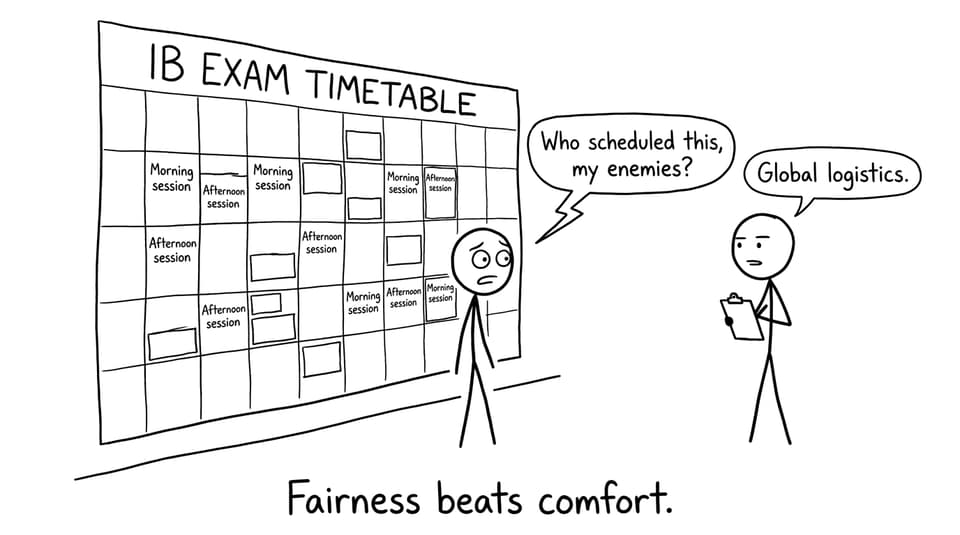
If you’ve ever opened the IB timetable and felt your stomach drop, you’re not being dramatic. You’re being rational. On paper, an IB schedule can look like someone stacked your hardest papers back-to-back, sprinkled in a “double day,” and then dared you to stay calm.
But the IB doesn’t build exam schedules around comfort. It builds them around something stricter: global fairness.
The quick checklist: what actually shapes the IB timetable
Before you take the schedule personally, keep this short list in mind. The IB timetable is shaped by:
-
Global coordination across time zones
-
Exam security and leakage prevention
-
Subject combinations and clash reduction
-
A manageable window for schools and examiners
If you want to get practical fast, start by learning how to interpret the timetable correctly in How to Read the IB Exam Schedule Without Getting Confused.
The IB is a global system, not a local one
The first thing students forget is scale. The IB runs exams across hundreds of countries, with countless subject combinations, and with strict expectations that the same qualification means the same thing everywhere.
That’s why the timetable uses fixed sessions (morning/afternoon) that are coordinated by exam zones, not by what feels “balanced” for one school. If you’ve ever wondered why “morning” doesn’t always feel like morning, What Time Do IB Exams Start? explains the logic.
In other words: the IB is scheduling for the world, not just for your week.
Exam security forces tough decisions
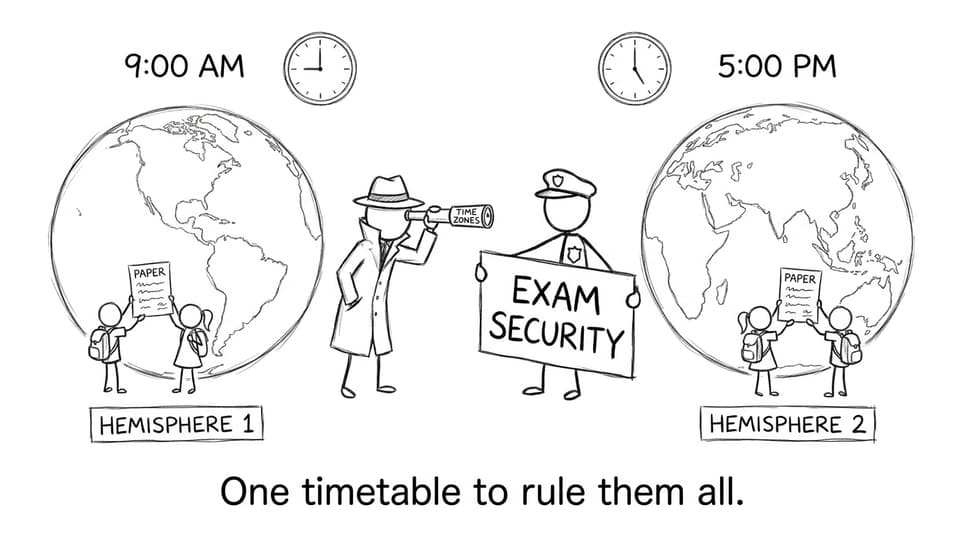
If the IB spaced everything out perfectly, it would also create more opportunities for exam content to travel. Security is a quiet architect of the timetable.
Time zones alone create risk. If one region sits an exam significantly earlier than another, the IB has to prevent information leaks. That’s one reason certain papers are carefully positioned and why the timetable can feel “tight.”
Subject combinations create unavoidable pressure points
Even if the IB wanted to make your personal sequence easier, it can’t optimize for every combination of:
-
Multiple languages
-
HL + SL mixes
-
Essay-heavy subjects plus calculation-heavy subjects
The goal becomes minimizing clashes and keeping the system markable. That’s why some exams end up close together: the timetable is reducing collisions across millions of possible student schedules.
When you’re planning, it helps to work backwards from the realities of timing and duration. Use How Long Are IB Exams? Time Breakdown Explained to translate “Paper 2” into pacing and energy cost.
Why grouped exams aren’t a judgement on difficulty
A common misunderstanding is that the IB is “testing you” by stacking hard subjects. More often, grouping is about:
-
Keeping the overall exam window reasonable
-
Making supervision simpler for schools
-
Aligning marking and processing timelines
So yes, it can feel unfair. But it’s not personal. And crucially: it doesn’t change how you’re graded. The same IB mark schemes and standards apply regardless of when you sit.
What you can control: turning the IB timetable into a plan
You can’t move exams. But you can change how the schedule lands on you.
A calm approach looks like this:
-
Identify your “pressure block” days early
-
Front-load heavy content revision before the exam window
-
Use lighter tools between papers (recall, not relearning)
-
Train stamina with timed practice so the timetable feels familiar
Students who adapt well tend to treat the timetable as a forecasting tool. If you want a clear framework, How to Plan Final IB Revision Using the Official Timetable lays it out.
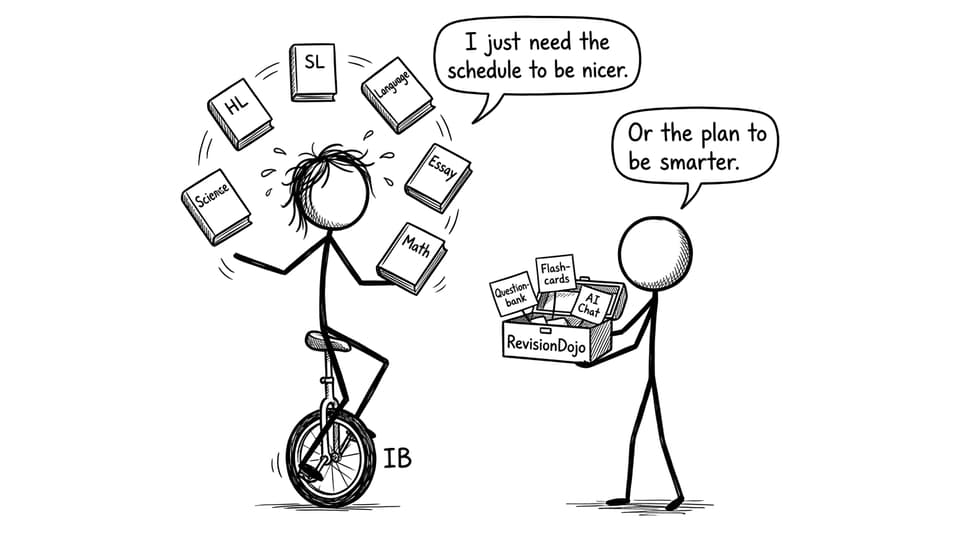
This is where RevisionDojo becomes more than “resources.” It becomes a system: build accuracy with the Questionbank, lock in recall with Flashcards, get unstuck fast with AI Chat, and rehearse performance using Predicted Papers and Mock Exams. When coursework stress is bleeding into revision, the Coursework Library and Grading tools help you close loops quickly, and Tutors are there when you need a human diagnosis.
The takeaway: the IB schedule won’t bend, so your strategy must
The IB schedules exams for fairness, security, and global logistics, even when that feels harsh at a personal level. Once you accept that, planning gets simpler: you stop arguing with the timetable and start building around it.
If you want to turn your IB schedule into a calm, realistic plan, use the RevisionDojo Study Planner and run one connected workflow: Study Notes to learn, Questionbank to practice, Flashcards to retain, AI Chat and Grading tools to improve faster, and Predicted Papers and Mock Exams to rehearse performance.