



The TOK moment you probably recognize
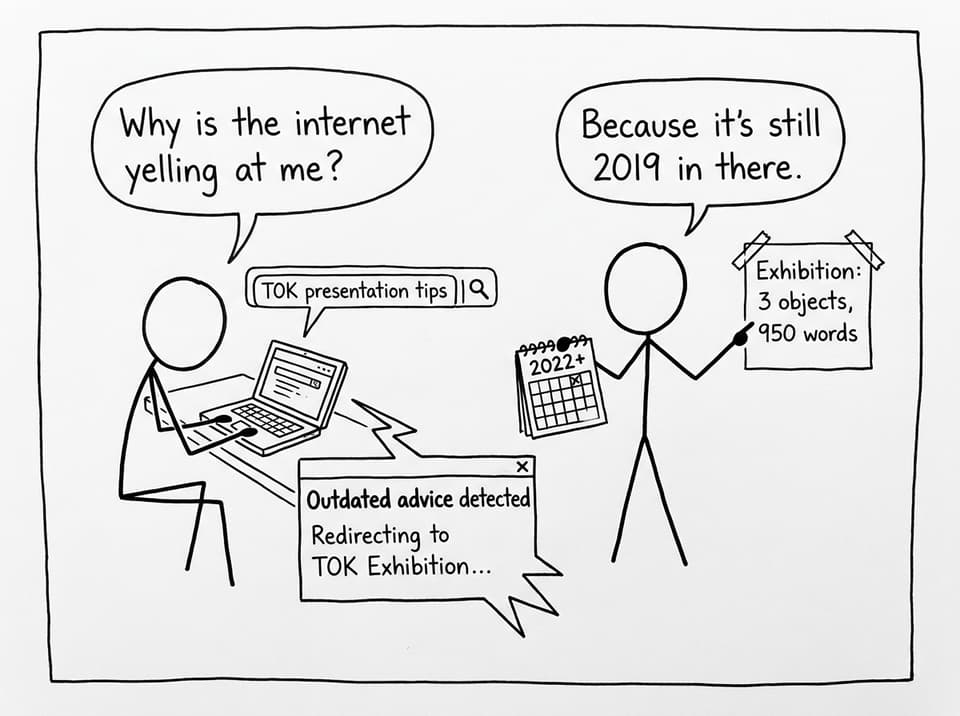
At some point, almost every IB student types the same phrase into a search bar: “TOK presentation tips.”
And then the confusion starts.
Some sites talk about speeches and group slides. Others mention a planning document. A few promise “the perfect real-life situation.” It can feel like you have missed a secret part of TOK.
You haven’t.
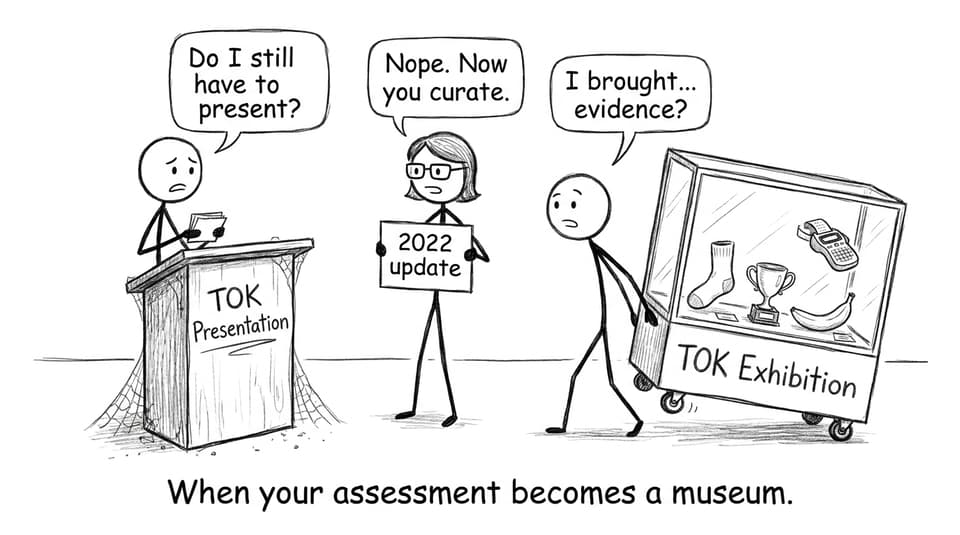
The simple truth is that the TOK Presentation is no longer part of the course. The IB removed it in the 2022 curriculum update and replaced it with the TOK Exhibition. If you started the Diploma in 2022 or later, your internal assessment is the exhibition, not a presentation.
Quick checklist: what you need to know about TOK now
Keep this short list nearby while you plan your TOK work:
-
The old TOK Presentation is retired (pre-2022).
-
The new internal assessment is the TOK Exhibition.
-
You choose one prompt from the IB’s list of 35.
-
You pick three specific, real objects (or images of real objects).
-
You write one commentary of up to 950 words total (not per object).
-
Your teacher marks it; the IB moderates a sample.
For the big-picture TOK layout (essay vs exhibition, weightings, and requirements), start with IB Theory of Knowledge Resources.
What the TOK Presentation used to be (and why it felt so different)
The older TOK Presentation was a live, spoken task delivered to your class. You would start with a real-life situation, pull out a knowledge question, and build an argument that circled back to the original situation.
That format rewarded certain things:
-
Speaking clearly under pressure
-
Handling questions in the room
-
Making abstract TOK ideas understandable out loud
It also created a problem the IB could never fully solve: two students in different schools could have completely different conditions. A small class, a supportive teacher, a noisy room, a group partner who vanished the week before. In a course like TOK, consistency matters.
Why TOK replaced the Presentation with the Exhibition
The IB never writes a dramatic “here’s what went wrong” announcement, but the logic is easy to spot when you think like an assessor.
A written exhibition commentary is:
-
Easier to standardise across schools
-
Easier to moderate, because the moderator can actually see what was assessed
-
More accessible for students who are thoughtful writers but anxious speakers
-
Better aligned with modern TOK framing, where your perspective as a knower and the context of knowledge matter
In other words, the change pushed TOK toward evidence you can read, compare, and justify.
What the TOK Exhibition is (the version you are actually assessed on)
The TOK Exhibition is a curated argument, not a performance.
You select one prompt, then use three objects to show how knowledge behaves in real life: how it’s created, trusted, challenged, or shared. The key is that your objects are not decorations. In strong TOK, the object forces you into a knowledge insight you couldn’t reach with vague examples.
If you want a complete walkthrough of how the task works, use IB TOK Exhibition: Your Complete Guide to Success. For a more process-driven approach, follow How to Excel in Your IB TOK Exhibition: Complete Step-by-Step Guide.
What makes a strong TOK Exhibition (and what usually weakens it)
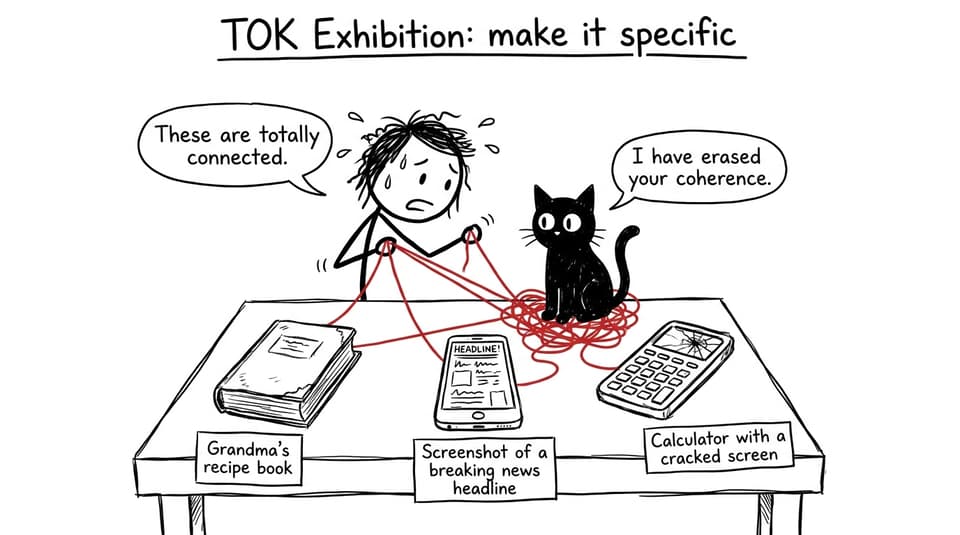
Your objects must be specific, not symbolic
Students lose marks in TOK when they choose objects that are basically metaphors.
A “globe” can mean anything. A “textbook” can mean anything. The examiner can’t see your thinking because the object doesn’t force a precise knowledge context.
Instead, choose objects with real origin stories: who used it, where it came from, and what knowledge system it sits inside. RevisionDojo’s notes on Picking Objects That Actually Work explain this difference in a way that’s easy to apply.
Your commentary must analyse, not narrate
A common trap: writing three mini-stories about your objects and hoping the prompt connection is “obvious.” In TOK, obvious is usually invisible.
Your commentary should repeatedly do three moves:
-
Give just enough context to make the object real
-
Make the link to the prompt explicit
-
Extract a knowledge insight (assumptions, reliability, perspective, authority, limits)
If you want models for that style of writing, read How to Create an Engaging TOK Exhibition Commentary and the focused notes on Writing a Strong Commentary.
Know how the TOK Exhibition is graded
Grades feel mysterious until you read the rubric in plain language. Two guides help you self-check quickly:
If you want instant, criteria-based feedback, RevisionDojo also has the IB TOK Exhibition Grader to help you spot where your TOK reasoning is still too descriptive.
How RevisionDojo helps you turn TOK into a scoring system
The hard part of TOK is that it can feel like fog: lots of big words, not enough clear next steps. RevisionDojo is built to turn that fog into a plan.
If you are working on the exhibition, you can:
-
Use Study Notes and Flashcards to lock in what examiners reward
-
Use AI Chat to test whether your object links are actually arguable (not just descriptive)
-
Use Grading tools to identify missing justification and weak coherence
-
Learn from the Coursework Library, including IB TOK Exhibition Examples
-
Build confidence across subjects with Questionbank, Mock Exams, Predicted Papers, and support from Tutors when deadlines stack up
The bottom line: forget the TOK Presentation, master the TOK Exhibition
If you keep seeing “TOK Presentation tips,” treat them like an old map to a building that was renovated years ago. Interesting history, wrong directions.
Your job now is the TOK Exhibition: one prompt, three specific objects, one tight commentary that makes your thinking visible.
When you’re ready to plan, draft, and polish, use RevisionDojo’s exhibition resources, the TOK grader, and exemplar library to turn your work into something coherent and markband-ready. The sooner you stop chasing the retired presentation, the sooner your TOK effort starts paying you back.