


Formative assessment is supposed to feel like a compass.
But in a lot of IB classrooms it feels like weather: frequent, unpredictable, and somehow always arriving right when you wanted to study.
You get a task back. There are comments. Maybe a number. Maybe a rubric. And then you move on because the next deadline is already tapping you on the shoulder.
Meaningful formative assessment in IB contexts isn’t about adding more mini-tests. It’s about building a feedback loop that changes what you do tomorrow--so your final exam performance changes too.
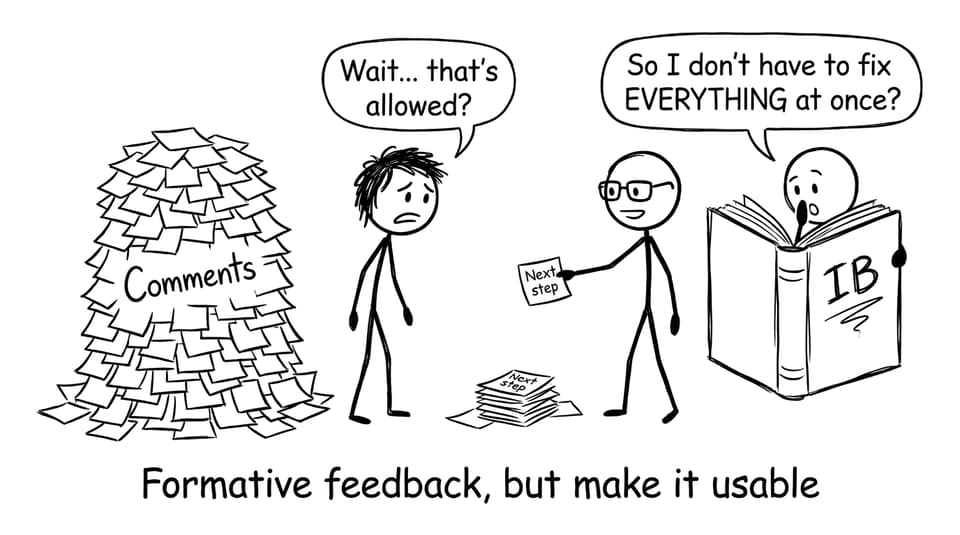
The quick checklist for meaningful formative assessment in IB
If you want formative assessment to matter for IB exams, keep this simple checklist nearby:
-
Tie every formative task to IB criteria or exam command terms (not just “completion”).
-
Ask for feedback you can act on in one sitting (one skill, one fix).
-
Do a short self-assessment before you see the teacher’s feedback.
-
Convert feedback into an “error rule” you can repeat under pressure.
-
Retest quickly--within 48 hours--so the loop closes.
This isn’t extra work. It’s the same work, but arranged so it actually compounds.
What formative assessment means in IB (and what it’s not)
The IB philosophy pushes assessment for learning: feedback that helps you improve while the learning is still happening. Formative assessment is the part of your workflow where mistakes are allowed to be useful.
The problem is that students often treat formative work like a rehearsal that doesn’t count. And teachers sometimes treat it like a checkpoint that must be recorded. In both cases, the real point gets missed: formative assessment only becomes “formative” when it produces action.
A practical definition that works for IB students:
-
If feedback changes what you do next, it’s formative.
-
If feedback just sits there, it’s decoration.
When you train yourself to translate comments into a next attempt, you’re learning the most exam-relevant skill of all: adjusting in response to criteria.
Design your IB feedback loop (the one that actually raises marks)
You don’t need more feedback. You need a better loop.
Start with IB criteria, not vibes
A formative task becomes meaningful when it’s aligned to how IB will reward you later.
That means:
-
Use the same language as the rubric (criterion descriptors, command terms, “effective use of evidence,” “evaluation,” “method,” “justification”).
-
Build mini-tasks that target one slice of performance.
In practice, this looks like writing one paragraph that only trains evaluation, or doing a short data-response that only trains conclusion quality.
If you’re practicing with exam-style questions, a good place to make this concrete is RevisionDojo’s Questionbank, where practice is structured to behave like assessment rather than generic homework.
Make feedback painfully specific (and small)
The most dangerous feedback in IB is also the most common: “add more detail.” It sounds helpful but it doesn’t tell your brain what to do.
Instead, aim for feedback that is:
-
Specific: names the exact missing move
-
Actionable: can be fixed in 10--20 minutes
-
Repeatable: becomes a rule you can apply next time
Example translations:
-
“Explain more” becomes “Define the term, then link it to the mechanism, then state the consequence.”
-
“Needs evaluation” becomes “State a limitation, then explain impact, then propose improvement.”
On RevisionDojo, many students build this loop by pairing targeted practice with instant feedback from Jojo AI Chat: not to get answers, but to diagnose what the rubric wanted that you didn’t show.
Retest fast: close the loop while it’s still warm
If you wait a week, you’ll only remember the feeling of being corrected, not the actual correction.
The high-return move for IB students is fast retesting:
-
Do the task
-
Get feedback
-
Write one “error rule”
-
Redo a similar question within 48 hours
This is where tools matter. RevisionDojo’s connected workflow (Study Notes -> practice -> feedback) makes fast retesting realistic because you can review the exact concept using Study Notes and immediately apply it again.
Make self-assessment and peer feedback feel worth it
Self-assessment in IB isn’t about being harsh on yourself. It’s about learning what the rubric is actually asking for, so you can spot the gap earlier.
A simple IB self-assessment script
Before you look at any teacher comment, ask:
-
Which criterion did I try to score on?
-
What did I do that an examiner would reward?
-
What did I fail to show, even if I understood it?
Then compare your answers to the feedback. When you do this consistently, you stop seeing feedback as judgment and start seeing it as a map.
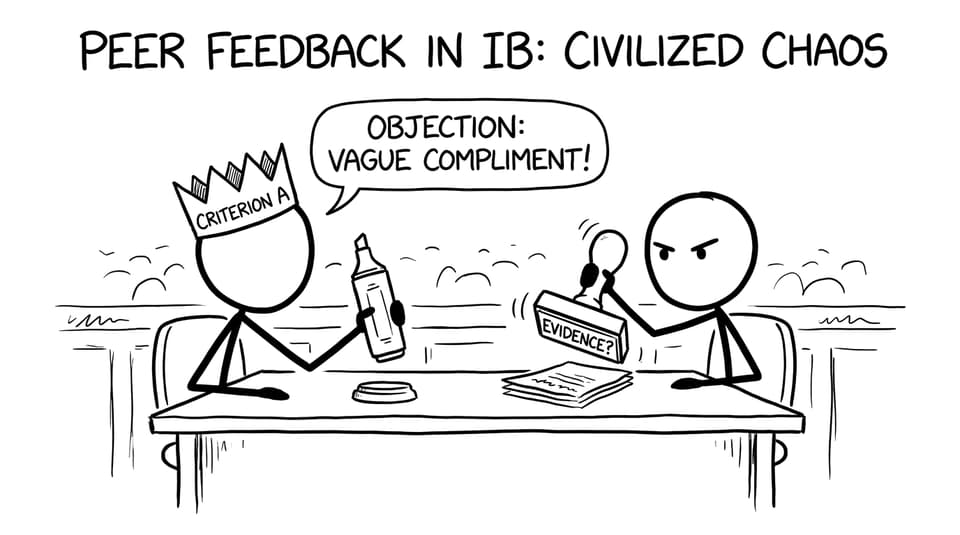
Peer feedback that isn’t just “looks good”
Peer review helps when it stays anchored to IB criteria.
Try a two-rule format:
-
One “keep” linked to a descriptor (what meets the criterion)
-
One “change” linked to a descriptor (what would raise the level)
If you revise using flashcards, you can even build a mini rubric deck: prompts that test your ability to identify evaluation, evidence, definitions, and structure. RevisionDojo’s Flashcards are useful here because retrieval practice makes rubric language feel normal, not scary.
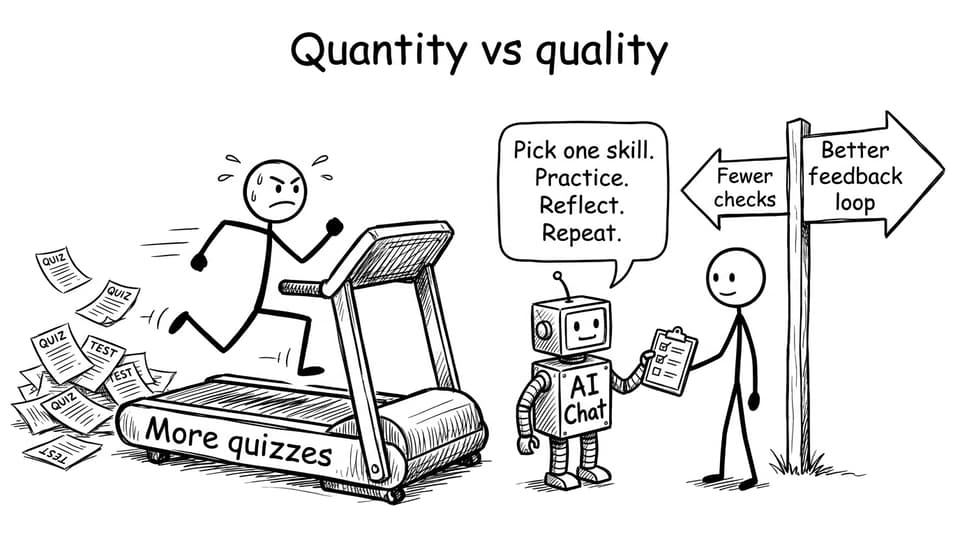
Don’t confuse frequency with usefulness
In the IB, it’s easy to feel productive because you’re constantly producing something: drafts, quizzes, reflections, practice sets.
But too much formative assessment can numb you. If everything is assessed, nothing feels like it matters.
A better approach is fewer, higher-quality checkpoints:
-
One targeted formative task for a key skill
-
One piece of feedback you can apply
-
One retest to prove you learned it
Then, once a week, put that skill under time pressure using Mock Exams or IB Predicted Papers (written by IB examiners) so your progress shows up in exam conditions.
A student-friendly formative workflow inside RevisionDojo
Here’s a calm, repeatable loop many IB students use when they want feedback to turn into marks:
-
Clarify one weak area with IB resources on RevisionDojo
-
Review the exact concept in Study Notes
-
Practice that one slice with the Questionbank
-
Ask Jojo AI Chat to grade and diagnose your mistake pattern
-
Turn the diagnosis into 3 flashcards (definitions, steps, command term moves)
-
Use a grading loop for written work with the IB Coursework Grader
-
Once a week, simulate pressure with IB Predicted Papers
And if you need a human to help you see what you can’t yet see, RevisionDojo can connect you with Tutors as a strategy reset, not a panic purchase.
Conclusion: Make IB formative assessment a growth engine
Meaningful formative assessment in IB contexts isn’t about collecting more evidence that you’re busy. It’s about building a loop where feedback produces a better next attempt.
Align tasks to IB criteria. Keep feedback small and actionable. Reflect briefly, then retest quickly. That’s how you turn comments into confidence.
If you want one place to run that entire loop, RevisionDojo is built for it: Questionbank, Study Notes, Flashcards, AI Chat, Grading tools, Predicted Papers, Mock Exams, Coursework Library, and Tutors. Start with one weak skill today, and make your next piece of feedback the one that actually changes your score.