
If you have ever walked out of a feedback meeting thinking, I don't even know what they wanted, you have felt the real cost of unfair internal grading.
Not unfair in a dramatic, obvious way. Not a teacher "out to get you." The kind of unfairness that happens quietly, when two pieces of similar work receive different marks because the marker was tired, impressed by confidence, distracted by neat formatting, or influenced by a student’s reputation.
In the IB, internal assessments and coursework are meant to be measured by criteria, not personality. But the system is still human. The best schools reduce that human drift with systems: shared rubrics, moderation habits, and transparent evidence.
This guide is written for IB students preparing for exams, because fairness in internal grading affects more than your coursework mark. It affects your trust, your motivation, and how you revise when the pressure rises.
A quick checklist for IB internal grading fairness
Use this as a simple lens for whether your class (or you) is operating in a fair IB grading environment:
-
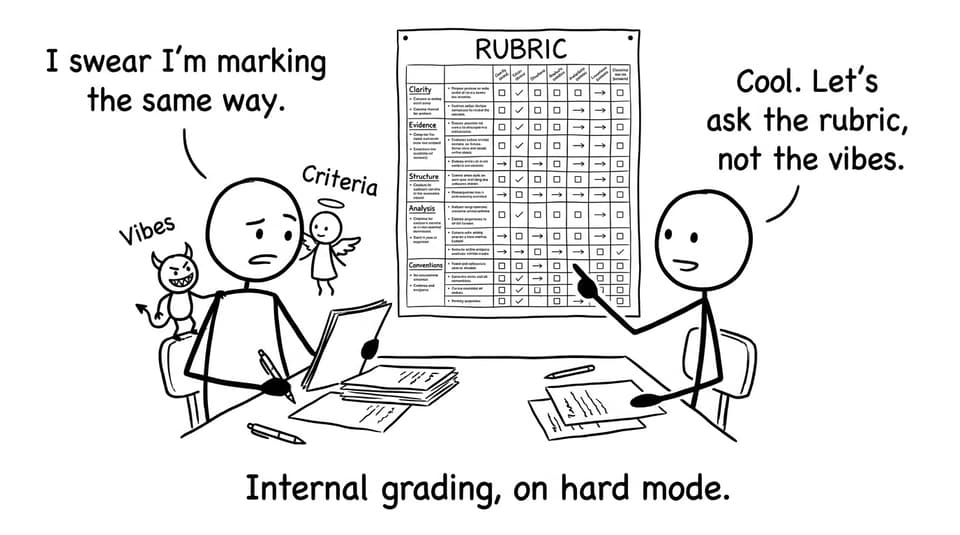
Criteria are used consistently (not "best guess" marking)
-
Feedback points to rubric language and evidence in your work
-
Samples are moderated by more than one marker (even informally)
-
Borderline cases are discussed, not decided in isolation
-
Marks and comments are recorded clearly enough to be explained later
-
Patterns are reviewed with data (to spot drift and inconsistency)
If even half of these are true, your internal grading is already becoming more defensible, and more fair.
What bias looks like in IB internal grading (and why it’s common)
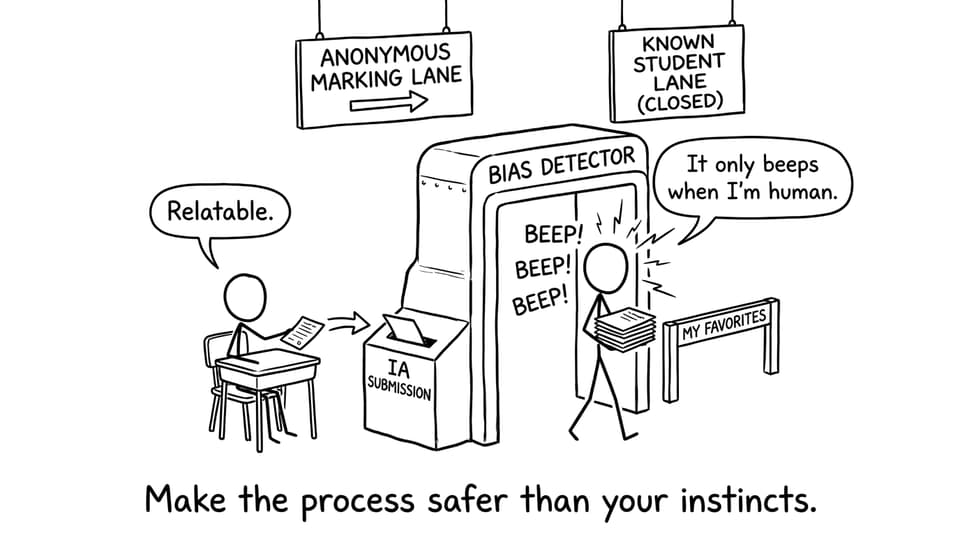
Bias in IB marking rarely looks like prejudice. More often, it looks like a shortcut your brain takes when it is trying to be efficient.
A marker sees one strong feature and subconsciously assumes the rest is strong too. A marker remembers a student as "brilliant" or "disorganised" and that memory becomes an anchor. A marker reads a polished introduction and relaxes, even though the evaluation is thin.
Common bias patterns in internal grading include:
-
Halo effect: one impressive feature raises everything else
-
Leniency or harshness drift: a teacher becomes generous or strict over time
-
Anchoring: an early markband becomes a reference point for later work
-
Confirmation bias: you notice what fits what you expected to see
The uncomfortable truth: the IB relies on teachers, and teachers are human. The hopeful truth: humans can build systems that protect fairness.
How IB rubrics create fairness (when people actually use them)
Rubrics are not decoration. In the IB, they are the contract.
The fairest internal grading environments treat the rubric like a shared language. That means students can point to descriptors and teachers can justify decisions with evidence.
What this looks like in practice:
-
Teachers use the official rubric wording as the baseline
-
The department builds a shared understanding of what top-band evidence looks like
-
Comments reference criteria (not vague phrases like "needs more depth")
-
Extra "secret" criteria (neatness, style, personality) are deliberately removed
If you want to understand this process more clearly, these explainer posts help:
For students, the practical takeaway is simple: write work that is easy to justify with the rubric, not just work that feels impressive.
Moderation: the quiet system that protects (or harms) fairness
Moderation is where schools either get calmer or more chaotic.
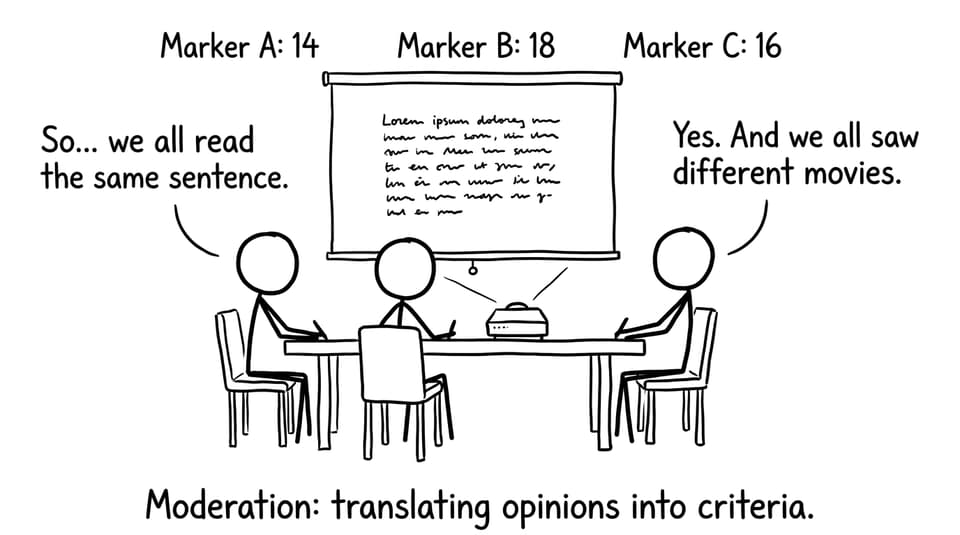
In a strong IB department, moderation is not an emergency meeting. It is a routine. Teachers compare anonymised samples, talk through borderline decisions, and align on what evidence earns which band.
In a weaker system, moderation becomes a scramble: a few rushed checks right before submission, minimal documentation, and inconsistent standards between classes.
As a student, you cannot control the department. But you can ask better questions:
-
"Which criterion limited my mark the most?"
-
"What evidence would move this up one band?"
-
"Can you point to the descriptor that matches your decision?"
These questions pull the discussion away from vibes and back toward criteria, which is exactly what fair IB internal grading requires.
How data makes internal grading fairer (without turning it cold)
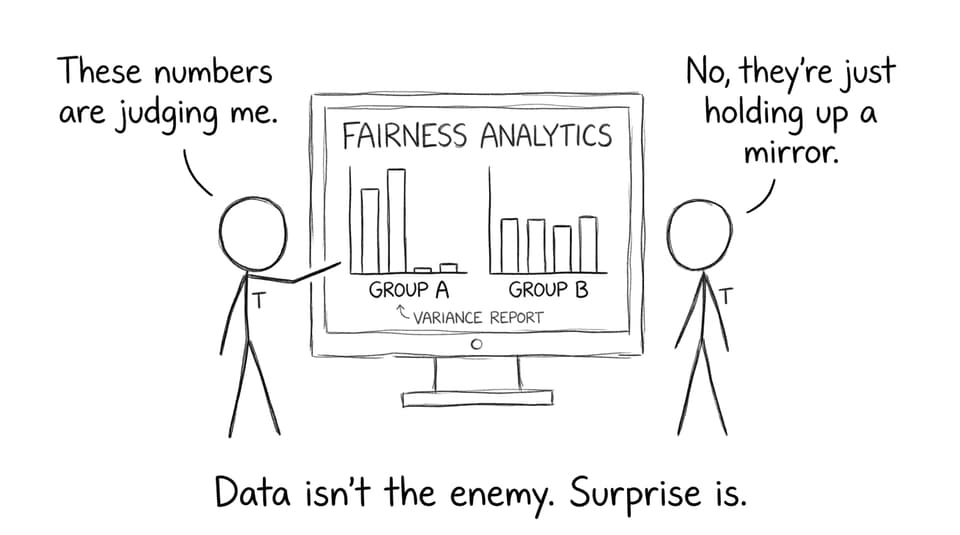
Data does not replace professional judgement. It checks whether judgement is consistent.
When a department reviews distributions and differences between markers, bias becomes visible. Not as a personal attack, but as a pattern to investigate.
Useful fairness checks include:
-
score spread by criterion (are some criteria consistently under-marked?)
-
differences between first marker and second marker
-
changes over time (is the cohort being marked more harshly later in the year?)
This is where platforms can help. For schools, RevisionDojo for Schools supports shared rubrics, moderation workflows, and reporting that makes consistency easier to prove.
For students, RevisionDojo’s ecosystem also reduces grading confusion because it keeps feedback looped and specific: practice your weak skills in the Questionbank, clarify concepts in Study Notes, retain them with Flashcards, and use AI Chat to translate confusing feedback into concrete edits.
If you want a good overview of how those pieces fit together for IB exam prep, see:
What you can do as an IB student when internal grading feels unfair
Fairness improves when your work becomes easier to mark consistently.
Here are student-side moves that reduce ambiguity and protect you from subjective interpretation:
Make your evidence obvious
Markers are scanning for proof. Use clear headings, signposting, and explicit links between claim and evidence.
Write for the rubric, not the reader’s mood
A great paragraph can still lose marks if it does not meet the criterion. Keep checking whether each section earns something.
Build a second-opinion loop
Before submission, get criterion-based feedback. RevisionDojo’s IB Coursework Grader can help you see where your draft is thin, while your teacher sees the final version.
Keep exams moving while coursework is happening
Coursework stress often steals revision time. Use a structured loop so your IB exam prep does not collapse: IB: I Study All Day but Remember Nothing and IB: The Last 2 Weeks Before Exams (What Matters).
Conclusion: Fair IB internal grading is built, not wished for
Fairness in IB internal grading is not about perfect objectivity. It is about repeatable standards.
When teachers use rubrics consistently, moderate regularly, and check patterns with data, bias loses its hiding places. And when students write work that makes evidence easy to see, they make fairness easier to achieve.
If you want to feel more in control, build a clear feedback loop inside RevisionDojo: revise concepts with Study Notes, lock them in with Flashcards, sharpen exam technique in the Questionbank, ask targeted questions in AI Chat, and use Grading tools like the IB Coursework Grader to make your draft more criteria-proof. Fairness improves when your work becomes impossible to misunderstand; and that is a skill that carries straight into your IB exams.