Understanding why MYP Individuals and Societies matters beyond exams begins with a simple truth: adult life often requires decisions based on incomplete information. News reports conflict. Statistics need context. Policies create trade-offs. Communities disagree about what progress should mean.
MYP Individuals and Societies prepares you for that uncertainty. Through history, geography, economics, politics, sociology, and related disciplines, you learn to investigate questions, interpret evidence, understand perspectives, and make reasoned judgments. Those abilities can improve assessment performance, but their value lasts much longer than any test.
Specific facts may eventually fade. The habit of asking What is the evidence, whose perspective is missing, and what could happen next? can remain useful for life.
The value beyond the grade
The subject helps you learn to:
- distinguish supported claims from confident opinions
- examine the origin, purpose, value, and limitations of information
- explain causes, consequences, patterns, and change
- understand why people experience the same issue differently
- connect individual choices with wider social systems
- communicate conclusions with evidence and appropriate nuance
- revise your position when better evidence appears
These are practical tools for navigating media, relationships, communities, further education, and eventually the workplace.
You learn to question information intelligently
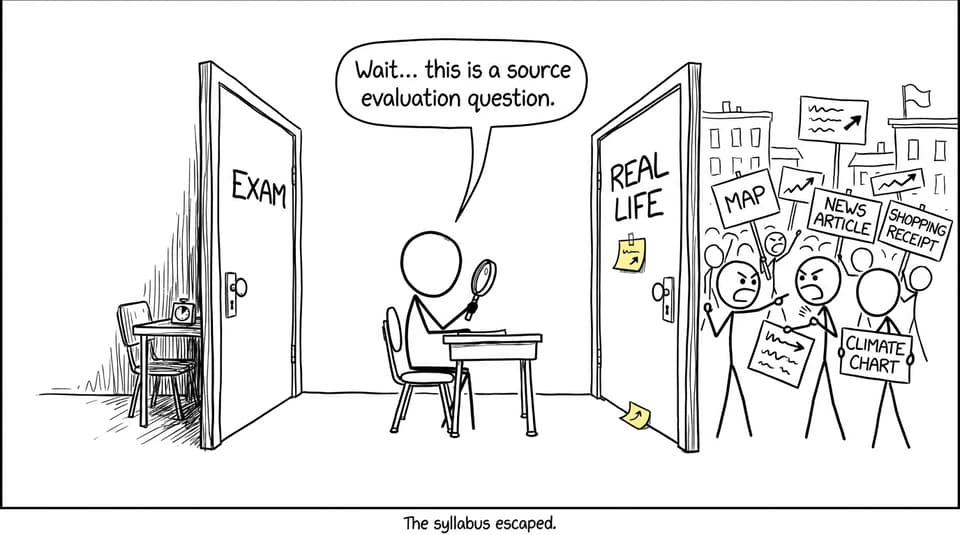
The internet makes information accessible but difficult to judge. A polished graph may hide a weak sample. A dramatic headline may simplify a complicated study. A historical account may describe one perspective accurately while overlooking another.
Individuals and Societies teaches a better response than immediate belief or automatic cynicism. You learn to ask who created the information, what purpose it serves, which evidence supports it, and whose perspective is absent. You also check whether another credible source confirms or complicates the claim.
This is critical thinking in practical form. It helps when researching an assignment, reading election coverage, watching a viral video, or assessing something shared in a group chat. The goal is calibrated trust: confidence that changes according to evidence quality.
Systems thinking makes complex problems clearer
Housing costs connect to wages, planning decisions, migration, transport, and public services. Climate decisions involve geography, energy, politics, consumption, technology, and inequality. Changing one part of either system may create consequences elsewhere.
Individuals and Societies offers different lenses for examining these relationships. History reveals how a situation developed. Geography shows how location and environment affect outcomes. Economics explains incentives and trade-offs. Politics highlights institutions, power, and decision-making.
No single lens explains everything. That is the lesson. The RevisionDojo guide to interdisciplinary learning shows how combining perspectives can produce stronger explanations. Instead of reducing an issue to one cause, you begin mapping interactions and unintended effects.
Perspective creates empathy without removing judgment
Understanding another perspective does not require agreeing with it. It means identifying the experiences, interests, and circumstances that make a position understandable to the person holding it.
Imagine a city proposing a new public transport route. Commuters may value shorter journeys. Residents may worry about noise. Businesses may expect more customers. Environmental groups may welcome reduced car use, while local government faces budget limits.
A weak response chooses one group and declares it correct. A stronger response compares evidence, recognizes trade-offs, and reaches a justified conclusion. This intellectual empathy matters in teamwork, leadership, citizenship, and disagreements with friends or family. The world needs people who can listen carefully without abandoning their capacity to judge.
Research becomes a repeatable method
School research can feel like collecting enough links for a bibliography. Good inquiry is different. It begins with a focused question and ends with an answer the available evidence can support.
In Individuals and Societies, you practise how to define a manageable question, plan the evidence needed, compare sources, recognize uncertainty, communicate a defensible conclusion, and reflect on possible improvements. That process transfers naturally to the MYP Personal Project, later IB study, university research, and workplace problem-solving.
The MYP ATL skills guide explains how research, thinking, communication, and self-management support independent learning. RevisionDojo’s guide to using real-world case studies in MYP can also help you organize an investigation around context, evidence, concepts, and judgment.
Clear writing strengthens clear thinking
An argument may feel convincing in your head and collapse when written down. That is not failure. Writing reveals the missing links between claim and evidence.
MYP Individuals and Societies asks you to explain rather than merely state. Instead of writing “urbanisation creates problems,” you identify which problems, for whom, through what mechanism, and under which conditions. Words such as because, however, and therefore make your reasoning visible.
That ability transfers to presentations, applications, proposals, and difficult conversations. RevisionDojo’s guide to common MYP Geography and History response errors can help identify where explanations become vague or unsupported.
Relevance can restore motivation
MYP Individuals and Societies motivation often falls when revision becomes a pile of disconnected definitions. It improves when each topic reconnects to a human choice.
Do not study migration only as terminology. Ask why people move, who benefits, and which policies might respond fairly. Do not study empires only as timelines. Ask how power was maintained, whose accounts survived, and how earlier decisions still shape societies.
The Orientation in Space and Time guide demonstrates how movement, place, identity, and change make history meaningful. The MYP Individuals and Societies resource hub organizes support around major topics and concepts.
Turn the subject into a weekly practice
RevisionDojo brings understanding, recall, application, and feedback together. Study Notes can clarify a difficult idea, Flashcards strengthen retrieval, and the Questionbank develops application. AI Chat can challenge an explanation, while Grading tools help you compare work with criterion-based expectations.
The platform also offers Mock Exams, Predicted Papers, a Coursework Library, and Tutors for students who need structured or individual support. These tools should develop your judgment, not replace it.
Try one short practice today: choose an issue, write a focused question, compare two credible sources, record one limitation for each, and produce a four-sentence judgment. Use the RevisionDojo MYP Individuals and Societies review loop to decide what to practise next.
That routine captures why the subject matters. You are learning to meet a complicated world with curiosity, evidence, empathy, and enough humility to change your mind.