
History becomes unforgettable the moment it stops being “the past” and starts being a receipt.
You see it when a border dispute turns into a headline. When your family story contains a migration route. When a scientific discovery changes what a whole generation believes is possible. In MYP, the Global Context Orientation in Space and Time exists for that exact moment: it helps you read the present with the help of the past.
And if you’re an IB student preparing for exams, here’s the good news: learning to think in MYP “space and time” isn’t just interesting. It’s practical. It’s how you turn a paragraph of facts into analysis that earns marks.
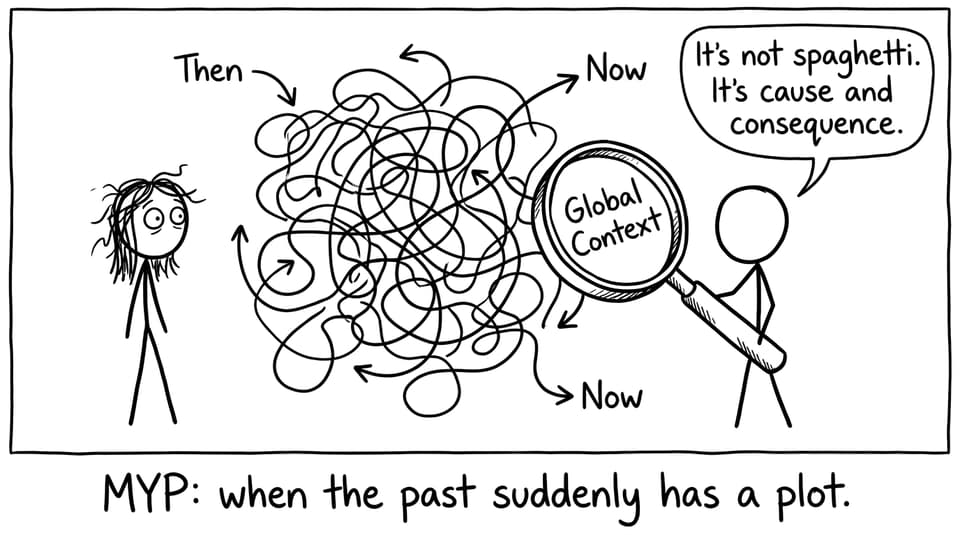
A quick MYP checklist: are you really using Orientation in Space and Time?
Use this before you write a response, design a project, or revise a unit in MYP:
-
Can you name a turning point (something changes)?
-
Can you explain cause and consequence (why it changed, what it led to)?
-
Can you show continuity (what stayed the same)?
-
Can you connect place (geography, environment, location) to decisions and outcomes?
-
Can you add perspective (how different groups experienced it differently)?
If you can do those five things, you’re not memorising history. You’re doing MYP history.
For a broader overview of how Global Contexts shape units across subjects, bookmark: Six Global Contexts in IB MYP: Real-World Applications.
What “Orientation in Space and Time” means in MYP (in plain language)
In MYP, Orientation in Space and Time is the lens for:
-
personal histories and heritage
-
migration, exploration, and exchange
-
how societies change over time
-
relationships between people, place, and time
The guiding question behind it is essentially: What is the meaning of where and when?
That question sounds philosophical, but it becomes very concrete in assessments. Examiners reward students who can show that events sit inside patterns: long-term trends, turning points, geographic constraints, and competing perspectives.
If you want the clean “unit planning” version of this idea (Global Context, key concept, related concept, statement of inquiry), this is a strong reference point: MYP Global Contexts: Concept-Driven Teaching That Sticks.
Why this Global Context matters for MYP exams
There’s a quiet trap in MYP humanities revision: students collect examples like souvenirs. Dates, names, treaties, locations. It feels productive. But it often produces answers that are busy rather than sharp.
Orientation in Space and Time solves that by giving your knowledge a job.
When you revise through this lens, you naturally write the kinds of sentences that score:
-
“This mattered because…” (significance)
-
“A key turning point was…” (change over time)
-
“From the perspective of…, the outcome looked different…” (perspectives)
-
“Geography shaped this because…” (place and constraints)
If you struggle to organise those points under timed conditions, use this structure guide: How to Structure High-Scoring MYP Individuals & Societies Essays.
How to apply Orientation in Space and Time across subjects in MYP
This is where MYP becomes surprisingly powerful: the same lens works across the timetable.
Individuals and Societies: the natural home of MYP space and time
In Individuals and Societies, Orientation in Space and Time is almost a cheat code for relevance.
Try framing revision topics as “movement + meaning”:
-
migration routes and identity shifts
-
exploration, trade, and unequal outcomes
-
urbanisation and changing social structures
Then practise turning that into exam writing. A good place to build both content and technique is the MYP Individuals & Societies Resources hub.
If you’re revising a topic like population change or urbanisation, you can go deeper with a chapter-focused page such as Urban Systems and Sustainable Management.
Language and Literature: time travel through voice
In MYP language courses, Orientation in Space and Time shows up when you ask: How does context shape voice?
You can revise by:
-
comparing speeches from different eras to track changes in rhetoric
-
analysing narration as a product of time, place, and social norms
-
writing from a historical viewpoint to practise perspective and empathy
If you want a central starting point for skills and texts, use: MYP English Lang & Lit.
Sciences: discoveries have a timeline too
Science can look timeless in a textbook, but in MYP it becomes richer when you notice the human story underneath.
Good “space and time” angles include:
-
how scientific models change when new evidence appears
-
how technology shifts what humans can observe
-
how environmental change is tracked across long timescales
A fun example that literally connects space, time, and evidence is cosmology. If that’s on your course, revise it with: The Big Bang theory Notes.
For strategy (not just content) in science revision, this is worth reading: How to Revise for MYP Sciences Without Memorising Everything.
Arts: memory, heritage, and changing meaning
Art captures time the way a timeline can’t: it stores mood, identity, and cultural change.
In MYP, you can connect Orientation in Space and Time by:
-
tracking how art movements respond to social change
-
analysing how migration and heritage appear in motifs
-
creating visual timelines that show evolution of style and message
A simple MYP workflow to revise “space and time” without drowning in content
Here’s a revision loop that works because it respects how MYP marks are earned:
-
Study Notes to rebuild understanding fast
-
Flashcards to keep key terms, concepts, and examples active
-
Questionbank to practise application under exam conditions
-
AI Chat to challenge your explanations and fix vague reasoning
RevisionDojo is built around that loop. Start from the MYP hub, then use topic pages and practice tools to stay targeted.
If you’re planning the final month before on-screen exams, this guide is built for that pressure: MYP eAssessments: 30-Day Study Plan That Works.
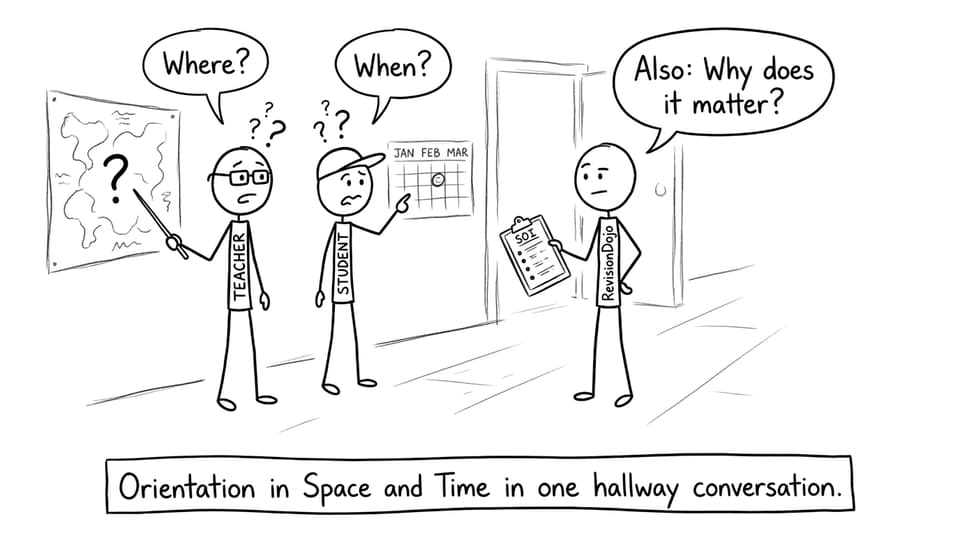
Build a strong Statement of Inquiry (SOI) with MYP space and time
If your unit or project needs a Statement of Inquiry, try this formula:
Change over time + place matters + perspectives differ
Examples you can adapt:
-
“Movement across space and time shapes identity and cultural exchange.”
-
“Turning points create new systems, but the consequences are experienced unevenly.”
-
“Geography influences decisions, and decisions reshape places over time.”
If you’re doing the Personal Project, the Global Context must show up in what you research, create, and reflect on. This breakdown helps you choose and justify it cleanly: MYP Personal Project Global Contexts Explained.
Closing: make MYP history feel like yours
Orientation in Space and Time is the MYP reminder that history is not a museum. It’s a map of how people made choices under constraints, how those choices reshaped places, and how consequences echo forward.
If you want that lens to turn into exam marks, build a routine where knowledge becomes arguments: revise with Study Notes, practise with the Questionbank, lock in key language with Flashcards, and pressure-test your explanations with AI Chat. Then bring it together with timed practice using Mock Exams and Predicted Papers, and use Grading tools and the Coursework Library when your work needs criteria-level polish.
Start from the RevisionDojo MYP hub and make your next revision session feel less like memorising and more like understanding where you are in space and time -- and why it matters.
