


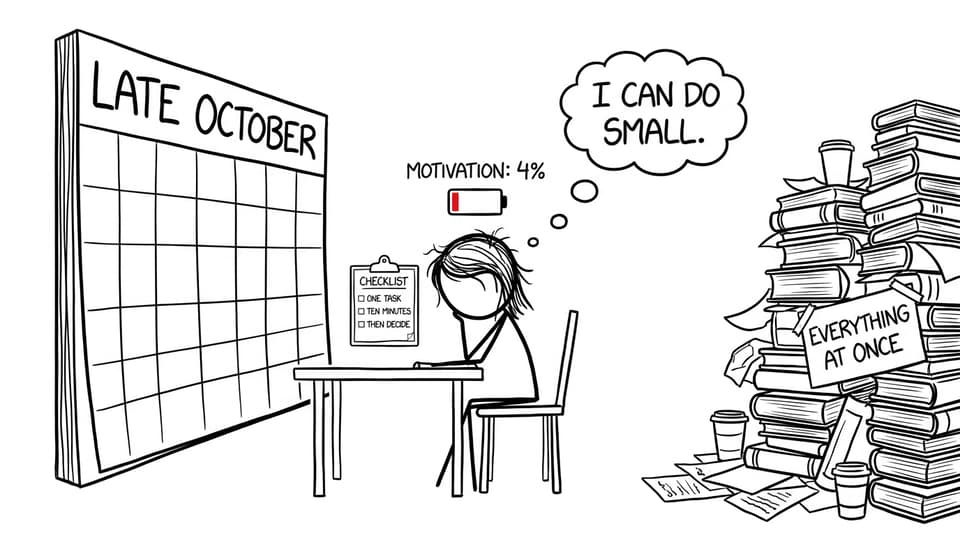
Late October can feel strangely heavy. The excitement of September has faded, assignments are accumulating, and winter break remains too distant to offer much comfort. If motivation drops late October, do not wait to feel inspired again. Reduce the next step, protect your energy, and rebuild momentum through short, measurable work.
This period does not mean you are failing at the IB. More often, it means the routine that worked in September no longer suits your workload. The goal is not to recover beginning-of-term enthusiasm. It is to build a calmer system that works when enthusiasm is absent.
Your late-October reset checklist
Before redesigning your timetable, try this:
- Choose one subject and one precise task.
- Work for 20-25 focused minutes.
- Use active recall or questions instead of passive rereading.
- Record one result, such as questions completed or errors corrected.
- Take a genuine break away from your screen.
- Decide tomorrow's first task before stopping.
- Tell someone if low mood or exhaustion becomes persistent.
This is deliberately modest. When your capacity feels low, an ambitious plan can become another reason not to begin.
Understand why late October feels different
September is powered by novelty. New teachers, fresh folders, and clean calendars make effort feel like progress. By late October, the work is repetitive while rewards still feel distant.
IB students may also balance subject tests, internal assessment planning, CAS commitments, extended writing, and ordinary life. Each responsibility may be manageable alone. Together, they create decision fatigue and too few clear starting points.
This distinction matters. Laziness appears to demand discipline. Overload demands prioritisation.
Spend five minutes separating your responsibilities into three groups:
- Urgent: work with a real deadline in the next seven days
- Important: topics or coursework that need steady progress
- Optional: tasks that feel productive but can wait
Make the work smaller than the resistance
When a task feels enormous, your brain starts negotiating. You clean your desk, reorganise files, or search for a better revision method. These activities may be useful, but they can also protect you from starting.
Replace broad instructions with observable actions:
- Change “revise Biology” to “answer eight cell respiration questions.”
- Change “work on English” to “write one thesis and two topic sentences.”
- Change “finish my IA” to “check the labels on three graphs.”
- Change “study Mathematics” to “correct yesterday's three weakest answers.”
RevisionDojo's IB Questionbank and study resources make this easier because you can move from a vague goal to focused practice. On a low-energy evening, a small Questionbank set is more approachable than an undefined revision session.
The first task should almost feel too easy. Starting reveals whether you are genuinely exhausted, confused about the topic, or simply reluctant to begin. Each problem requires a different response.
Use a minimum viable study day
Not every day should carry the same workload. A sustainable fall-term routine includes high-focus days, ordinary days, and maintenance days.
On a maintenance day, try this 30-minute loop:
- 7 minutes of Flashcards
- 15 minutes of targeted questions
- 5 minutes reviewing mistakes
- 3 minutes choosing the next action
That session will not solve the semester. It does something more useful: it prevents one difficult day from becoming a week of avoidance.
When energy returns, extend the loop. Use Study Notes to clarify one narrow concept, practise it in the Questionbank, and use AI Chat when a misunderstanding blocks progress. The sequence matters: learn briefly, attempt something, inspect the result, and correct it. The guide to staying motivated without burning out provides a broader routine.
Protect your IB well-being during the fall term
Sometimes motivation is a planning problem. Sometimes it is an energy problem wearing a planning costume.
Begin with the basics you are most tempted to sacrifice. Keep a consistent stopping time, eat before demanding study sessions, move during breaks, and protect sleep rather than treating it as leftover time. The IB healthy study habits guide can help you balance work and recovery.
Distinguish ordinary resistance from sustained distress. A few unmotivated evenings are common. Persistent hopelessness, major sleep changes, regular tearfulness, panic, or losing interest in nearly everything deserves attention. Speak with a parent, teacher, school counsellor, doctor, or another trusted adult. Productivity advice should never hide a well-being problem.
If you are experiencing exhaustion and emotional detachment rather than simple procrastination, learn more about IB burnout and recovery.
Replace motivation with visible feedback
Motivation often follows evidence rather than preceding it. Completing six questions, correcting one paragraph, or finally understanding a difficult process gives your brain proof that effort is going somewhere.
Create a simple feedback loop:
- Attempt a small task without excessive preparation.
- Check the result.
- Identify one content gap or technique error.
- Fix that specific weakness.
- Retest it within a few days.
Active practice often feels more energising than endless rereading because it produces an outcome. Explore why IB motivation comes and goes for further guidance.
RevisionDojo keeps this loop in one place. Study Notes provide clarity, Flashcards maintain recall, the Questionbank turns knowledge into performance, and AI Chat unblocks confusion. Grading tools and the Coursework Library make feedback concrete. Predicted Papers and Mock Exams support timed practice, while Tutors offer human guidance and accountability.
Build a realistic bridge to November
Plan the next seven days, not the entire school year. Choose three academic priorities, schedule 2-3 demanding sessions when your concentration is strongest, and protect one block for genuine rest.
Use the guides to staying sane during the IB and building lasting IB motivation when you need more structure.
Progress may look quiet: one question set, one corrected paragraph, or one sensible early night. You do not need full motivation before moving forward. Start with one topic and complete one feedback loop. RevisionDojo gives you the connected learning, practice, coursework support, and guidance to keep rebuilding momentum.