

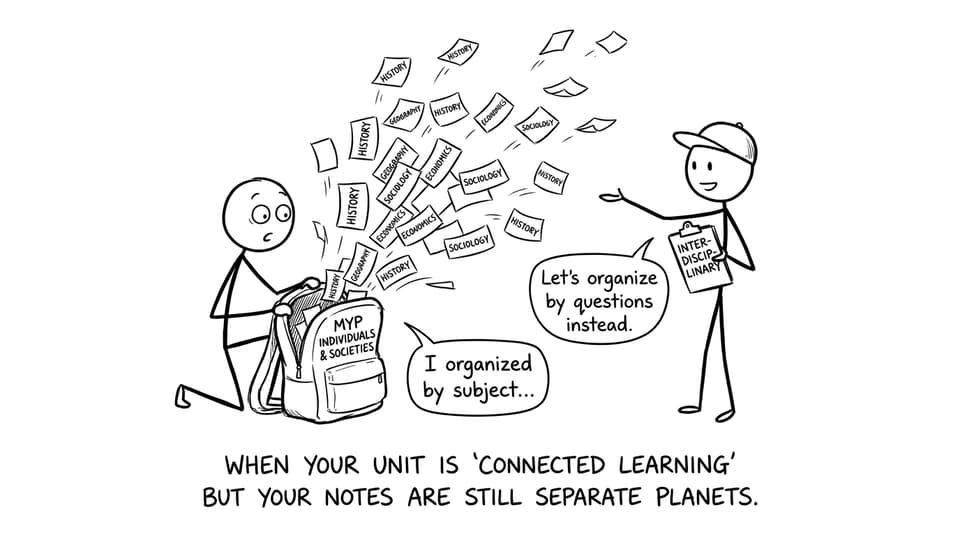
If you’ve ever revised Individuals and Societies by making four piles of notes -- history here, geography there, economics somewhere else -- you’ve already felt the problem.
The real world doesn’t arrive in neat folders. A protest is politics and identity. A drought is geography and development. A trade war is economics and power.
That’s why the MYP treats Individuals and Societies as a place to practise interdisciplinary learning: not “learning more topics,” but learning how to connect ideas, evidence, and perspectives until they actually explain something.
Revision for exams becomes calmer when you see the course this way. You stop memorizing disconnected facts and start building reusable thinking.
Individuals and Societies in MYP (what it really is)
In the MYP, Individuals and Societies is essentially the IB’s social sciences space. Schools can shape it in different ways, but it usually draws from:
-
History
-
Geography
-
Economics
-
Political science
-
Sociology
-
Anthropology
The point isn’t to become a mini-expert in every field. The point is to understand how societies work, how people make decisions inside systems, and how evidence can support a clear argument.
If you need a quick home base for topics, lessons, and practice, start with the MYP Individuals & Societies Resources hub.
A quick exam-focused checklist for interdisciplinary learning
Use this before a timed response, project, or revision session in MYP Individuals and Societies:
-
Can I name the concept driving the question (change, systems, power, identity, etc.)?
-
Which two disciplines are most useful here (history + economics, geography + politics, etc.)?
-
What evidence will I use (a statistic, a policy, a map pattern, a specific event)?
-
What perspective could challenge my first idea?
-
Which MYP criteria am I being marked on (A--D), and what will the marker see?
That last bullet is the difference between “good notes” and “good marks.”
What interdisciplinary learning means in MYP (in exam terms)
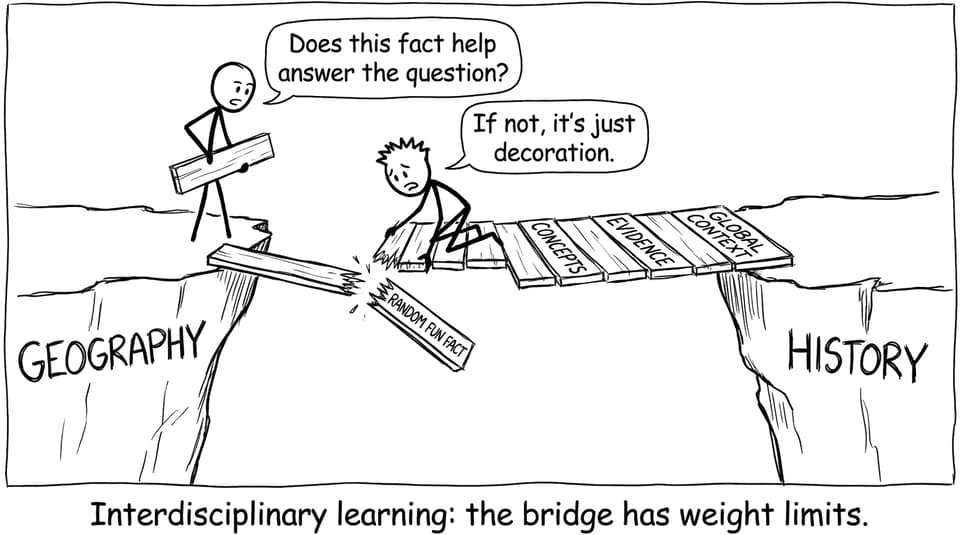
Interdisciplinary learning in MYP is not just mentioning two subjects in the same paragraph. It’s showing that combining lenses produces a better answer than using only one.
Think of it like this:
-
History helps you explain change over time and causation.
-
Geography helps you explain space, environment, and human patterns.
-
Economics helps you explain incentives, trade-offs, and development.
-
Sociology helps you explain group behaviour, identity, and norms.
When an exam question asks you to analyse inequality, migration, conflict, or sustainability, it’s almost always begging for more than one lens.
For targeted guidance on how the IB designs interdisciplinary tasks, read MYP Interdisciplinary Assessment: Criteria, Tips, Examples and borrow the phrasing patterns for synthesis.
The inquiry cycle: how MYP turns “content” into thinking
Most MYP Individuals and Societies units follow a rhythm that looks simple but is quietly powerful:
Ask
You start with a question that can’t be answered by a definition. Example: How does urbanization change quality of life?
Research
You collect sources: maps, graphs, case evidence, historical accounts, policy summaries.
Analyse
You look for patterns, causes, consequences, and competing explanations.
Communicate
You turn the messy thinking into something readable: a structured response, a debate, a report.
Reflect
You evaluate what your evidence can prove, what it cannot, and how your perspective changed.
If you want this cycle to feel more “exam-like,” practise it with timed prompts in the MYP Individuals & Societies Specialisation Questionbank, then use RevisionDojo’s AI Chat to pressure-test your reasoning (not just your memory).
Key concepts and global contexts (your fastest revision shortcut)
A common MYP revision mistake is revising by chapter title only. A faster method is revising by concept + global context, because that’s how units actually connect.
Key concepts you’ll meet again and again:
-
Change
-
Systems
-
Power
-
Time, place, and space
-
Identity
Global contexts help you anchor those concepts in real issues:
-
Fairness and development
-
Globalization and sustainability
-
Orientation in space and time
Try this in revision: pick one concept (like systems) and one context (like globalization and sustainability). Then build a one-page “connection map” using examples from multiple units. Your brain starts storing knowledge in a way that matches how exam questions are written.
For vocabulary that makes your writing sound precise under pressure, use the MYP Individuals & Societies Key Definitions.
How assessment works in MYP Individuals and Societies
In the MYP, assessment is criteria-based. You’re not competing against classmates -- you’re showing evidence of skill.
Individuals and Societies typically uses four criteria, each scored 0--8:
-
Criterion A: Knowing and Understanding
-
Criterion B: Investigating
-
Criterion C: Communicating
-
Criterion D: Thinking Critically
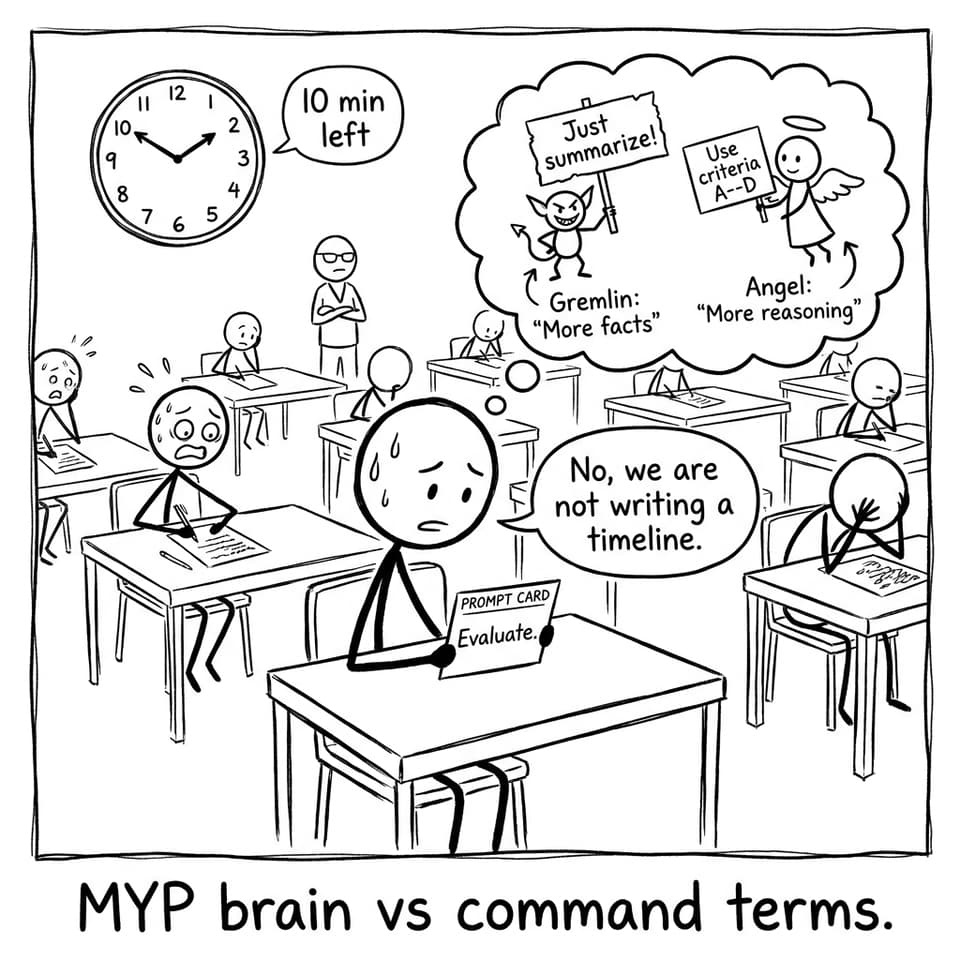
Where students lose marks: they treat Criterion A (knowledge) like it’s the whole grade.
Where students gain marks: they use knowledge to do something -- investigate a claim, communicate a line of reasoning, or evaluate perspectives.
To make the criteria feel concrete, read MYP Individuals & Societies Criteria Explained: Score Higher, Stress Less and pair it with How Are MYP Students Graded? Criteria Explained.
How to revise MYP Individuals and Societies like an interdisciplinary student
Here’s a simple routine that matches MYP demands and exam reality:
Build an “example bank,” not an “example pile”
Choose a handful of flexible case studies (urbanization, trade, resource use, conflict, migration). For each, write:
-
the key concept it illustrates
-
one statistic or specific detail
-
two perspectives
-
one limitation of the evidence
This is exactly what RevisionDojo’s MYP Individuals & Societies Flashcards are great for: quick recall, then quick application.
Practise writing with structure
Use a repeatable paragraph pattern: Point -> Evidence -> Explanation -> Link back to the question.
If your responses drift, steal the structure from How to Structure High-Scoring MYP Individuals & Societies Essays.
Use tools the way examiners think
RevisionDojo works best when you match tools to criteria:
-
Study Notes for clean conceptual explanations (Criterion A)
-
Questionbank for targeted practice and feedback (Criteria B and D)
-
Flashcards for key terms and examples you can actually use (A and C)
-
AI Chat to challenge weak reasoning and fix vague claims (D)
-
Grading tools to see what your work looks like through rubric language (all criteria)
-
Mock Exams and Predicted Papers for timing and decision-making under pressure (all criteria)
-
Coursework Library for models of clarity and academic honesty
-
Tutors when you need a human to diagnose patterns and rebuild confidence
Even if your assessment isn’t called an “exam,” the skill is the same: make your thinking visible.
FAQ
Is Individuals and Societies in the MYP basically just memorizing facts?
In MYP, facts matter, but they are not the finish line. Marks come from what you do with knowledge: explaining cause and consequence, comparing perspectives, and making judgements with evidence. If you only list information, you often max out at a mid-level response because the thinking stays hidden. A strong answer uses a few accurate details and then pushes them into analysis. That’s why interdisciplinary learning helps so much: it gives you more than one way to interpret the same evidence. When you revise, practise turning a fact into a claim, then into a judgement.
How do I show interdisciplinary learning in an MYP exam-style response?
Start by choosing one main argument, then select evidence that fits it from more than one lens. For example, if the question is about migration, you might use a geography push-pull factor, an economic incentive, and a political policy response. The key is to connect them explicitly using synthesis language like “taken together,” “this suggests a tension,” or “a limitation of a single-lens explanation is…”. Interdisciplinary learning is visible when your explanation changes because you added another discipline, not when you simply name-drop subjects. Planning helps: write one sentence explaining why the disciplines belong together for this question. Then structure your paragraphs so each one advances the same argument.
What are the biggest mistakes students make with MYP criteria A--D in Individuals and Societies?
The most common mistake is over-investing in Criterion A and under-performing everywhere else. Students often believe that more case studies automatically equals more marks, but in MYP the marker rewards selection and relevance. Another frequent issue is Criterion C: students have good ideas but present them in an unstructured way, so the communication looks uncertain. For Criterion B, students sometimes research widely but forget to build a focused question, which makes investigation feel like collecting, not investigating. For Criterion D, the mistake is avoiding evaluation because it feels risky, then ending with a summary instead of a judgement. The fix is simple: practise one criterion at a time using the same topic, and let RevisionDojo’s Questionbank feedback guide what “top-band” actually looks like.
Closing: make MYP feel like the real world (and your exams)
The best thing about MYP Individuals and Societies is also the hardest part: it refuses to let you think in single-subject boxes.
Interdisciplinary learning trains you to notice systems, weigh perspectives, and build arguments that survive real questions. That’s exactly what exam success looks like when the timer starts and the prompt is unfamiliar.
If you want one place to turn interdisciplinary units into higher marks, start with MYP Individuals & Societies Resources, then run a loop: Study Notes -> Flashcards -> Questionbank practice -> AI Chat feedback -> Mock Exams. That’s how MYP revision becomes less about panic and more about control.


