
The first time you hear someone say, “IB Year 2 is where it gets real,” it usually lands like a warning. Not because you doubt them, but because you can already feel the calendar tightening. In the IB, difficulty isn’t just about harder content. It’s about more things mattering at once.
So which year of IB is harder? Most students will tell you Year 2. But the honest answer is more useful: Year 1 is harder to start, and Year 2 is harder to sustain.
This guide breaks down the real Year 1 vs Year 2 challenges, so you can plan like someone who intends to finish strong.
Quick overview: Year 1 vs Year 2 in the IB
Use this checklist to diagnose which “hard” you’re dealing with in the IB:
-
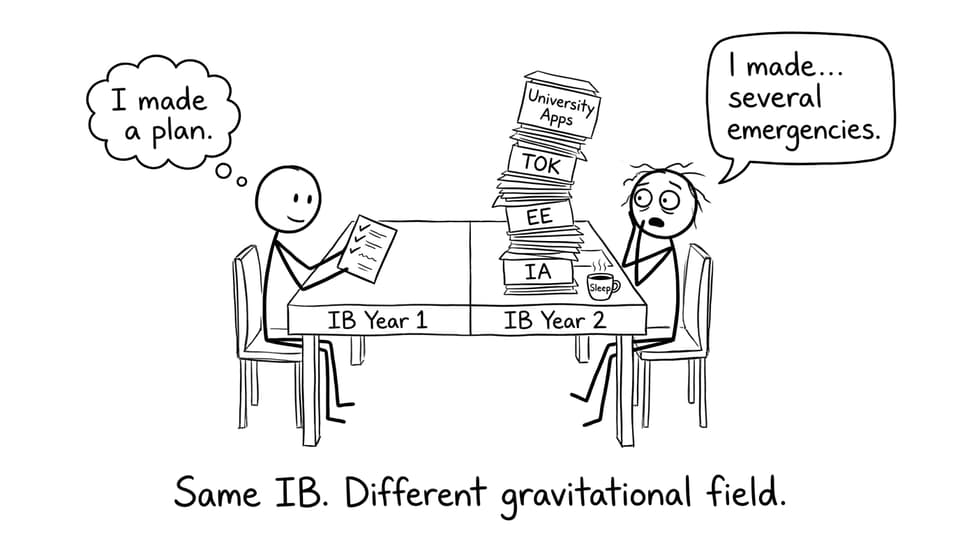
Year 1 feels hard because it’s new: new rubric language, new pacing, new standards, and the Core (TOK, EE, CAS) suddenly exists.
-
Year 2 feels hard because it’s stacked: exams, IAs, EE, TOK essay, and university applications overlap.
-
Year 1 rewards curiosity and consistency.
-
Year 2 rewards structure and ruthless prioritisation.
If you want a single toolset that supports both modes, start at RevisionDojo for IB and build your routine around Notes, Flashcards, Questionbank practice, and timed mocks.
Why IB Year 2 usually feels harder
In the IB, Year 2 is when the programme stops being a set of classes and becomes a single integrated performance.
Final exams become the main event in IB Year 2
In Year 2, your external assessments dominate your mental bandwidth. It’s not just “more revision.” It’s the reality that timing, exam technique, and markscheme logic matter as much as understanding.
A useful shift is to treat your revision like training, not studying. That means:
-
learning the content,
-
practicing exam questions under time,
-
reviewing mistakes for patterns,
-
repeating.
RevisionDojo was built for exactly this loop: use Study Notes for clarity, then apply it immediately with the Questionbank.
IB deadlines collide in Year 2
Year 2 is also where “one more thing” becomes the theme.
Most students face overlapping deadlines for:
-
multiple Internal Assessments (IAs),
-
the Extended Essay (EE) submission,
-
the TOK essay (and often the exhibition earlier),
-
final exam prep.
Even strong students feel stretched because these tasks aren’t interchangeable. You can’t revise for Chemistry the same way you draft an English commentary or refine an EE bibliography. The context switching is exhausting.
University applications add a second timeline
Many IB students apply to universities during Year 2. That brings personal statements, interviews, admissions testing (where relevant), and scholarship essays.
The pressure isn’t just time. It’s emotional: you’re working hard in the IB while also trying to prove you deserve what comes next.
Independence becomes non-negotiable
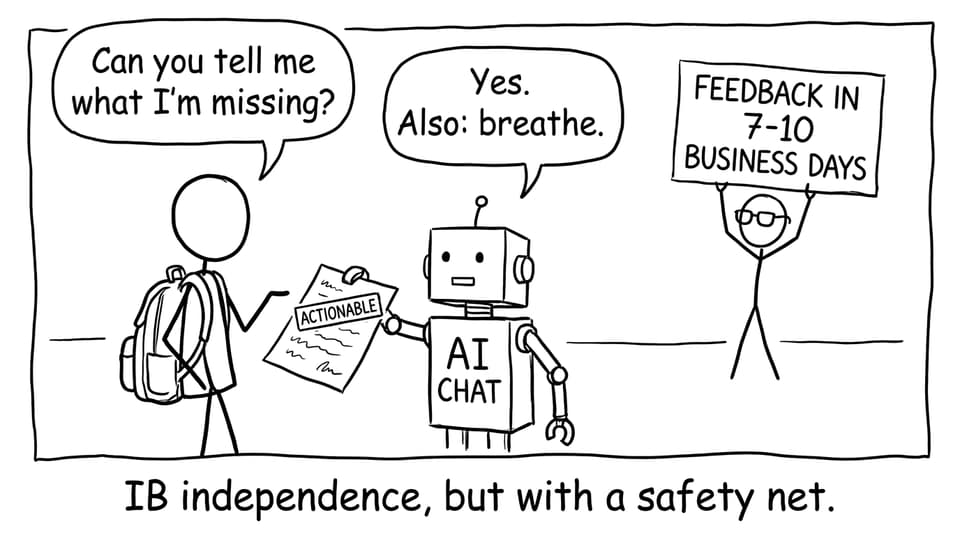
In Year 2, teachers often expect you to manage your own pacing. That’s not cruelty. It’s an implicit part of the IB: you’re supposed to demonstrate independent planning and sustained effort.
This is where support systems matter. RevisionDojo’s AI Chat can help you clarify concepts and refine explanations quickly, while Grading tools and feedback loops help you improve without waiting for the next class.
Why IB Year 1 can be quietly brutal
Year 1 isn’t usually heavier in deadlines. But it can feel harder because you’re learning how the IB thinks.
Adjustment shock: learning the IB “language”
Command terms, criteria, paper styles, and what counts as a “good answer” can feel unfamiliar at first. Plenty of students work hard in early Year 1 and still underperform because their effort isn’t aligned to the assessment.
A calm fix is to study the way you’ll be assessed. Use topic-aligned notes like Digital IB Study Notes: Access Anywhere, Anytime and translate reading into practice questions immediately.
Subject choices create future difficulty
Year 1 includes decisions that echo into Year 2: HL vs SL, workload balance, and whether your combination matches your strengths.
If you realise late that a subject is a poor fit, Year 2 becomes harder by default. The earlier you diagnose gaps, the cheaper they are to fix.
You start the Core before you understand it
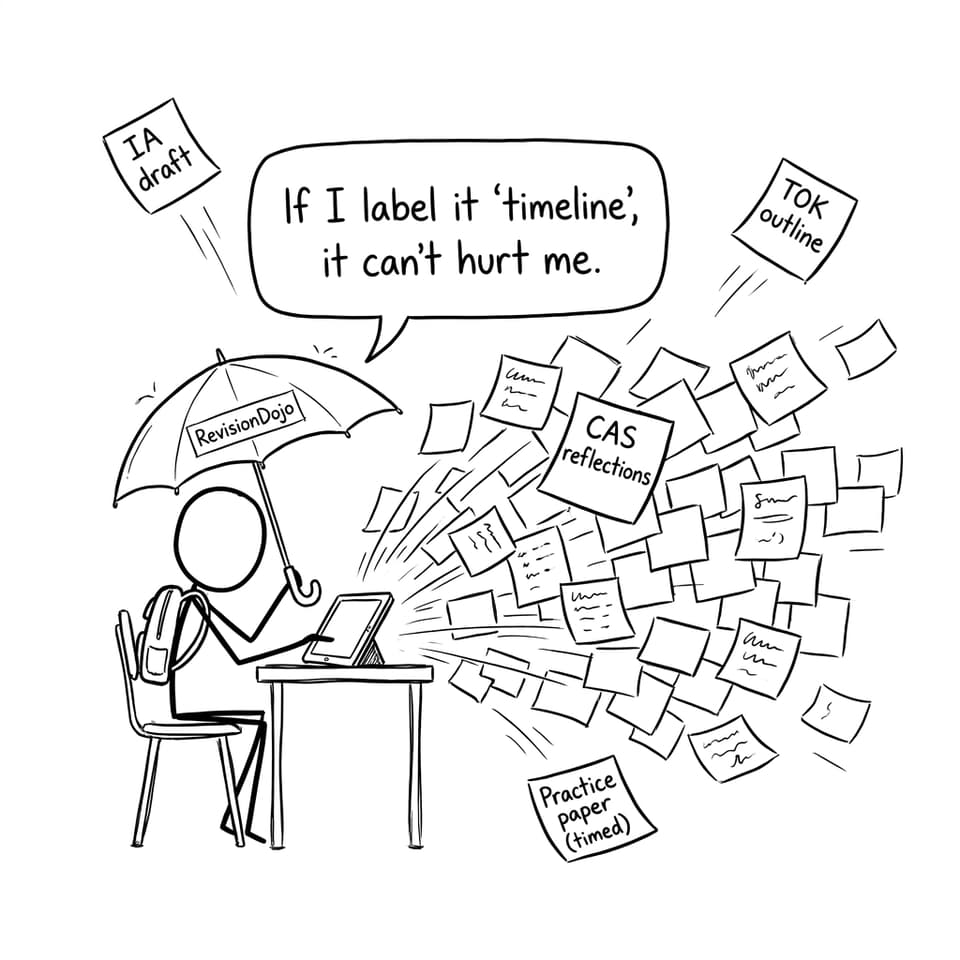
CAS, TOK, and the EE begin early, but they often feel abstract in Year 1. Students tend to “park” them until later. Then Year 2 arrives and the Core stops being theoretical.
A better approach is to draft early, lightly, and often. Small progress compounds.
Year 1 is where habits are built (or not)
The IB punishes last-minute bursts. It rewards small, repeatable systems: weekly review, spaced repetition, and frequent exam-style practice.
That’s why tools like IB Flashcards with Spaced Repetition (SRS) matter in Year 1. If recall becomes automatic early, Year 2 gets lighter.
The truth: what “harder” means in IB
Students argue about which year of IB is harder as if difficulty is a fixed number. But in practice, “hard” comes from different sources:
-
Year 1 hard = uncertainty + adaptation.
-
Year 2 hard = volume + consequence.
If you felt lost in Year 1, it’s normal. If you feel squeezed in Year 2, it’s also normal. The useful question is: what system reduces the friction right now?
A practical strategy for both IB years
In Year 1: build the base that Year 2 relies on
-
Use syllabus-aligned notes to avoid overstudying: IB Subject Note Collections
-
Turn content into active recall with Flashcards: IB Flashcard System
-
Start exam-style questions early: IB Question Bank: How to Use It Effectively
In Year 2: train under pressure, not just “revise”
-
Run timed rehearsals with predicted exams: IB Predicted Papers
-
Learn how to interpret these properly: IB Predicted vs Specimen Papers: What They Mean
-
Add structured group accountability if motivation dips: Collaborative IB Mock Exams
When your weeks are crowded, RevisionDojo’s ecosystem helps you keep one path: Study Notes to understand, Flashcards to remember, Questionbank to apply, Mock Exams and Predicted Papers to rehearse, AI Chat to get unstuck, and Tutors when you need a human to help you rebuild confidence.
Conclusion: Year 2 is harder, but Year 1 decides how hard
If you want the cleanest truth about the IB, it’s this: Year 2 is heavier, but Year 1 is the setup. Year 1 teaches you how the IB asks questions. Year 2 asks whether you can keep going when everything is due at once.
The good news is that difficulty isn’t destiny. With the right system, Notes for clarity, Flashcards for recall, Questionbank practice for technique, and timed rehearsal through Predicted Papers and Mock Exams, you can make the IB feel less like chaos and more like a plan.
Build your routine in one place: RevisionDojo.