




The first weeks of the IB Diploma can be misleading. September often looks manageable: a few assignments, some new terminology, perhaps an early quiz. By November, those separate commitments have begun to overlap.
To use a planner that fits the IB workload, you need one system that captures deadlines, converts them into small actions, and leaves room for the week to change. Start with a master calendar, plan one week at a time, and limit each day to a few concrete outcomes.
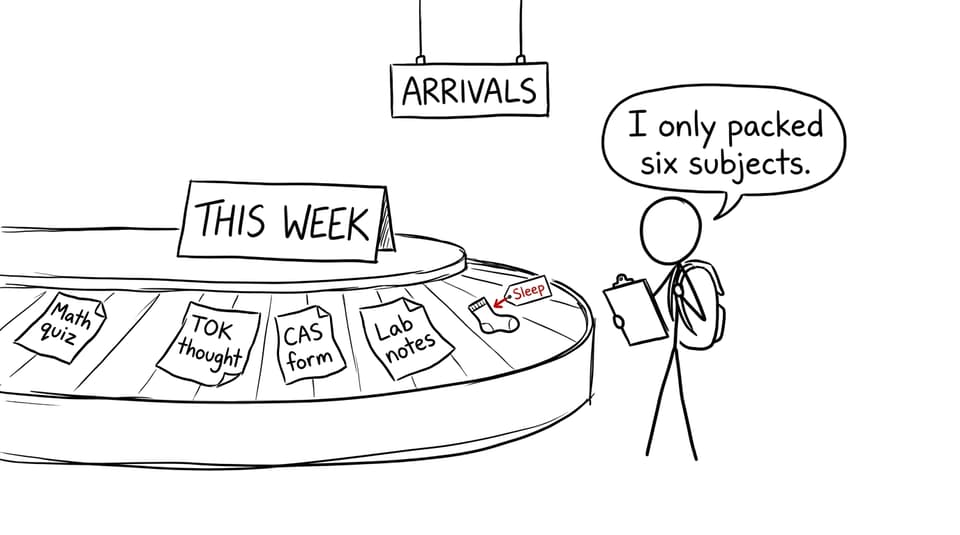
This matters because the Diploma Programme includes six subjects plus Theory of Knowledge (TOK), the extended essay (EE), Creativity, Activity, Service (CAS), and internally completed assessment work. A planner designed only for tomorrow's homework will eventually lose sight of that wider workload.
Your September-to-November planner checklist
Use this as the minimum viable system for your IB DP1 fall term:
- One master calendar containing every known academic and personal commitment
- One weekly planning session at the same time each week
- No more than three meaningful outcomes per day
- Time blocks attached to specific outputs
- One weekly block for TOK, EE, CAS, or future coursework
- Short recall and question practice alongside assigned homework
- Buffer space for tasks that take longer than expected
- A protected evening or substantial rest period each week
If your planner cannot show both deadlines and the work leading toward them, it is recording pressure rather than managing it.
Build three planning layers
A useful IB planner works at three distances. Each layer answers a different question.
| Planning layer | Question it answers | What belongs there |
|---|---|---|
| Term view | What is approaching? | Tests, submissions, school events, CAS commitments, travel, and core milestones |
| Weekly view | What matters now? | Priority subjects, preparation blocks, unfinished work, and one core action |
| Daily view | What will I finish? | One demanding task, one medium task, and one short task |
The term view prevents surprises
Enter every date your school has confirmed between September and November. Include draft deadlines, tests, school events, family plans, and CAS activities.
IB schools organize internal timelines differently, so your coordinator and teachers remain the source of truth. If a date is uncertain, add a reminder to ask for it rather than assuming it is months away.
The RevisionDojo IB Study Planner can create day-by-day subject plans around selected dates, topics, study days, and available minutes. It also lets you move unfinished work without rebuilding the entire plan.
The weekly view forces trade-offs
Once a week, look forward seven days and choose two or three priority subjects. Priority simply means those subjects deserve more attention because of a test, difficult topic, or approaching task.
Then add one core commitment. In early DP1, that might be a TOK reading, CAS reflection, or short piece of EE exploration if your school has introduced it. For a broader model, compare your plan with this balanced IB study schedule.
The daily view keeps ambition honest
A daily list containing 14 tasks is not a plan. It is an inventory of guilt. Choose three outcomes:
- Deep: complete a mathematics problem set and correct every error
- Medium: produce an outline for one English response
- Light: review biology Flashcards for 10-15 minutes
Write outputs rather than subjects. “Study chemistry” has no finish line. “Answer 12 stoichiometry questions and log mistakes” does.
Plan the IB DP1 fall term in phases
September, October, and November should not feel identical. A planner becomes useful when it responds to the changing purpose of the term.
September: measure before optimizing
Use your first month to record how long assignments take, when your concentration is strongest, and which subjects create the most follow-up work. Avoid copying an elaborate schedule from another student because their subjects, commute, activities, teachers, and energy patterns differ from yours. Begin with blocks of 25-50 minutes and adjust from evidence.
Build a simple learning loop. Use RevisionDojo Study Notes to clarify a concept, Flashcards to retrieve it, and the Questionbank to test whether you can apply it. The RevisionDojo guide for new DP1 students explains how to establish this rhythm without turning September into exam season.
October: identify recurring work
By October, patterns become visible. Recurring work deserves recurring calendar space. Create anchors for predictable tasks:
- Two focused blocks for your most demanding HL subjects
- Two or three 10-15 minute retrieval sessions
- One Questionbank session linked to the week's classroom topic
- One core or coursework maintenance block
- One buffer block that remains empty until needed
Feedback should also enter your planner. After a test, schedule correction before more content. RevisionDojo's Grading tools and AI Chat can help identify why an answer lost marks, while the IB question practice guide shows how to turn errors into targeted follow-up work.
November: protect capacity
November can compress the consequences of the previous two months as several subjects assess completed units while activities continue.
Do not respond by eliminating sleep and filling every weekend hour. Reduce optional tasks, shorten low-value note rewriting, and prioritize submitted work, upcoming assessments, and genuine knowledge gaps. Use these practical IB time-management techniques when the calendar feels crowded.
Full Mock Exams and Predicted Papers generally should not dominate the first DP1 term. Short timed sections on taught material can be useful, but the main objective is to build understanding and reliable habits.
Match each block to a study action
Time alone does not produce progress. A 45-minute box labelled “biology” can disappear into highlighting or reorganizing folders. Give every block a verb and an output:
- Understand: read one focused section of Study Notes and explain it without looking
- Recall: complete one Flashcards deck and flag weak items
- Apply: answer a targeted Questionbank set
- Diagnose: use AI Chat or Grading tools to inspect mistakes
- Draft: produce one paragraph, diagram, calculation, or source note
- Review: revisit errors after a delay
RevisionDojo keeps these actions connected. Its Coursework Library can reduce uncertainty when a task feels vague, while Tutors provide human diagnosis when repeated independent effort is not resolving the problem. For a repeatable structure, adapt this low-stress daily IB schedule.
Use a weekly reset instead of chasing perfection
Set aside 10-20 minutes at the end of each week. Ask what you completed, what moved, which subject needs more practice, what can be removed, and where you need buffer time.
Move incomplete work only if it still matters. A planner becomes dishonest when every unfinished task is carried forward indefinitely. Sometimes the right choice is to reduce the scope, ask a teacher for clarification, or delete a task that no longer serves a purpose.
The guide to staying organized with a full IB timetable offers a useful reset framework when your original schedule stops matching reality.
Make the planner serve the work
The best planner is not the prettiest one. It is the one you still trust on a difficult Thursday in November.
Keep one calendar, translate deadlines into visible next actions, and plan at less than your theoretical maximum. The remaining space allows your system to survive delays, fatigue, and unexpectedly difficult assignments.
RevisionDojo is the ultimate IB resource for turning planned blocks into focused work. Its Study Planner, Questionbank, Study Notes, Flashcards, AI Chat, Grading tools, Predicted Papers, Mock Exams, Coursework Library, and Tutors give each calendar block a clear next step. Your planner decides when to work. RevisionDojo helps you decide what to do when the block begins.