
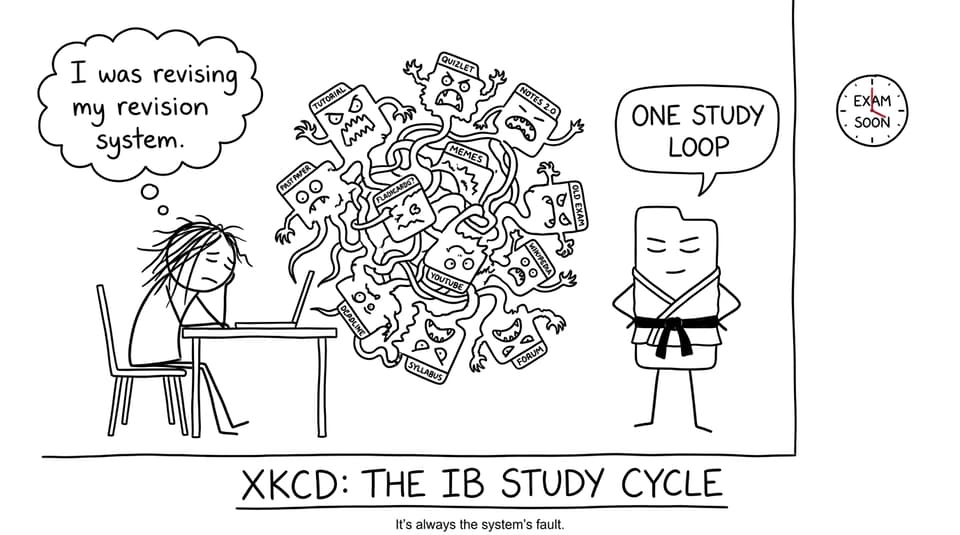
There is a peculiar kind of studying that feels productive without producing much evidence. Notes are highlighted. Videos are saved. Tabs multiply. Yet when an exam-style question appears, confidence disappears.
That is the problem RevisionDojo tries to solve. The short answer is yes: RevisionDojo is good for IB DP students who want one structured place to understand content, practise questions, receive feedback, and prepare under timed conditions. Its greatest value is not any single feature. It is the connection between Study Notes, Flashcards, the Questionbank, AI Chat, Grading tools, Predicted Papers, Mock Exams, the Coursework Library, and Tutors.
It is not a substitute for your teacher, current IB subject guide, or independent judgment. Used well, however, the RevisionDojo IB resource hub can reduce the distance between learning something and proving that you can use it.
RevisionDojo IB DP review at a glance
RevisionDojo is likely a strong fit if you want to:
- revise material organised around IB subjects and assessment demands
- separate Higher Level and Standard Level practice where relevant
- move quickly from explanation to active recall and application
- identify weak topics through question practice and feedback
- rehearse timing with Mock Exams and Predicted Papers
- improve coursework through criteria-aware feedback and exemplars
- keep several parts of DP preparation inside one study system
You should still check every resource against the current guidance supplied by your school. Syllabuses and assessment arrangements can change, while AI-generated feedback can be incomplete or mistaken. The platform works best as a responsive training environment, not an unquestionable source of truth.
Why an IB-specific platform matters
The Diploma Programme is difficult partly because it asks students to manage different kinds of thinking at once. The official DP curriculum contains six subject groups alongside the core of Theory of Knowledge, the Extended Essay, and Creativity, Activity, Service. Students normally study between three and four subjects at Higher Level, with the remaining subjects at Standard Level.
HL and SL are not merely labels for easy and difficult. The IB states that the two levels differ in scope, with HL students expected to demonstrate knowledge, understanding, and skills across a larger body of material. Both levels use the same grade descriptors, and each subject can award the same number of points.
That makes level-specific filtering important. A generic explanation may help you understand a concept, but effective exam preparation must reflect the depth, question formats, and syllabus content required at your level. RevisionDojo's IB exam-preparation app guide describes a workflow built around subject, topic, paper style, and HL or SL distinctions.
The platform also serves different DP subject groups in different ways:
| DP area | Particularly useful tools |
|---|---|
| Language and literature | Study Notes, essay feedback, command-term practice, Tutors |
| Language acquisition | Flashcards, vocabulary recall, AI Chat, oral preparation |
| Individuals and societies | Questionbank, essay marking, case-study review, timed practice |
| Sciences | Concept notes, diagrams, calculations, structured questions, Mock Exams |
| Mathematics | Worked explanations, targeted drills, error analysis, timed sets |
| The arts | Coursework guidance, exemplars, criteria-based feedback, Tutors |
| DP core | Coursework Library and Grading tools for EE and TOK development |
Coverage can vary by subject and feature, so students should inspect their exact course hub before committing their entire revision plan to it.
The strongest RevisionDojo features for exam preparation
Questionbank for turning knowledge into marks
Reading creates familiarity. Questions reveal whether that familiarity survives without the page in front of you.
The RevisionDojo Questionbank provides curriculum-aligned practice, mark schemes, AI-assisted grading, and options for tagging material for review. Topic filtering makes it useful early in revision, when a student may need to isolate equilibrium, cellular respiration, integration, or another narrow weakness.
Later, mixed-topic sets become more valuable because real examinations do not politely announce which mental method should be used. The important habit is to review why an answer lost marks. Was the problem missing knowledge, weak reasoning, an ignored command term, careless notation, or time pressure? Each cause needs a different remedy.
Study Notes and Flashcards for efficient recall
Good notes shorten the path to understanding. They should not become a comfortable hiding place from questions.
RevisionDojo offers subject collections organised by syllabus topic. Its overview of IB subject note collections explains how notes are framed around examination application rather than indiscriminate detail. This is especially useful when a textbook explanation is too broad for a quick revision session.
The next step should be retrieval. RevisionDojo's IB Flashcards with spaced repetition can support definitions, formulas, processes, quotations, vocabulary, and key examples. Keep each card narrow. If an answer requires an entire essay, it is not a flashcard; it is a small hostage situation.
Jojo AI Chat and grading feedback
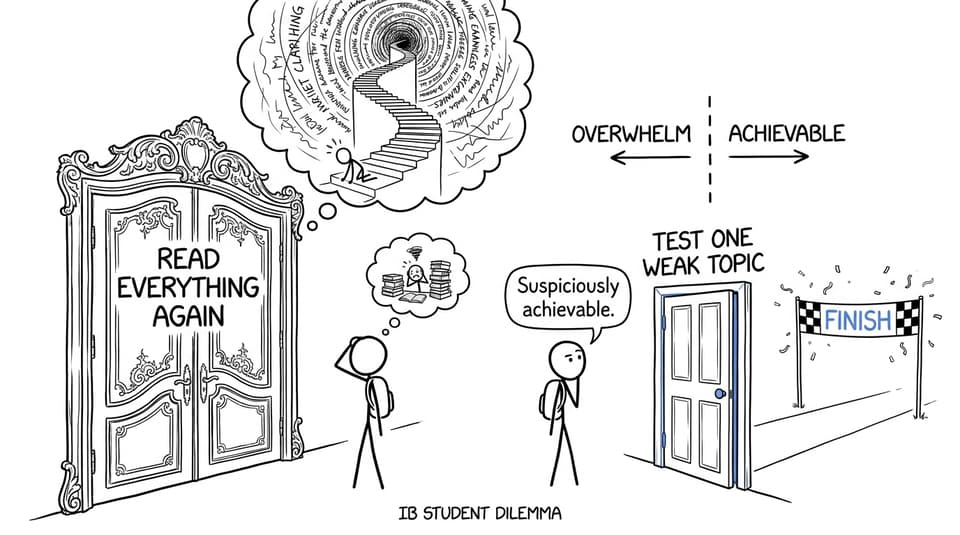
AI is most useful when it reduces the time between confusion and another honest attempt. Jojo AI Chat can explain concepts, break down mistakes, generate practice prompts, and discuss how command terms affect an answer. The guide to Jojo AI for IB students provides examples across SL and HL learning.
Use it with precise prompts. Instead of asking, “Teach me chemistry,” ask, “Explain why my equilibrium reasoning is incorrect, then give me one similar SL question without showing the answer.” Precision improves the usefulness of the response and keeps you intellectually involved.
The same caution applies to Grading tools. Rubric-aware comments can expose unclear analysis or missing evaluation, but AI feedback is advisory. Compare it with the current criteria, your teacher's instructions, and your own evidence. Never submit generated wording as your work.
Mock Exams and Predicted Papers
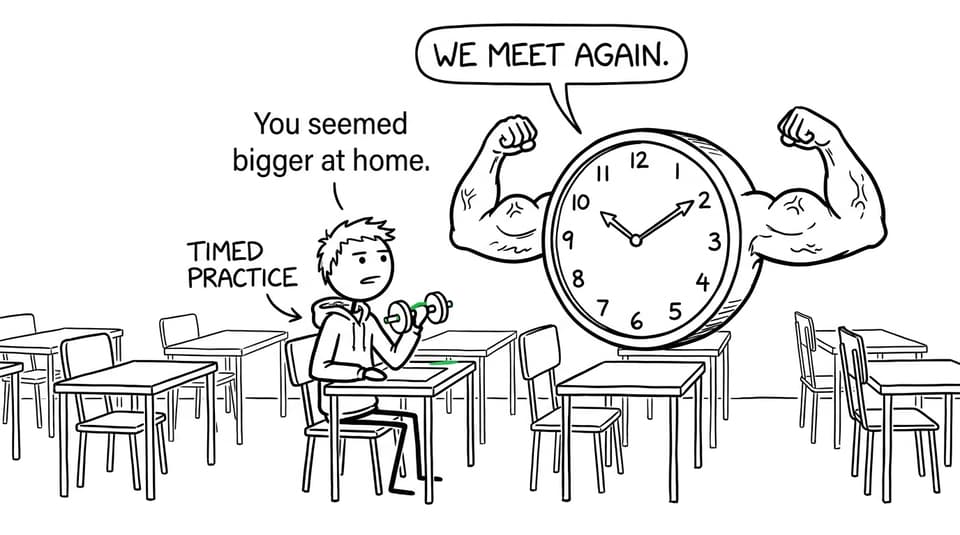
Students often postpone timed work until they feel ready. Unfortunately, readiness is partly created by timed work.
RevisionDojo's Mock Exams help students practise pacing, question selection, stamina, and recovery after getting stuck. Its IB Predicted Papers are designed as realistic practice material. They should be treated as simulations, not forecasts of exact examination content.
A useful progression is simple: begin with a timed topic set, move to a paper section, and eventually complete a full simulation under the rules relevant to that subject. Review should take at least as much care as the attempt. The score tells you where you are; the error analysis tells you what to do next.
Is RevisionDojo good for HL and SL students?
Yes, provided students select resources for their actual level rather than assuming all content is interchangeable.
SL students benefit from focused coverage that prevents unnecessary work beyond their syllabus. HL students need the opposite protection: enough depth, extension content, and complex application to avoid mistaking surface fluency for mastery. Filtering questions by level and topic can support both aims.
The difference becomes especially important in mathematics and sciences, where HL may introduce additional content or demand more involved reasoning. In essay-based subjects, HL can affect assessment components, expected depth, or the range of material used. Always begin with the current subject guide or information supplied by your teacher, then use RevisionDojo to practise those requirements.
What about coursework and the DP core?
Exam preparation cannot be separated neatly from coursework. An unfinished investigation or Extended Essay can consume the attention intended for revision.
RevisionDojo's Coursework Library gives students models for understanding structure and quality, while Grading tools provide criteria-aware feedback on drafts. Used ethically, exemplars answer questions such as: How is analysis organised? What makes evaluation specific? How does a strong section connect evidence to a conclusion?
The wrong approach is to imitate wording or outsource decisions. The right approach is to study the principles, return to your own research, and improve your reasoning. Tutors add a human layer when feedback is ambiguous, a method has gone wrong, or subject-specific judgment matters more than speed.
Where RevisionDojo has limitations
A fair answer to “is RevisionDojo good for IB?” needs boundaries.
First, no platform can know every instruction given by your school or teacher. Second, AI explanations and grading should be checked rather than accepted automatically. Third, predicted material cannot tell you exactly what will appear in an examination. Fourth, feature depth and availability may differ among subjects or access plans.
There is also a behavioural limitation. An all-in-one platform can still be used passively. Reading notes for three hours inside RevisionDojo is not automatically better than reading them elsewhere. Improvement comes from retrieval, application, feedback, and correction.
A practical weekly RevisionDojo workflow
A strong routine gives every tool one job:
- Three focused sessions: read Study Notes for one subtopic, then complete matching Questionbank practice.
- Daily short recall: use Flashcards for 10 to 15 minutes, prioritising difficult cards.
- One feedback session: review marked answers and write a short rule for each recurring error.
- One timed session: complete a Mock Exam section or Predicted Paper under realistic conditions.
- One weekly review: choose next week's topics using evidence from your mistakes.
- Coursework when necessary: use the Coursework Library and Grading tools for defined drafting goals, not endless polishing.
- Targeted support: ask AI Chat a precise question or consult a Tutor when the same problem persists.
This resembles the sustainable method in RevisionDojo's guide to studying for IB exams without burning out: understand, recall, apply, and review. The cycle is simple. Its power comes from repetition.
The verdict
RevisionDojo is a strong IB DP resource because it brings the major parts of preparation into one connected environment. It supports content review, active recall, question practice, feedback, coursework development, and timed rehearsal across HL and SL subjects.
Its value still depends on how you use it. Check requirements against official guidance. Treat AI as a coach rather than an authority. Spend more time answering and correcting than collecting resources.
The best study system is rarely the one with the most material. It is the one that helps you find the next weakness, practise it, and return a little stronger. Explore RevisionDojo's all-in-one IB tools and begin with one subject, one weak topic, and one honest attempt.