
Starting the Diploma Programme can feel like arriving halfway through a conversation. Older students speak in acronyms. Teachers mention internal assessments months before they are due. Someone confidently announces that sleep disappears in IB DP1, and nobody thinks to ask whether that is actually true.
Here is the useful answer: the IB is demanding, but many of the stories surrounding it exaggerate the difficulty or misunderstand where the difficulty comes from. Most students do not need extraordinary intelligence, perfect grades or a permanently empty social calendar. They need consistent routines, accurate feedback and the willingness to adjust.
These ten IB myths matter because beliefs shape behaviour. If you expect constant misery, every difficult week looks like proof. If you understand that struggle is information rather than failure, the first year of IB becomes much easier to navigate.
What new IB students should know first
The Diploma Programme combines six subjects with the core: theory of knowledge, creativity, activity, service and the extended essay. That sounds like an enormous list because, at first, every component occupies the same amount of space in your imagination.
In practice, the workload develops over time. Your immediate priorities are simpler:
- Learn what each subject assesses, not just what it teaches.
- Record deadlines in one reliable place.
- Review new material every week.
- Ask for help while a problem is still small.
- Protect sleep, exercise and time away from schoolwork.
A useful IB workload planner turns those principles into visible weekly decisions. You do not need to map the entire two-year programme today. You need to make the next seven days manageable.
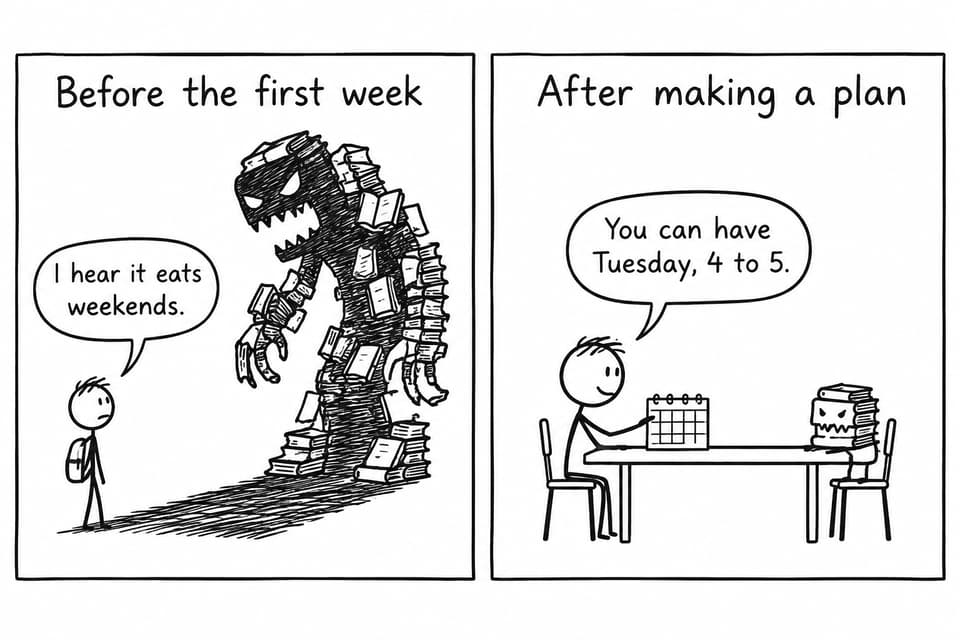
The workload often becomes less frightening once it has a specific place in your week.
Myth: You must be naturally brilliant to succeed
The IB rewards knowledge, but it also rewards learnable skills: interpreting command terms, selecting evidence, structuring arguments, showing calculations and evaluating limitations. A student who studies deliberately can outperform someone who understands quickly but practises inconsistently.
Do not ask, “Am I clever enough for IB?” Ask, “Which skill cost me marks, and how can I practise it?” That question creates somewhere to go.
Try this week: Choose one marked task. Identify one recurring weakness, such as vague analysis or incomplete working, and complete two short exercises focused only on that weakness.
Myth: IB DP1 takes away all your free time
There will be busy periods. There should not be permanent crisis. When every evening disappears, the cause is often unclear planning, inefficient revision, excessive perfectionism or several delayed tasks colliding.
Study time also varies by school, subject combination and season. RevisionDojo’s guide to studying outside class in DP1 offers a practical starting point, but your actual plan should reflect your timetable and current needs.
Try this week: Track how you spend three afternoons. Separate focused study from low-attention time spent switching between a document and your phone. Improve the pattern before adding more hours.
Myth: A bad first test predicts your final grade
Your first assessments measure performance at the beginning of a two-year course. They may expose unfamiliar question styles, weak prior knowledge or revision methods that no longer work. None of those findings is a verdict.
The dangerous response is not receiving a disappointing grade. It is hiding the paper, deciding you are “bad” at the subject and repeating the same preparation. Students adjusting to the programme can use this guide for new DP1 students to distinguish normal transition difficulties from problems requiring support.
Try this week: Sort every lost mark into knowledge, interpretation, technique or time management. Ask your teacher which category deserves attention first.
Myth: Rereading notes is enough revision
Rereading feels productive because familiar material becomes easier to recognise. Exams usually require something harder: retrieving an idea without seeing it, applying it in context and expressing it under time pressure.
Use notes to understand a topic, then close them. Explain the concept aloud, answer a question or create a small set of prompts. RevisionDojo’s comparison of flashcards and practice questions shows how the two methods serve different purposes.
Try this week: After each study session, spend five minutes writing what you remember on a blank page. Check it afterward and turn genuine gaps into Flashcards or Questionbank practice.
Myth: Every assignment directly determines your diploma score
Classwork matters because it develops knowledge and gives teachers evidence of progress. However, not every worksheet, quiz or presentation is an official assessment component. Your school may also use its own policies when calculating reports and predicted grades.
Ask what a task is for. Is it diagnostic practice, a school report assessment, preparation for coursework or part of an official component? The answer changes how you should allocate time, although it never makes careless work useful.
Try this week: Create a list of upcoming tasks and label each by purpose. If the status of one is unclear, ask your teacher rather than relying on rumours.
Myth: CAS is just a race to collect hours
Creativity, activity, service is not supposed to become a competition over who can log the largest number. Requirements and procedures should always be confirmed with your school’s CAS coordinator, but meaningful participation, reflection and evidence matter more than inventing impressive totals.
Choose experiences that fit your interests and schedule. A sustainable weekly activity is often more valuable than an elaborate project you cannot maintain.
Try this week: Write down one creative, active or service experience you would willingly continue even without CAS. Ask your coordinator whether it could meet your school’s expectations and how it should be documented.
Myth: You can forget the extended essay until DP2
You do not need a polished research question in your opening weeks. You should, however, begin noticing which subjects and questions hold your attention. Leaving every decision until late removes the thinking time that good research needs.
The opposite extreme is also unhelpful. Forcing a highly specific topic before you understand your subjects can produce a question with weak evidence or unsuitable methods.
Try this week: Keep a simple “possible questions” page. Add topics that genuinely interest you and note what evidence might exist. Exploration now prevents panic later.
Myth: Your internal assessment must change the world
An internal assessment is assessed against subject-specific criteria. It does not need to discover a new scientific law, resolve an international conflict or introduce an original branch of mathematics. Ambitious ideas can become difficult to control, measure or explain.
A focused question with accessible evidence is usually a better foundation than a spectacular idea with no workable method. Use a realistic term-by-term IA planner and study appropriately shared examples in RevisionDojo’s Coursework Library to understand structure without copying content.
Try this week: When an idea appears, test its feasibility. Ask whether you can obtain the evidence, apply an appropriate method and explain the limitations.
Myth: Reaching 24 points automatically guarantees the diploma
The familiar 24-point figure is only part of the passing criteria. Students must also satisfy minimum performance conditions and complete the core requirements. Theory of knowledge and the extended essay can contribute up to three additional points, while CAS must be completed but does not add numerical points.
Read a careful explanation of IB bonus points, then confirm current requirements with your coordinator. Do not build your strategy around a slogan overheard in a corridor.
Try this week: Learn how your six subjects and core components fit into the diploma. Understanding the system early makes later decisions calmer.
Myth: Strong students handle everything alone
Independence means taking responsibility, not refusing support. Teachers, coordinators, classmates and family members can all help you notice problems that are difficult to see from inside a stressful week. A Tutor may be useful for a specific obstacle, but needing one is neither inevitable nor embarrassing. This guide to succeeding in IB without a tutor can help you decide what support is appropriate.
Digital tools also require judgment. RevisionDojo’s AI Chat and Grading tools can explain concepts and provide feedback, but they should strengthen your thinking rather than replace it. Always follow your school’s academic integrity rules.
Try this week: Identify one question you have been avoiding. Bring it to a teacher, classmate or appropriate support tool within 48 hours.
A calmer way to begin the first year of IB
The hardest part of DP1 is often not the volume of work. It is uncertainty. You do not yet know which difficulties will pass, which habits will matter or how long unfamiliar tasks should take.
Structure reduces that uncertainty. RevisionDojo brings Study Notes, Flashcards, a Questionbank, AI Chat, Grading tools, Predicted Papers, Mock Exams, a Coursework Library and Tutors into one IB-focused resource. You do not need every feature at once. Begin with the tool that solves today’s problem, whether that is understanding a topic, practising retrieval or receiving feedback.
If your deadlines and routines are still scattered, create a free RevisionDojo account and download the free DP1 planner. Add your known dates, choose three priorities for this week and leave space for ordinary life. A good plan should not make every hour productive. It should stop every unfinished task from occupying every hour.