
When people talk about the EE, they usually talk about topics: the “perfect” research question, the “right” sources, the “cleanest” structure.
But examiners don’t mark topics. They mark criteria.
And in 2027, one part of the EE quietly became the single biggest lever you can pull: Criterion D (Discussion and evaluation), now worth 8 marks out of 30.
That sounds like a small change until you picture it in real life. You’re up late polishing the introduction for the third time. You’re formatting citations. You’re trying to make your body sections look impressive. Meanwhile, the highest-weighted EE criterion is asking a simpler question: Did you discuss what you found, support it with evidence, and evaluate how effective your essay really is, including strengths, weaknesses, limitations and all?
This post breaks down what Criterion D means in 2027, why it matters so much for your EE, and how to write it like someone who understands how marks actually move.
The 2027 answer: Which EE criterion is worth the most marks?
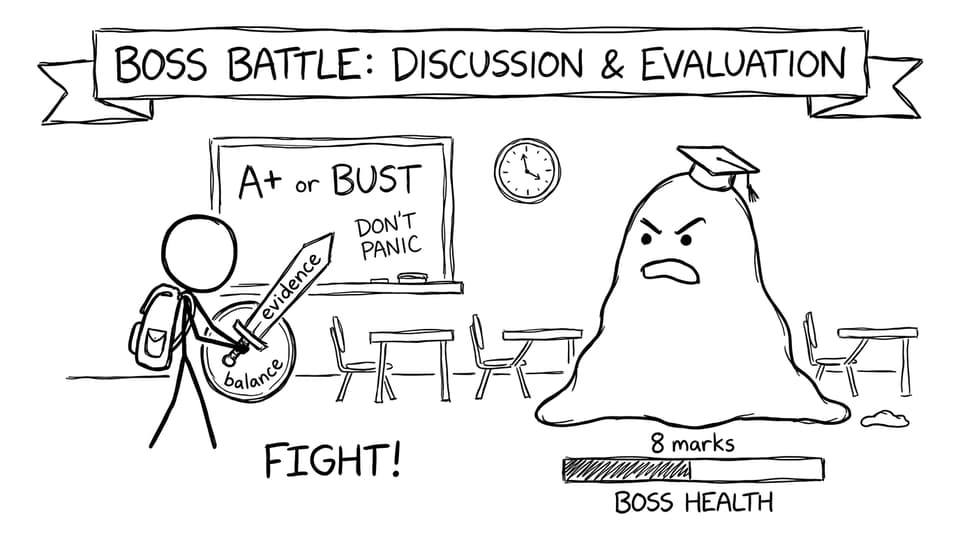
Criterion D (Discussion and evaluation) is worth 8 marks out of 30, making it the single highest-weighted criterion in the 2027 EE assessment.
Criterion D assesses two big things:
- Balanced discussion of research findings supported by evidence
- Evaluation of the essay’s effectiveness, including strengths and limitations
In other words, it rewards a mindset: I can argue clearly, and I can also judge my own argument honestly.
If you want a full criteria map (and how each criterion is interpreted), see RevisionDojo’s breakdown: Assessment Criteria for the IB Extended Essay.
A quick EE checklist for maximizing Criterion D
Before you edit another paragraph, run this Criterion D checklist over your EE:
- Do I state my findings clearly (not just present information)?
- Do I support each key claim with evidence (data, quotations, calculations, examples)?
- Do I show balance by considering counterarguments or alternative interpretations?
- Do I explicitly discuss limitations (method, sources, scope, assumptions, bias, uncertainty)?
- Do I evaluate the effectiveness of what I did (what worked, what didn’t, and why)?
- Do I end with a conclusion that feels earned rather than announced?
If you’re missing two or more items, Criterion D is likely leaving marks on the table.
To see how “critical discussion” should sound, compare your draft to this guide: Tips for Writing a Critical Discussion Section in Your EE.
Why Criterion D matters more than students think
There’s a pattern in almost every good EE story.
The student starts with a confident idea. The early research feels like collecting treasure: quotes, case studies, data points. The draft grows. The bibliography grows. The word count grows.
Then something uncomfortable happens.
The evidence doesn’t line up perfectly. The results are messier than expected. The sources disagree. The method has trade-offs. The student realizes their strongest paragraph is also their most fragile.
Criterion D is designed for that moment.
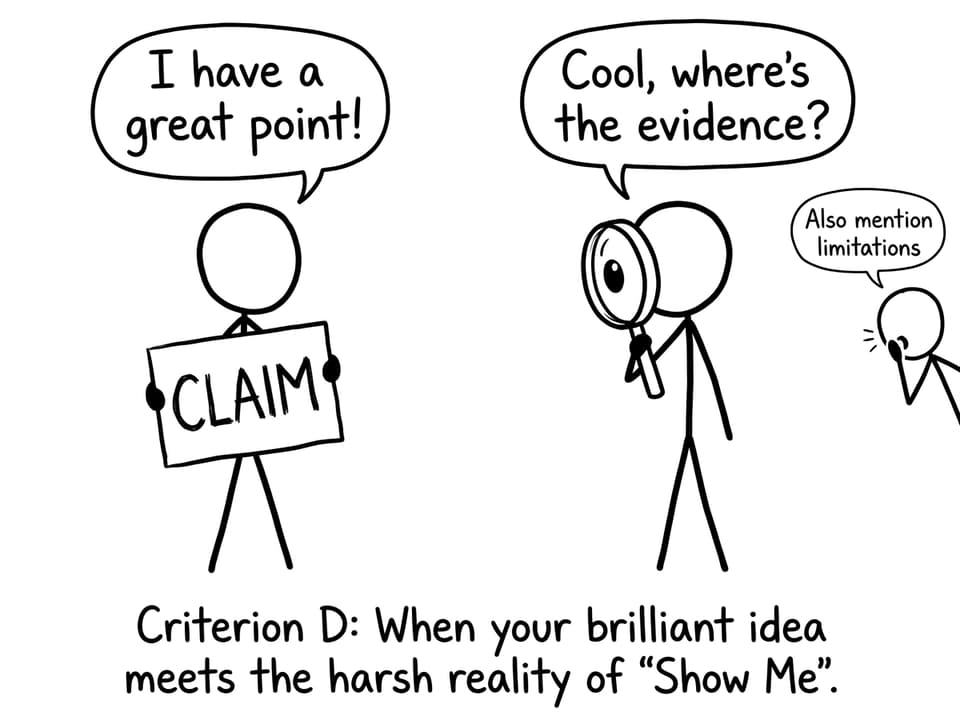
It’s not asking you to pretend your research is flawless. It’s asking you to prove you can think like a researcher: interpret findings, weigh evidence, and judge limits.
That’s why Criterion D can rescue a EE that’s “good but not great.” You don’t need a groundbreaking topic. You need a discussion that shows you understand what your evidence can and cannot support.
For a broader end-to-end process (research, drafting, revision), this is a strong companion: Mastering IB Extended Essays: How to Research, Write, and Revise.
What “balanced discussion” looks like in an EE
Balanced discussion doesn’t mean you must argue against yourself until nothing is left.
It means you can do three things at once:
- Make a claim (your position)
- Support it with evidence (your proof)
- Acknowledge what could also be true (constraints, counterarguments, nuance)
Here are practical ways to show balance in your EE without losing clarity:
Use “weight of evidence” language
Instead of absolute statements:
- “This proves…”
- “This shows that…”
Try:
- “The evidence suggests…”
- “A stronger interpretation is…”
- “Taken together, the sources point to…”
This sounds small, but it signals that you’re evaluating, not just reporting, which which is the heart of Criterion D in the EE.
Place counterarguments where they actually matter
A common mistake is adding a counterargument paragraph that feels like a ritual.
A better approach:
- Make a point.
- Present evidence.
- Immediately address the strongest objection.
- Explain why your interpretation still holds (or how it changes).
That structure reads like thinking in real time.
Compare sources instead of stacking them
A stacked paragraph sounds like: Source A says X. Source B says X. Source C says X.
A Criterion D paragraph sounds like: Source A and B agree on X, but Source C’s different method makes the conclusion less certain, so the best-supported claim is actually Y.
If you want a clear structure for your overall essay sections (so your discussion has a place to live), use: How to Structure an Extended Essay (EE).
What “evaluation of effectiveness” actually means
The phrase “evaluate your essay’s effectiveness” scares people because it sounds like you’re supposed to grade yourself.
In the EE, effectiveness evaluation is more practical:
- Did your method match your research question?
- Were your sources appropriate and sufficient?
- Did your approach introduce bias or uncertainty?
- Did your scope help you go deep, or did it still spread you thin?
- If you repeated the project, what would you change first, and why?
This is where students often write vague lines like “There were limitations.” Criterion D wants specifics.
Strong limitation statements are measurable
Examples of specific limitation framing:
- “Because the data set only covers 2018-2022, the conclusion may not generalize to earlier periods where X differed.”
- “This analysis relies on translated extracts, so nuance in tone may be lost, affecting interpretations of character motivation.”
- “The experiment used three concentration levels; additional intervals could reveal non-linear behavior not captured here.”
If your EE is feeling messy, check common pitfalls: Mistakes to Avoid in IB Extended Essays.
How to build an 8-mark Criterion D section (a simple template)
Use this template to plan or revise your EE discussion so it naturally hits Criterion D expectations.
Start each main section with a “finding” sentence
Not background. Not narrative. A finding.
Example starters:
- “The results indicate that…”
- “Across the sources, a consistent pattern emerges…”
- “A key divergence appears when…”
Follow with evidence, then interpretation
A reliable pattern for high-scoring EE writing:
- Evidence (what you observed or found)
- Interpretation (what it means for the research question)
Add balance: alternative explanation or counterclaim
Pick the strongest alternative interpretation and treat it seriously.
Evaluate: limitation + impact + mitigation
For each big claim, add:
- Limitation: what could weaken this claim?
- Impact: how much does it matter?
- Mitigation: what did you do, or what would you do next time?
This is how you turn “limitations” into actual evaluation, and why Criterion D is now the highest-weighted EE criterion.
Practical ways RevisionDojo helps you improve EE Criterion D
Criterion D improves fastest with feedback that is specific, repetitive, and criterion-based.
RevisionDojo is built for that.
- Use the IB Coursework Grader to get rubric-aligned feedback on your EE, including where discussion becomes descriptive and where evaluation is missing.
- Use IB EE Feedback Tool: Improve Your Extended Essay Score to translate rubric language into concrete revision actions.
- If you’re still shaping your research direction, start with RevisionDojo’s EE Guides so your argument is built to support evaluation later.
And when your brain is fried at 11:40 p.m., RevisionDojo’s AI Chat can help you stress-test claims (“What counterargument would an examiner raise here?”) while your Study Notes and Flashcards keep subject content sharp for the discussion.
If you need to pressure-test the whole project timeline, RevisionDojo’s Tutors can help you decide what to cut, what to deepen, and which evaluation points are worth writing.
Mini case study: the fastest Criterion D upgrade
A student writes a EE with a clear argument but weak evaluation.
Draft sentence: “This shows the policy was effective.”
A Criterion D upgrade adds three layers:
Revised:
- “The evidence suggests the policy improved X in the short term, particularly in Y contexts.”
- “However, the strongest limitation is that the data underrepresents Z, which could inflate the apparent effect.”
- “A more effective approach would compare matched regions or extend the time window to test whether the effect persists.”
Same topic. Same research.
But now the student is discussing and evaluating, which exactly what the 8 marks in Criterion D are paying for.
Bringing it home: treat Criterion D like your EE’s compass
The best EE writers aren’t the ones who never doubt themselves.
They’re the ones who know exactly where doubt belongs: in the discussion, shaped into evaluation, backed by evidence, stated with balance.
In 2027, Criterion D is worth 8 marks for a reason. It rewards students who can do the hardest academic move: argue clearly and still see the edges of their argument.
If you want a practical next step, take your latest EE draft and run it through RevisionDojo’s IB Coursework Grader. Then revise one body section using the “finding -> evidence -> interpretation -> counterview -> limitation” template above. You’ll feel the difference immediately.
And when you’re ready to level up the whole process, RevisionDojo’s Questionbank, Study Notes, Flashcards, AI Chat, Grading tools, Predicted Papers, Mock Exams, Coursework Library, and Tutors are built to make your IB workload feel less like panic and more like progress, one one criterion at a time, one EE paragraph at a time.