


The moment you open a blank document for your Extended Essay, it can feel like you’ve been handed a map with no legend. You know there’s a destination. You even know the route matters. But the path is foggy, and every new tab you open seems to add another mile.
That’s the real reason structure matters in the IB Extended Essay. It doesn’t just make your writing look academic. It keeps your thinking honest. It forces every paragraph to answer the same quiet question: Does this help solve my research question?
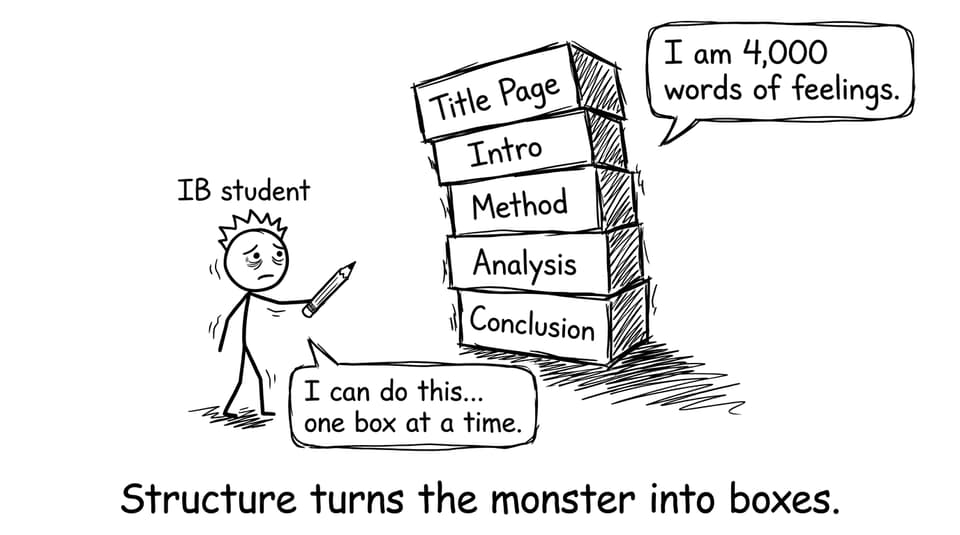
IB Extended Essay structure at a glance
Use this as your quick blueprint before you draft. It’s simple on purpose.
-
Title page
-
Table of contents
-
Introduction (context + research question + roadmap)
-
Body (evidence + analysis + evaluation)
-
Conclusion (direct answer + limits + implications)
-
References/bibliography
-
Appendices (optional)
For more detail on what examiners expect in each section, keep EE Structure in 2027: The IB Extended Essay Blueprint open while you outline.
Step 1: Build the title page and table of contents (don’t overthink it)
In IB writing, presentation isn’t about decoration. It’s about removing friction for the reader.
Keep your title page clean and formal. Then add a table of contents that matches your headings exactly. Most students do this too early and regret it. A good habit is to generate your table of contents last, then update page numbers after final edits.
If you want a formatting-focused checklist, use How to Format Your EE According to IB Guidelines: Tips + FAQ.
Step 2: Write an introduction that earns the reader’s trust
A strong IB introduction is short, calm, and specific. It should do three jobs:
-
Context: the reader understands the academic setting.
-
Research question: it’s easy to find and clearly phrased.
-
Roadmap: you preview how you’ll investigate.
If you need a tight process, follow IB Extended Essay: 7 Steps for a Strong Introduction.
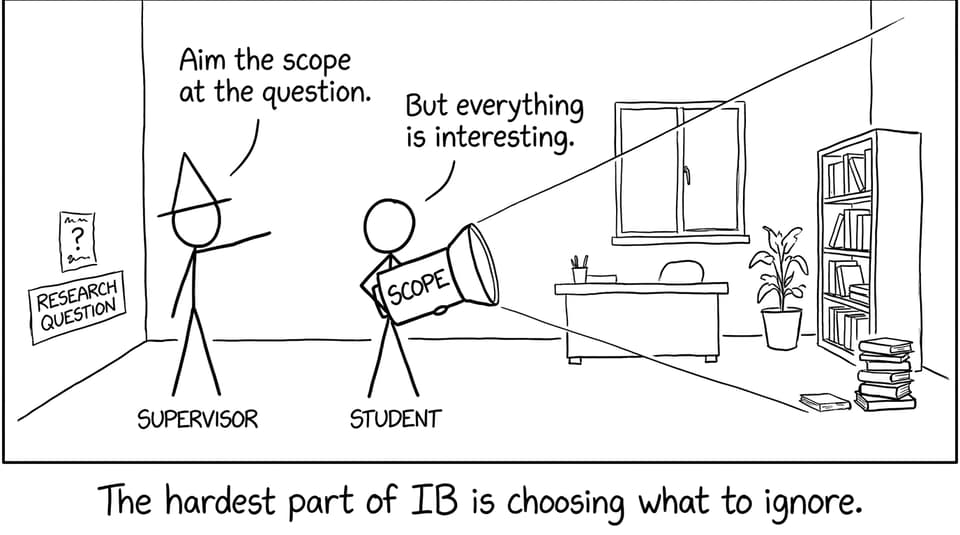
Step 3: Plan your body using the “claim, evidence, analysis, link” loop
Most IB Extended Essays don’t lose marks because the student didn’t work hard. They lose marks because the body becomes a guided tour of information.
A reliable structure for each section is:
-
Claim: a point that helps answer the research question.
-
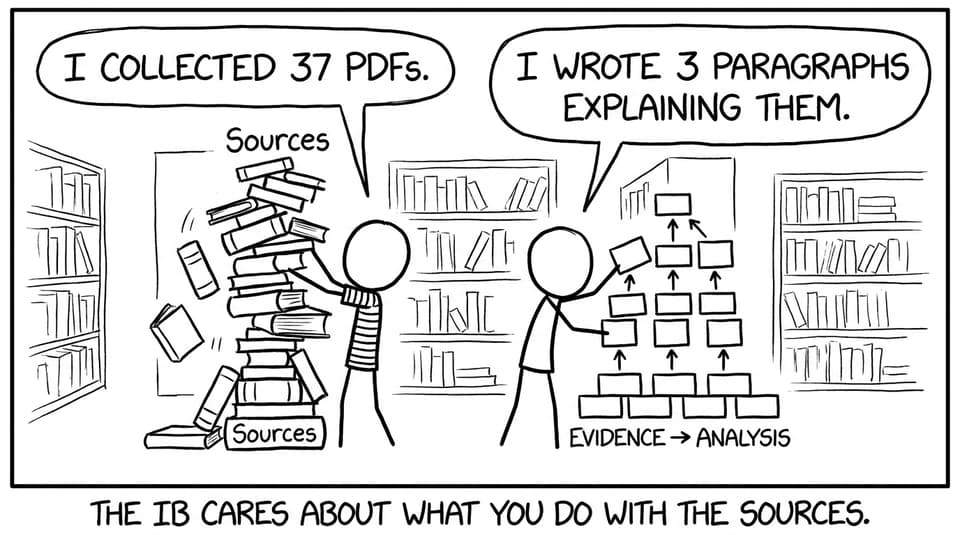
Evidence: quotations, data, case studies, calculations, observations.
-
Analysis: what the evidence means and why it matters.
-
Link: a sentence that connects back to the research question.
That loop keeps your EE from becoming descriptive. It also makes your argument easier to revise because you can see exactly which step is missing.
To strengthen your outline before drafting, use How to Create an Effective EE Outline for a Logical Flow.
Step 4: Treat methodology like a set of choices, not a paragraph you “have to include”
Depending on your subject, your method might be experimental, textual, comparative, or data-based. But the IB reader always wants the same thing: clarity.
Write your methodology so another student could replicate your approach or at least understand your decision-making. Explain why this method fits the research question, and acknowledge the limitations early. That honesty often makes your analysis stronger, not weaker.
If your research phase feels chaotic, How to Survive the IB Extended Essay Research Process offers a practical workflow for sources and note systems.
Step 5: Make evaluation visible (it’s where high marks live)
In IB terms, “critical thinking” usually looks like evaluation:
-
comparing interpretations
-
testing assumptions
-
noticing what your evidence can’t prove
-
weighing trade-offs and limits
You don’t add evaluation at the end like a decoration. You weave it through the body so the reader sees you thinking in real time.
A helpful way to pressure-test your draft is to run your sections through RevisionDojo’s Grading tools like the IB Coursework Grader. It mirrors rubric language and helps you spot where you’re summarizing instead of analyzing. Then use AI Chat to ask one precise question, such as: “Which paragraph is most descriptive, and how do I turn it into analysis without adding new sources?”
Step 6: Write a conclusion that answers the research question directly
A strong IB conclusion does not re-tell the essay. It synthesizes.
-
Restate the research question.
-
Answer it clearly using your findings.
-
Explain what your answer implies.
-
Acknowledge limitations and realistic extensions.
If you want to see how structural expectations are shifting, read IB Extended Essay 2027 Changes: What to Know for EE.
Step 7: References, academic integrity, and appendices
Your references should be consistent and complete. More importantly, your citations should be built as you research, not added in a frantic weekend.
Academic honesty in the IB is less about fear and more about being traceable: where did this idea come from, and how did you use it?
For a clear integrity checklist, use Top Strategies for Ethical Research and Referencing in IB.
Appendices are optional. Include them only if they support (not replace) your analysis.
How RevisionDojo helps you structure your IB EE without panic
Good structure is a project-management problem disguised as a writing problem. That’s why the best support tools feel calm.
RevisionDojo is designed to be that calm hub for IB students:
-
Use the Coursework Library and IB Extended Essay Guides to internalize what a high-scoring EE looks like.
-
Use the Grading tools and IB Extended Essay (First Assessment 2027) Grader for criterion-based feedback.
-
Keep your exam prep moving with Study Notes, Flashcards, and the Questionbank so the EE doesn’t consume your whole week.
-
When you want a human second set of eyes, RevisionDojo Tutors help you refine research questions, structure, and clarity.
If you want more targeted EE help, browse All IB Extended Essay Posts.
Closing: the IB EE is a map you draw as you walk
A good IB Extended Essay structure is less like a rigid template and more like a set of guardrails. It keeps you from wandering when the research gets interesting and the deadline gets loud.
If you want your structure to hold up under pressure, build it once, then refine it with tight feedback loops. Use RevisionDojo as your home base: the Coursework Library for models, Grading tools for clarity, AI Chat for targeted questions, and the Questionbank, Study Notes, and Flashcards to keep your exam prep strong while your EE improves. Your future self will thank you for making the work feel guided, not chaotic.