
The moment the IB Extended Essay becomes “real”
Most students don’t panic because the IB Extended Essay is hard. They panic because it’s vague.
One teacher says, “Make it more analytical.” A friend says, “Just add more sources.” You rewrite the introduction three times, and somehow the essay gets longer but not better. Then you finally open the criteria and realize the uncomfortable truth: the examiner isn’t grading your effort. They’re grading alignment.
If you understand how the IB Extended Essay assessment criteria work, the fog clears. You stop writing “more” and start writing “for marks.” This guide breaks down each criterion, what examiners actually reward, and a simple scoring mindset you can use while drafting.
Quick checklist: what the criteria are really measuring
Before we go criterion by criterion, use this as your mental map. A high-scoring IB Extended Essay usually shows:
-
A research question you can say in one breath
-
A method that matches your subject’s expectations
-
Subject knowledge used to build an argument (not to decorate paragraphs)
-
Evidence that is analyzed and then evaluated (strengths, limits, alternatives)
-
Reflection that shows decisions and learning, not a diary recap
If you want a home base for Extended Essay planning, start with IB Extended Essay Guides and keep the All IB Extended Essay Posts page bookmarked for “I’m stuck” moments.
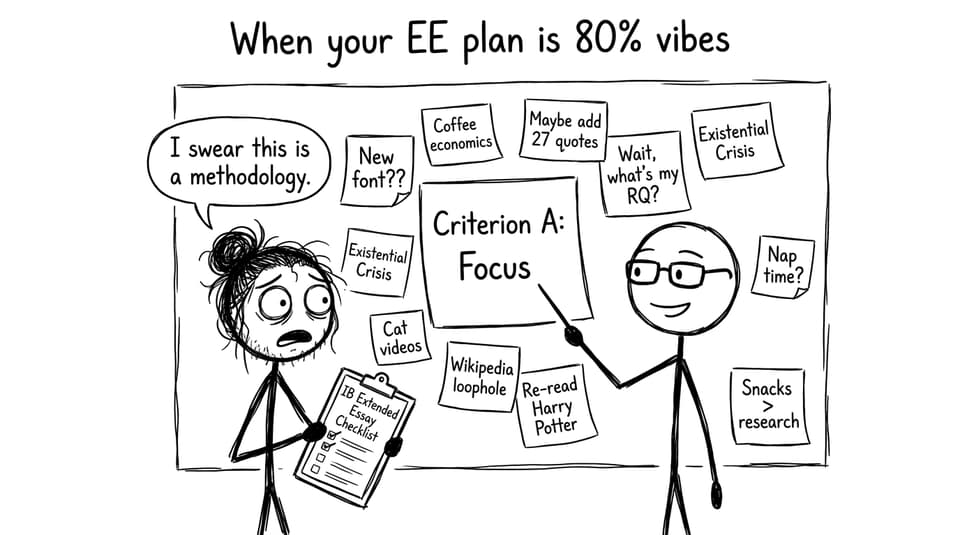
Criterion A: Focus and method (your investigation design)
Criterion A is where your IB Extended Essay either becomes a project or stays a wish.
Examiners look for a focused research question, a subject-appropriate method, and a structure that follows logically from both. The hidden idea is coherence: your question, method, and headings should feel like they belong to the same essay.
How to score higher in Criterion A
-
Write a research question with clear variables, scope, or boundaries (time period, location, text, case study)
-
Justify your method briefly: why this approach fits this subject
-
Build an outline where each section earns its place by answering the question
If you’re unsure what “focused” looks like, RevisionDojo’s AI Chat is useful for pressure-testing research question wording. And when your structure feels messy, comparing against models in the Coursework Library via IB Coursework Examples: IA, EE and TOK Exemplars can quickly reset your expectations.
For students working toward the newer framework, the article EE Assessment Criteria Explained (2027 Guide) is a clear companion.
Criterion B: Knowledge and understanding (show you belong in the subject)
Criterion B rewards accurate, relevant knowledge. Not impressive trivia. Not long quotations. Just the right concepts used precisely.
A strong IB Extended Essay sounds like someone who understands the discipline’s language and uses it to make meaning. That means definitions are clean, terminology is consistent, and context is included only when it helps answer the research question.
How to score higher in Criterion B
-
Use key terms correctly and consistently (define once, then use confidently)
-
Use sources as evidence you interpret, not blocks you display
-
Keep every paragraph anchored to the research question
When your content feels thin, RevisionDojo’s Study Notes can help you rebuild the subject foundation quickly without spiraling into endless reading. Pair that with Flashcards to lock down definitions and theorists so your writing stays sharp under pressure.
Criterion C and D: Critical thinking, discussion, and evaluation (where marks are won)
This is the core of the IB Extended Essay: your thinking.
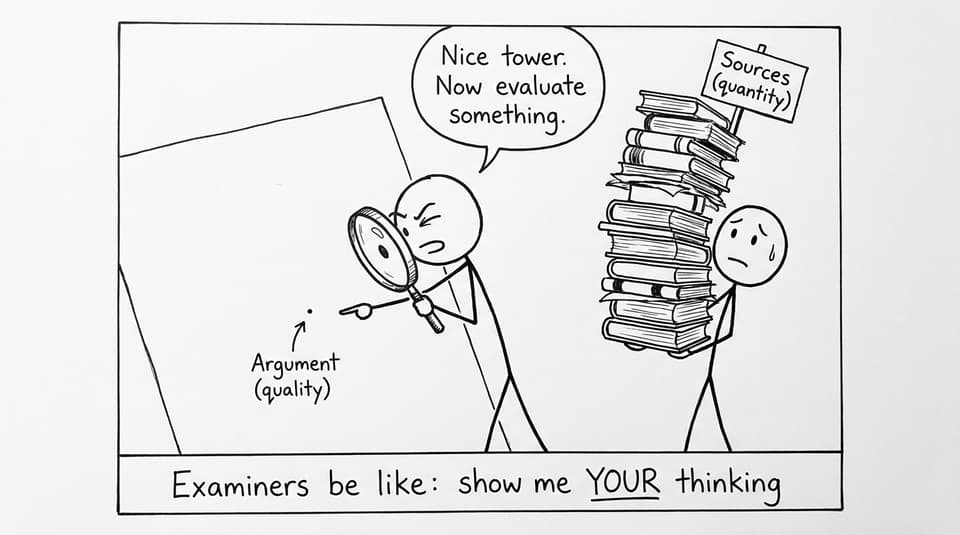
Criterion C is about analysis and line of argument. Criterion D (often weighted most in newer mark breakdowns) is about discussion and evaluation: weighing evidence, acknowledging limitations, and comparing interpretations.
The easiest way to lose marks here is “book report energy”; lots of information, very little judgment.
How to score higher in Criterion C and D
-
Make a claim, then prove it with evidence, then explain why that evidence matters
-
Include at least one meaningful counterpoint or limitation per major section
-
Use comparison language: “however,” “this suggests,” “a limitation is,” “an alternative interpretation is”
A practical RevisionDojo workflow here: draft one body section, run it through the Grading tools using the IB Coursework Grader, then ask AI Chat one targeted question like: “Where am I summarizing instead of evaluating?” That tight feedback loop usually improves the essay faster than rewriting everything.
If you tend to drift into common traps, Mistakes to Avoid in IB Extended Essays is worth reading early.
Criterion E: Engagement and reflection (prove your decisions)
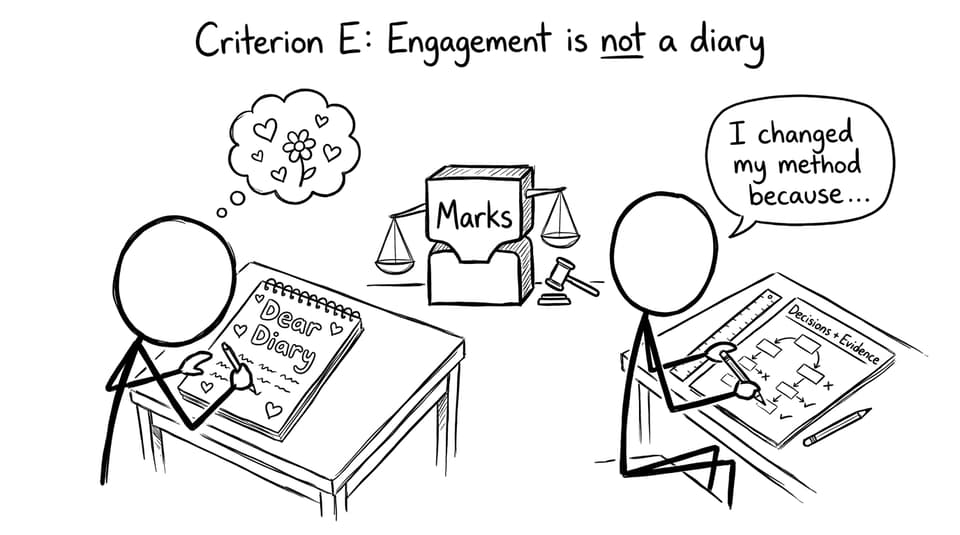
Criterion E is not graded on enthusiasm. It’s graded on intellectual honesty.
Examiners want evidence that you made choices: what you changed, why you changed it, and what you learned about your question or method along the way. A high-scoring IB Extended Essay reflection reads like a researcher explaining decisions, not a student narrating events.
How to score higher in Criterion E
Use a simple pattern in each reflection entry:
-
Decision: What did I change (question, sources, method, structure)?
-
Reason: What evidence or problem forced that change?
-
Result: What improved because of it?
If you’re preparing for newer reflection formats, the overview in IB Extended Essay 2027 Changes: What to Know for EE helps you understand what’s shifting and what stays constant.
Scoring guide: how the IB Extended Essay is marked
The exact mark totals can vary depending on the assessment model used in your session, but the key idea is stable: each criterion is judged separately, and a weakness in one area can’t always be “covered” by strength elsewhere.
A simple way to think about scoring is:
-
Criterion A: Is the essay designed well?
-
Criterion B: Does the student understand the subject?
-
Criterion C/D: Is there real analysis and evaluation?
-
Criterion E: Does the reflection show decisions and growth?
If you want a deeper scoring breakdown for the newer structure, see EE 2027 Criteria: What’s New and How to Score High.
Write your IB Extended Essay like each paragraph has a job
The best IB Extended Essay advice is quietly boring: make every section earn marks.
When your research question is sharp, your method makes sense, your knowledge stays relevant, your argument evaluates evidence, and your reflection shows real decisions, examiners don’t have to search for quality. They can award it.
If you want the process to feel calmer (and faster), use RevisionDojo as your system: build confidence with Study Notes and Flashcards, protect exam performance with the Questionbank, and upgrade drafts with AI Chat, the Coursework Library, and the Grading tools in the IB Coursework Grader. That’s how the IB Extended Essay stops being a guessing game and becomes a scoring plan.