
The night your IB Extended Essay draft stops feeling like “a long document” and starts feeling like “a set of marks waiting to be lost” is usually the night you finally want real feedback.
Not generic feedback like “tighten your intro” or “add more sources.” But the kind that points to the exact reason a paragraph sits in the middle markbands, and what to do next.
That’s the core idea behind an IB Extended Essay feedback tool: turning revision from anxious editing into a criterion-aligned plan that actually improves your Extended Essay score.
The fast checklist: what a feedback tool should fix
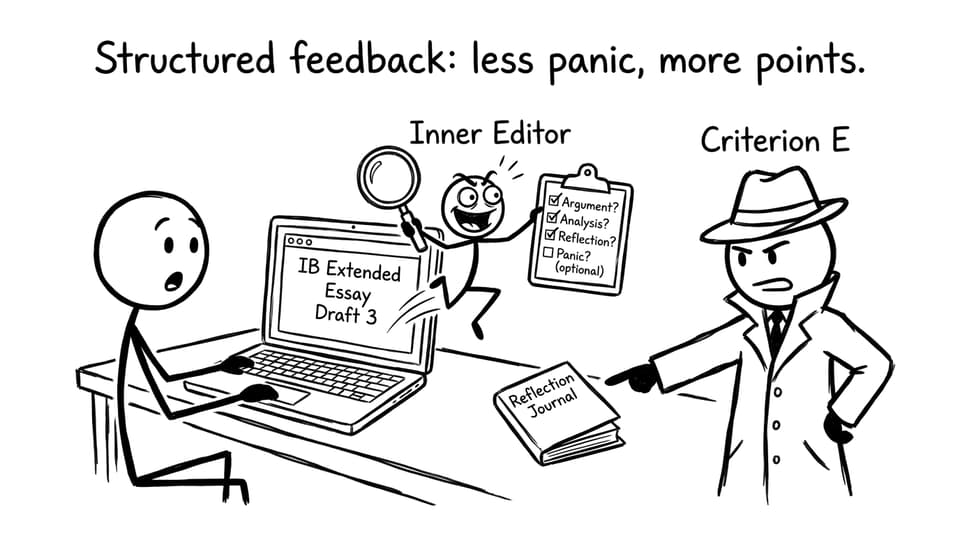
Before you revise another line, use this quick screen. A good IB Extended Essay feedback tool should help you:
-
Lock a focused, arguable research question
-
Build an argument that progresses (not just “covers topics”)
-
Upgrade description into analysis and evaluation
-
Produce reflections that earn engagement marks (not diary entries)
-
Map changes to the rubric, so each edit has a purpose
If you want a strong starting hub, keep IB Extended Essay Guides open as you work; it’s built to keep your IB Extended Essay aligned from question to final polish.
Why unstructured EE revision quietly costs marks
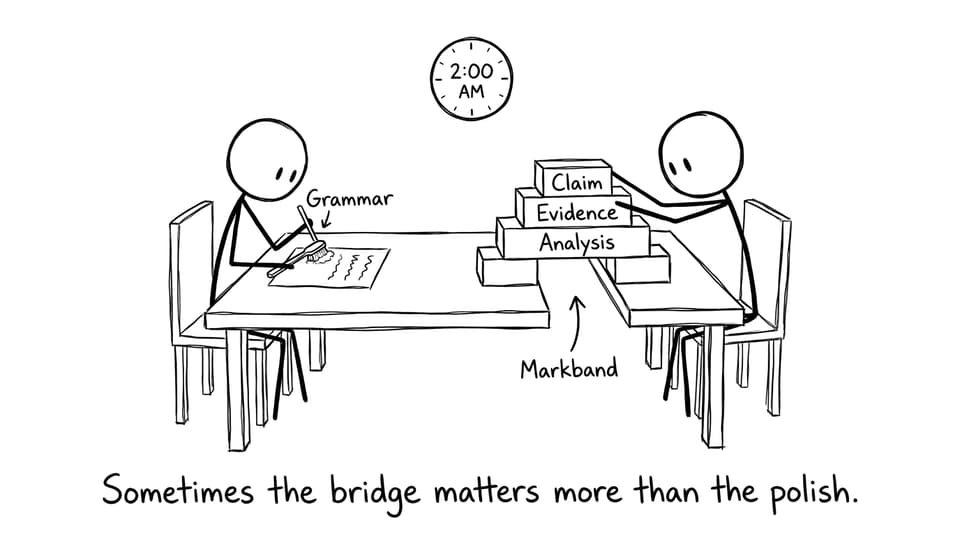
Most students don’t lose IB Extended Essay marks because they didn’t work hard. They lose marks because effort gets spent on low-impact improvements.
It looks like:
-
Fixing wording while the argument still doesn’t answer the research question
-
Adding citations while the analysis still reads like a summary
-
Expanding background sections that don’t earn credit
-
Writing “reflection” that explains emotions, not decisions
A criterion-driven task (like the IB Extended Essay) punishes “nice writing” when the structure and analysis are not doing examiner work.
For a bigger picture of what goes wrong early, read Mistakes to Avoid in IB Extended Essays.
How RevisionDojo turns feedback into a score-improving system
RevisionDojo is designed as an all-in-one IB basecamp, so your IB Extended Essay doesn’t compete with exam prep; it fits inside a system.
Here’s the simple workflow many students use:
Use the rubric the way examiners do
Start by making the criteria your table of contents.
-
If you’re unsure what each criterion is really asking, use What Are the Assessment Criteria for the IB Extended Essay? (Full Breakdown).
-
If you’re in the newer syllabus cycle, keep EE 2027 Criteria: What’s New and How to Score High nearby while you revise.
This is what an IB Extended Essay feedback tool does best: it forces you to revise in the same categories you’ll be graded in.
Get criterion-specific feedback fast (without waiting a week)
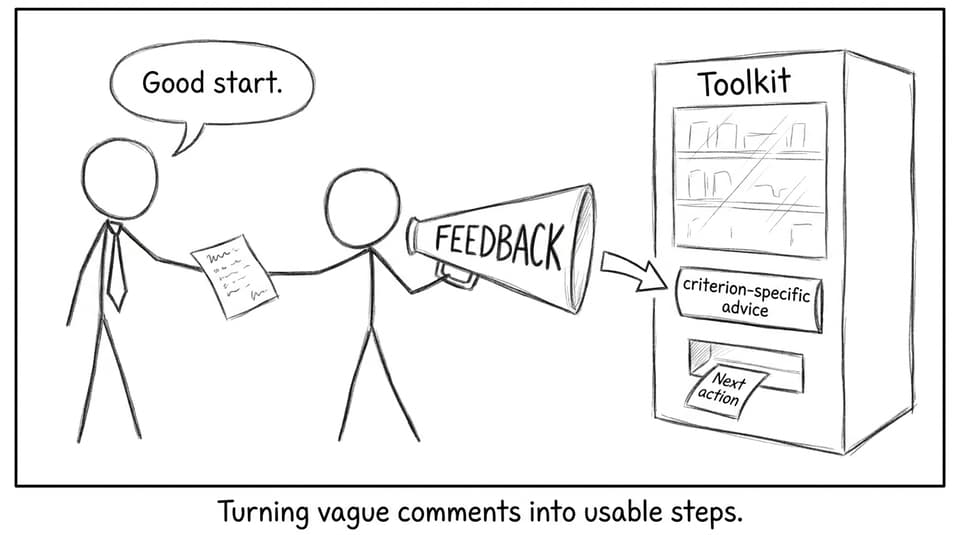
When you need speed, use the IB Coursework Grader to get rubric-calibrated commentary on what’s working, what’s missing, and what to fix first.
Then use RevisionDojo’s AI Chat to interrogate the feedback like a tutor would:
-
“Which paragraph is most descriptive, and how do I rewrite it into evaluation?”
-
“Where does my argument stop answering the research question?”
-
“What would a higher-level counterargument look like in my subject?”
If you want to go deeper on the overall improvement process, see How to Improve Your IB Extended Essay Draft.
The three highest-impact upgrades a feedback tool should trigger
If your time is limited, aim for changes that move markbands.
Research question precision
A strong IB Extended Essay begins with a question you can answer in 4,000 words.
A feedback tool should push you to narrow scope, define key terms, and remove “two essays in one.”
Tip: if your question contains “and,” test whether it secretly demands two separate investigations.
Argument structure that can be traced
Examiners should be able to summarize your argument by reading only:
-
Introduction claim
-
Topic sentences
-
Conclusion
If that summary doesn’t clearly answer the research question, your draft needs structural revision more than stylistic editing.
Reflection that earns marks (Criterion E)
Reflection in the IB Extended Essay is assessed. It’s not optional polish.
Use these support resources to make it concrete:
A strong pattern is: Decision -> Reason -> Consequence -> Next step. A good IB Extended Essay feedback tool will keep pulling you back to that.
A practical 60-minute EE feedback loop (that won’t derail exam revision)
During exam season, your IB Extended Essay needs boundaries.
Try this loop 2-4 times per week:
-
10 min: Choose one criterion to target (one only).
-
25 min: Revise one section (not the whole essay).
-
15 min: Run it through the Coursework Grader or a checklist from RevisionDojo EE guides.
-
10 min: Write 4 reflection bullets: what changed, why, what improved, what to do next.
Then return to exam work using RevisionDojo’s Questionbank, Study Notes, Flashcards, Mock Exams, and Predicted Papers to keep your momentum. (RevisionDojo is built so coursework and exams can share the same calm system.)
FAQ
Do I still need my supervisor if I use an IB Extended Essay feedback tool?
Yes, and you’ll usually get better value from supervisor time. An IB Extended Essay feedback tool helps you arrive with specific questions instead of a vague request for “general feedback.” It also helps you separate high-impact fixes (argument, analysis, criterion alignment) from low-impact fixes (wording). When your supervisor comments, you can map each note to a criterion and decide what to change first. This prevents the common trap of doing lots of editing that doesn’t move marks. Think of the tool as your day-to-day coaching and your supervisor as the strategic check-in.
What if my research question changes halfway through my IB Extended Essay?
That’s normal, and often a sign you’re thinking like a researcher. A good IB Extended Essay process treats the research question as something you refine, not something you tattoo onto your first outline. The important part is documenting why the change happened and what evidence forced it. That reflection can directly support your engagement marks when written clearly in the RPF and discussed in the viva voce. If your question changes, your structure must change with it, so don’t keep old sections that no longer answer the new question. A feedback tool helps you spot those “leftover paragraphs” that quietly lower coherence.
How can I tell if my IB Extended Essay is too descriptive?
If most paragraphs simply report what a source says, you’re describing. Analysis begins when you explain so what and therefore in relation to your research question. Evaluation begins when you weigh strengths, limitations, or alternatives (including counterarguments). A fast test is to highlight your own sentences versus quoted or paraphrased content: your voice should guide the reasoning. Another test is whether each paragraph contains at least one sentence that links evidence to a claim and then to the research question. Using an IB Extended Essay feedback tool makes this visible because it flags missing reasoning steps rather than just grammar.
Conclusion: make feedback the strategy, not the afterthought
The IB Extended Essay rewards students who revise with intention: clear question, traceable argument, real analysis, and reflection that shows decisions over time.
If you want your next draft to improve your Extended Essay score (not just look “cleaner”), build a criterion-based routine with RevisionDojo: start with the IB Extended Essay Guides, use the IB Coursework Grader for fast rubric feedback, and lean on AI Chat, the Coursework Library, and Tutors when you need a second set of eyes.
Your IB Extended Essay is still your work. A strong feedback tool just makes every revision count.