
A long essay can sound alarming when it first appears on the family calendar. Parents may imagine 4,000 words written in one exhausting weekend, while students may worry that they are expected to become university researchers overnight.
The reality is more manageable. The Extended Essay, usually called the EE, is an independent research project of up to 4,000 words completed as part of the International Baccalaureate Diploma Programme. A student investigates a focused question, uses methods appropriate to the chosen subject, develops an evidence-based argument, and reflects on the research process with guidance from a school supervisor.
It is demanding, but it is not supposed to be completed alone or all at once. For IB Diploma parents, the most useful role is not to direct the research. It is to understand the process, encourage steady progress, and help the student protect time for work that often develops slowly before it becomes visible.
The Extended Essay at a glance
Here is the short version parents can return to when the terminology becomes confusing:
- Length: Up to 4,000 words.
- Purpose: To develop independent research, academic writing, critical thinking, and reflection.
- Status: A compulsory part of the core for full IB Diploma candidates.
- Topic: A focused investigation connected to an approved Diploma Programme subject or interdisciplinary pathway, depending on the applicable guide.
- Support: A supervisor, usually a teacher at the school, provides guidance and holds required reflection meetings.
- Assessment: The completed work is assessed externally by an IB examiner.
- Diploma impact: The EE receives a grade from A to E and combines with Theory of Knowledge to contribute up to three core points.
- Ownership: The question, research, argument, and writing must remain the student's own.
The EE sits alongside Theory of Knowledge and Creativity, Activity, Service in the IB core. Parents unfamiliar with the wider programme may find it helpful to begin with this clear explanation of how the IB Diploma works or the more focused guide to TOK, the EE, and CAS requirements.
What is the Extended Essay designed to teach?
The obvious output is a formal essay. The deeper output is judgment.
Students must decide which question is worth asking, which evidence deserves trust, which method fits the subject, and which conclusions the evidence can genuinely support. These decisions cannot be reduced to memorizing content. That is precisely why the EE can feel unfamiliar even to a student who performs well in examinations.
The IB describes the project as preparation for undergraduate research. That does not mean the student must produce a groundbreaking academic discovery. It means they begin learning the habits that later research requires: narrowing a topic, evaluating sources, documenting evidence, managing uncertainty, and revising an argument when the research does not support the original assumption.
A history investigation, for example, should use historical evidence and engage with interpretations. A science investigation requires methods and analysis appropriate to that discipline. A literature essay must analyze texts rather than merely recount their content. The same broad structure applies, but good research looks different in each subject.
Choosing a topic is really choosing a manageable question
Students often begin with a subject they care about: climate policy, artificial intelligence, a novel, a historical conflict, or a medical issue. That interest is useful, but it is not yet a research question.
The turning point comes when the broad interest becomes a question narrow enough to investigate within 4,000 words. A strong question should be focused, researchable, open to analysis, and answerable using evidence the student can realistically access. If the question invites only a factual summary or a yes-or-no response, it will usually need refinement.
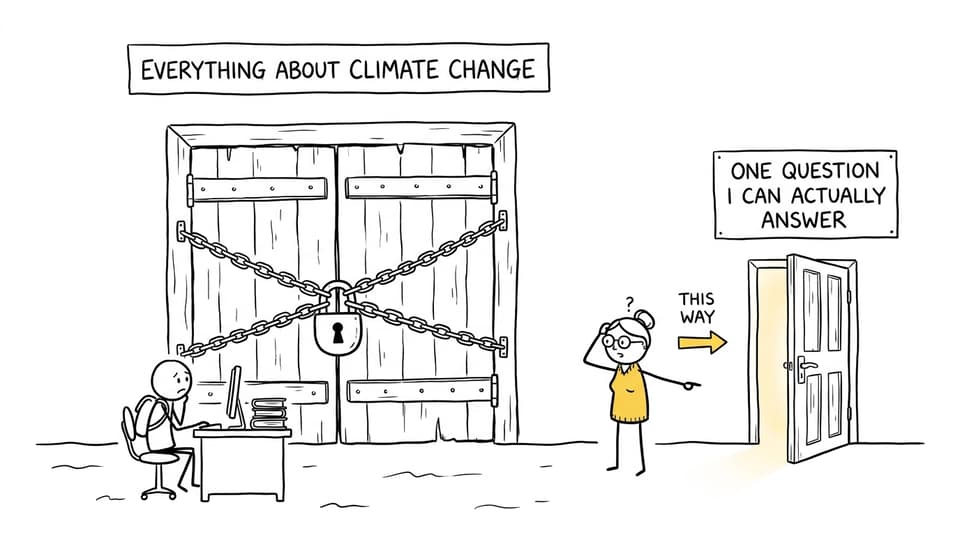
This stage can look like inactivity from the outside. A student may read for several days and produce only a revised sentence. Yet that sentence can save weeks of unfocused work. RevisionDojo's guide to surviving the Extended Essay research process explains how preliminary reading, source evaluation, and question development fit together.
What the finished essay generally contains
Although details vary by subject and assessment guide, a formal EE normally includes:
- A title page
- A table of contents
- An introduction establishing context and the research question
- A logically organized body containing evidence, analysis, and discussion
- A conclusion that answers the research question
- References and a bibliography
- Appendices only where appropriate
The body should not become a collection of interesting facts. Each section needs to move the investigation toward an answer. A useful drafting rhythm is claim, evidence, analysis, and connection back to the research question.
Students who need a starting framework can use the RevisionDojo EE structure guide and this practical guide to creating a logical Extended Essay outline. Formatting matters, but it should serve clarity rather than distract from the quality of the reasoning. The Extended Essay formatting checklist helps students check the formal details near the end.
How supervision and assessment work
The Extended Essay is independent, but independence does not mean isolation. The supervisor helps the student understand expectations, refine the direction of the investigation, monitor progress, and reflect on important research decisions. Under the established EE process, students have three mandatory reflection sessions, with the final conversation known as the viva voce.
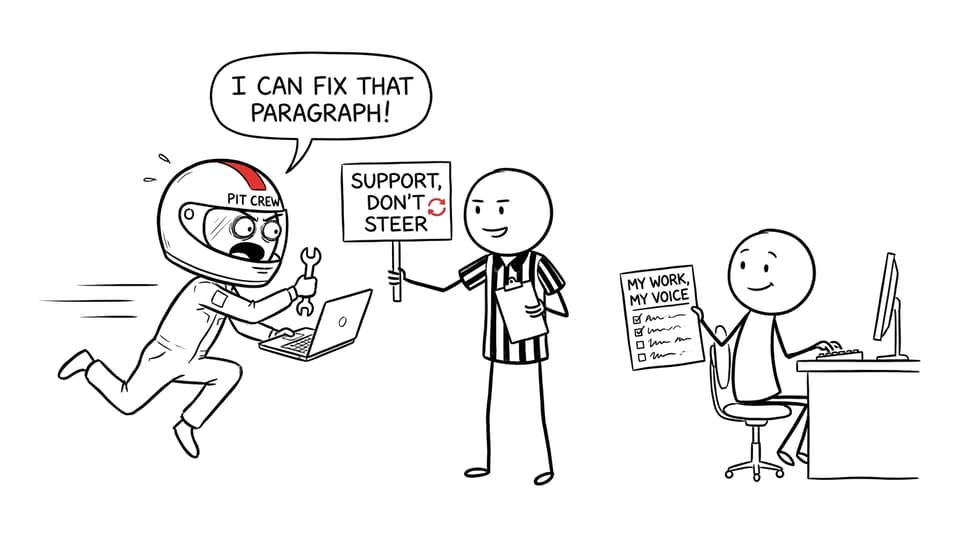
The supervisor is a guide, not a co-author or private editor. The student remains responsible for evaluating sources, forming the argument, writing the essay, checking citations, and making final decisions. That boundary protects both learning and academic integrity.
The essay is assessed externally rather than receiving its final grade from the school. Criteria consider areas such as the research framework, subject understanding, analysis, evaluation, and reflection, although criterion names and mark totals depend on the applicable assessment guide.
This distinction matters now because the IB's revised EE framework has its first assessment in May 2027. It introduces updated criteria and formal subject-focused and interdisciplinary pathways. Students should therefore follow their school's instructions for their own examination session rather than combining online guidance from different versions. RevisionDojo's overview of the 2027 Extended Essay changes explains the transition in plain language.
Why the Extended Essay matters to the diploma
The EE is graded from A to E. Its grade is combined with the student's Theory of Knowledge grade through the IB core points matrix, producing up to three points toward the maximum Diploma score of 45.
Those points matter, but they are not the whole reason to take the work seriously. Under current IB passing criteria, an E in either the EE or TOK is a failing condition for the Diploma. The project therefore cannot simply be ignored while the student concentrates on six examined subjects.
At the same time, parents should resist treating every draft as a prediction of the final grade. Research is uneven. A student can spend considerable time discovering that a source is weak, a method is unsuitable, or an argument needs to change. That work may not increase the word count, but it can improve the eventual essay.
How parents can help without taking over
The most valuable parental support is usually structural rather than academic. Consider asking questions such as:
- What is your next concrete step?
- When is your next supervisor meeting?
- Is your research question stable, or are you still testing it?
- Which school deadline comes before the final deadline?
- Do you need quiet time, transport to a library, or help planning the week?
These questions preserve student ownership. By contrast, rewriting sentences, selecting arguments, conducting research, or heavily editing a draft can compromise authenticity. Families should also be careful with AI tools: they should support understanding and feedback, not generate work that the student presents as their own.
If stress becomes the dominant feature of the project, focus first on the next manageable action rather than the full 4,000 words. The parent guide to Extended Essay overwhelm offers ways to provide reassurance without increasing pressure.
Academic integrity should remain part of these conversations from the beginning, not a final check before submission. Students must acknowledge quotations, paraphrased ideas, data, images, and other borrowed material consistently. RevisionDojo's guide to academic honesty in the Extended Essay clarifies the boundary between legitimate guidance and inappropriate assistance.
Turning independent research into a teachable process
The hidden difficulty of the EE is that students are told to conduct independent research before many of them feel they have been explicitly taught how to manage it. Advice such as “be analytical” or “improve the structure” may be accurate, but it is difficult to act on without examples and a clear next step.
RevisionDojo helps remove that gap. Its Extended Essay guides break research questions, structure, assessment expectations, and subject-specific decisions into manageable stages. The Coursework Library lets students examine how successful academic work is organized, while Grading tools provide rubric-aware feedback that students can use to plan their own revisions. AI Chat can help them question the logic of an argument or understand feedback without replacing their authorship, and Tutors can provide a human layer of guidance when a student remains stuck.
The rest of the RevisionDojo ecosystem helps protect time for the EE by making subject preparation more deliberate. Study Notes and Flashcards build understanding, the Questionbank develops application, and Predicted Papers and Mock Exams support timed preparation. Instead of choosing between coursework and exam revision, students can organize both within one IB-focused resource.
A calmer next step
For a parent asking what the Extended Essay is, the simplest answer is this: it is a long-term, independently written research project that teaches a student how to turn curiosity into a defensible academic argument.
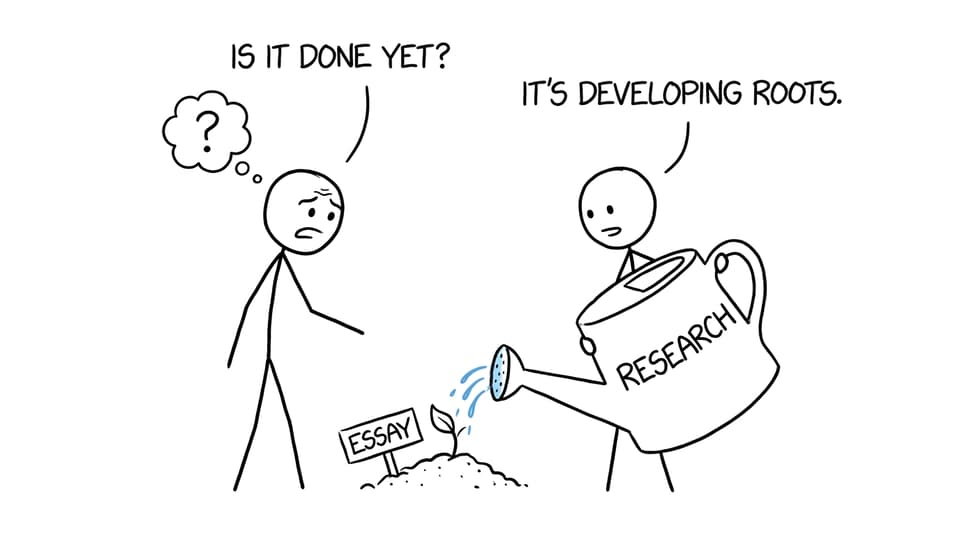
It will sometimes look messy because genuine research is messy. Questions change. Sources disappoint. Paragraphs are rebuilt. Progress often appears slowly and then all at once.
The best next step is not to ask whether all 4,000 words are finished. Ask whether the student knows the next decision they need to make. Then encourage them to use their supervisor, the correct assessment guide, and RevisionDojo's structuring and feedback tools to make that decision with clarity.