
The night your EE stops being “a project”
It usually happens late. The tabs are open. Your document has a title that sounds confident. And yet every paragraph feels like it belongs to a different person.
That’s the moment most IB students discover a quiet truth: your EE isn’t scored because you worked hard. It’s scored because your thinking lands clearly on the page.
In 2027, the basic EE structure is still familiar: introduction (research question and context), body (research, analysis, argument), conclusion (answering the research question). What changes year to year is not the skeleton, but the discipline: clearer signposting, stronger subject conventions, and less room for “interesting” detours.
This guide gives you a practical, examiner-friendly EE structure you can use in 2027, plus subject-specific adjustments (especially for sciences and geography with labelled figures/tables), and a checklist you can use to sanity-check your draft.
EE structure in 2027: the quick checklist
Use this as your “if I only had 3 minutes” overview. A strong EE in 2027 typically includes:
- Title page (clean, formal, no decoration)
- Table of contents (accurate page numbers)
- Introduction (context + focused research question + roadmap)
- Body (sections that build an argument through evidence and analysis)
- Conclusion (direct answer to the research question, plus implications/limits)
- References / bibliography (consistent style)
- Appendices (optional, only for supporting material)
If you need the official-feeling order and presentation details, pair this post with RevisionDojo’s formatting guide: How to Format Your EE According to IB Guidelines.
The core EE structure that won’t change in 2027
Think of your EE like a bridge. The examiner is willing to walk across it, but only if each section carries weight and points in one direction.
Title page and table of contents: the “trust layer”
These sections don’t earn argument marks, but they buy you credibility.
- Keep the title page minimal and correct.
- Generate your table of contents last (then update page numbers again after final edits).
A surprising number of students lose presentation polish because they finalize these too early.
Introduction: make your EE feel inevitable
A high-scoring EE introduction does three jobs:
- Context: the reader understands the academic setting of your topic.
- Research question (RQ): it’s specific, researchable, and worth answering.
- Roadmap: a brief plan of investigation (what you will analyze, and how).
If your introduction feels fuzzy, use RevisionDojo’s step-by-step breakdown: 7 Key Steps to Write a Strong Extended Essay Introduction.
Practical 2027 tip: write your RQ early, but rewrite your introduction late. Your EE evolves. Your opening should match what you actually proved.
Body: where your EE becomes an argument, not a scrapbook
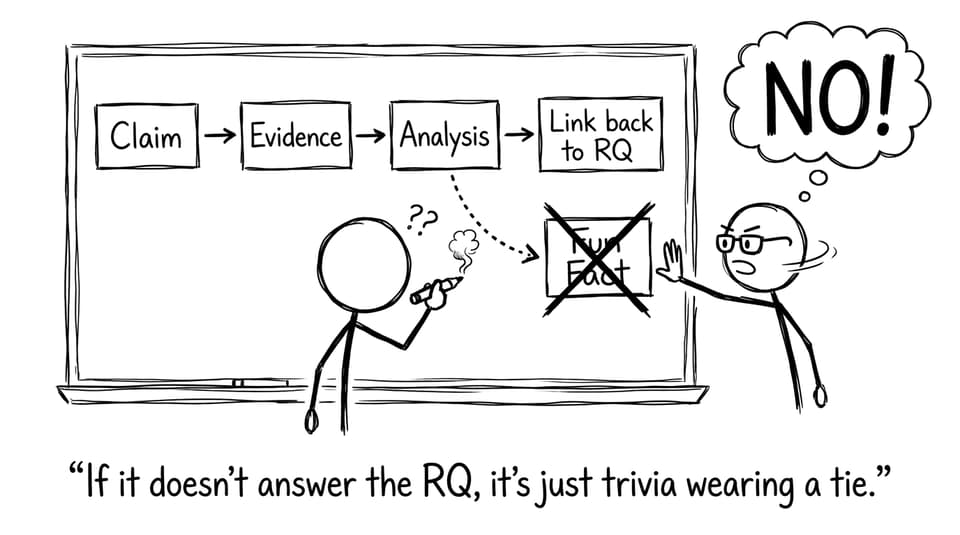
The body is the only place your EE can earn serious credit for reasoning. In 2027, the safest way to structure body sections is to ensure every subsection does this loop:
- Claim (a point that helps answer the RQ)
- Evidence (data, quotations, case details, calculations)
- Analysis (what the evidence means and why it matters)
- Link back to RQ (how this moves the investigation forward)
If you’re worried your draft is descriptive, this RevisionDojo post is the corrective lens: How to Make Your IB Extended Essay Analytical, Not Descriptive.
Conclusion: the examiner wants an answer, not a recap
Your EE conclusion should feel like the final click of a seatbelt.
In 2027, an excellent conclusion:
- Restates the RQ clearly
- Answers it directly based on your findings
- Synthesizes your main insights (not a paragraph-by-paragraph summary)
- Notes limitations and suggests realistic extensions
For a clear template, use: 7 Key Tips to Write a Strong IB Extended Essay Conclusion.
The most effective 2027 EE body layouts (choose one)
Students often ask for “the” perfect EE structure. In reality, you’re choosing the most logical path for your reader.
RevisionDojo breaks outlining down cleanly here: How to Create an Effective EE Outline for a Logical Flow.
Thematic structure
Best when your EE investigates ideas, motifs, themes, or categories.
- Literature and language
- Psychology concepts
- Philosophy-style arguments
Typical body headings might be: Theme A, Theme B, Theme C, then a synthesis section.
Chronological structure
Best when your EE tracks change over time.
- History investigations
- Economics policy over periods
- Geography change over years
This structure works only if each time period adds analysis, not just narrative.
Comparative structure
Best when your EE compares two texts, two systems, two methods, or two case studies.
The trick: keep the comparison consistent. If section 1 compares variable X, section 2 compares variable Y, and section 3 compares outcomes, the reader never gets lost.
Subject-specific conventions: what your EE must look like in 2027
Your EE is still an academic essay, but each subject has “what good looks like.” Examiners expect you to follow those conventions.
Sciences: structure like a careful investigation
For a science EE, the body often resembles:
- Background theory (only what you use)
- Methodology (replicable, justified)
- Results (clean tables/graphs)
- Analysis and evaluation (uncertainty, limitations, validity)
Labelled figures and tables are not decoration. They are how you make evidence readable.
Use captions that say what the reader should notice, not just what the figure is.
Geography: make data and visuals carry meaning
Geography EE writing is strongest when visuals do real work:
- Maps with clear legends and sources
- Tables that compress messy fieldwork into patterns
- Graphs that are referenced in analysis (not dropped in silently)
In 2027, many geography EEs fail quietly because the candidate collects data, but doesn’t interpret it with enough structure. Your headings should mirror your variables and comparisons.
Group 1 and humanities: argument, interpretation, and voice control
In essay-heavy subjects, your EE structure should privilege interpretation:
- Define your lens (theory, critical approach, framework)
- Use evidence selectively
- Keep paragraphs tethered to the RQ
If you want a subject example, explore the RevisionDojo guide hub: IB Extended Essay Guides.
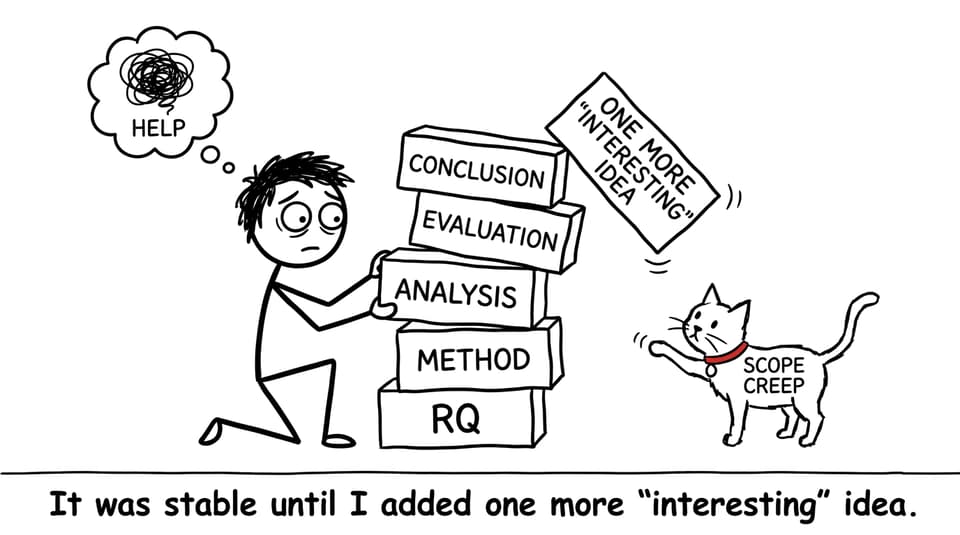
The 2027 EE structure problem nobody admits: scope creep
Most EEs don’t collapse because students can’t write.
They collapse because students keep adding.
A second case study. A new theory. Another variable. A “quick” historical context section that becomes 900 words.
Then your structure starts to sag. Your argument stops accumulating and begins wandering.
A practical guardrail: after every major edit, ask one question: Did this change help answer my RQ more precisely? If not, it belongs in a footnote, an appendix, or nowhere.
If you want a quick list of common traps, keep this open while revising: Mistakes to Avoid in IB Extended Essays.
How RevisionDojo helps you build a better EE (without guessing)
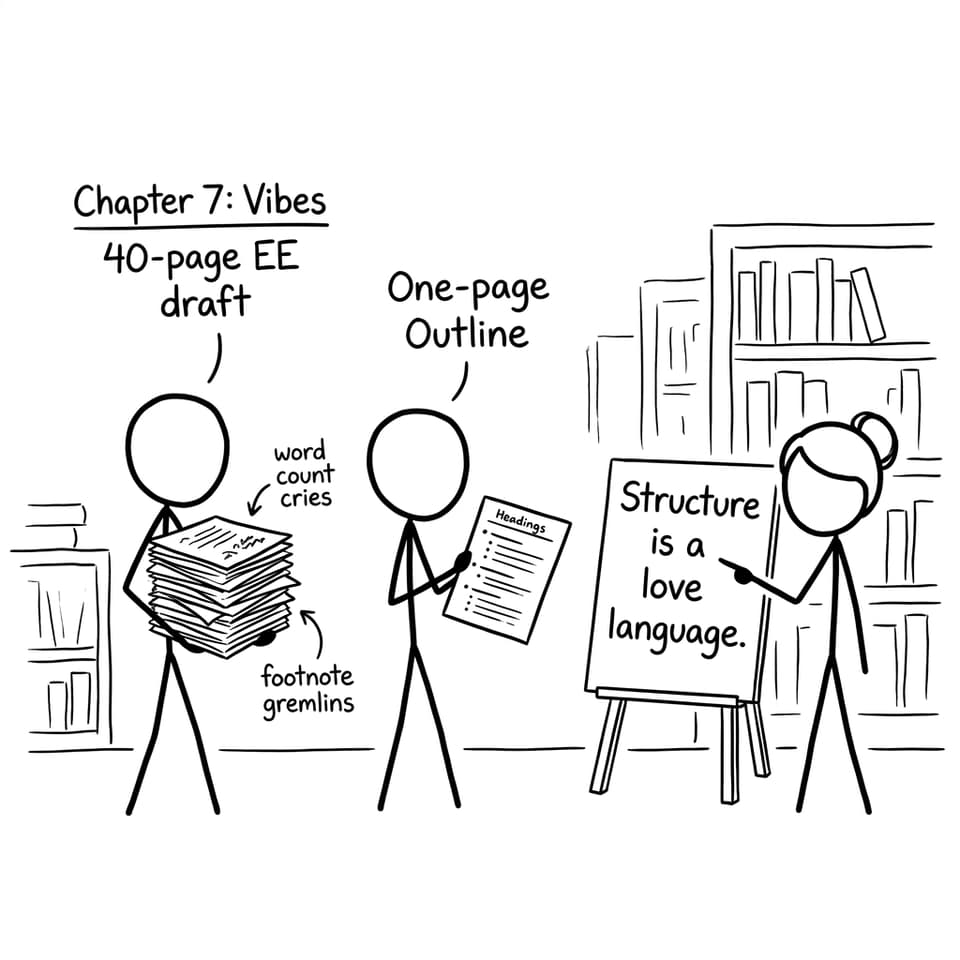
A good EE is calm. Not because the topic is easy, but because the process is structured.
RevisionDojo is designed to give you that structure:
- Study Notes to clarify background concepts quickly (so you don’t overwrite context).
- Flashcards to keep key terminology and theories active while drafting.
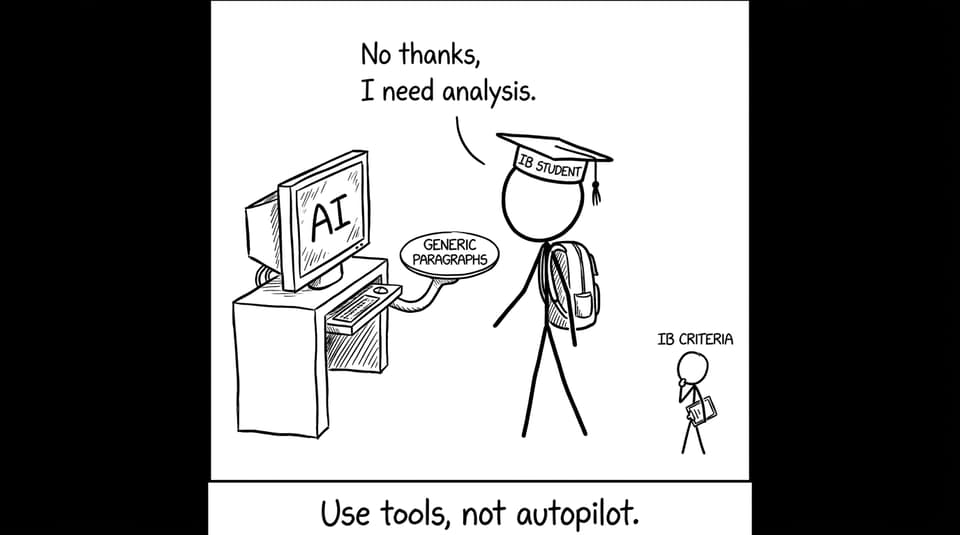
- AI Chat to test your RQ focus, generate outline options, and pressure-test whether a paragraph answers the RQ (use it as a mirror, not a ghostwriter).
- Grading tools to align sections with what criteria reward, so your structure matches marking reality.
- Coursework Library to see how strong academic writing signals analysis and evaluation.
- Tutors when you need a human to challenge your logic and tighten scope.
- For exam season alongside EE work: Questionbank, Predicted Papers, and Mock Exams to keep your IB subjects moving even when the EE tries to take over your calendar.
If you want a criterion-aligned improvement loop, this is a strong companion read: IB EE Feedback Tool: Improve Your Extended Essay Score.
Bringing it home: your EE is a promise you keep
The best EE structures in 2027 are not fancy. They’re faithful.
Faithful to the research question. Faithful to subject conventions. Faithful to the idea that every page should earn its place.
If you want a simple next step: open your draft, paste your RQ at the top of every section, and ask whether the section answers it more clearly than the previous one. Then use RevisionDojo to tighten the plan: explore the IB Extended Essay Guides, check your structure against How to Structure an Extended Essay (EE), and run a final polish with RevisionDojo’s tools so your EE reads like one mind from start to finish.