


Progress is easy to feel in one subject and difficult to see across eight. A strong science result can hide a weak investigation skill. Three hours of mathematics revision can feel productive without showing whether your reasoning improved. Busyness creates motion, but evidence reveals direction.
If you want to track my progress across MYP subjects, use one dashboard built around three things: your latest evidence, your criterion-level trend, and your next action. Update it for ten minutes each week. Do not rely only on study hours, confidence, or a single overall grade.
Your MYP progress checklist
Before building the tracker, collect:
- Your current MYP subjects
- The four assessment criteria used in each subject
- Your latest assessed task or teacher feedback
- One recent practice result per subject, if available
- Upcoming assessment dates
- A place to store mistakes and next steps
The MYP uses criterion-related assessment. In the usual subject groups, work is judged using four subject-specific criteria, commonly labelled A to D, with achievement levels from 0 to 8. Criterion names and expectations differ between subjects, so use the rubrics supplied by your school.
For more context, read how MYP students are graded and the guide to RevisionDojo's MYP assessment criteria coverage.
Build your tracker in six steps today
Create one row for every subject
Open a spreadsheet and enter each subject on a separate row. Add these columns:
| Subject | Latest evidence | Criteria assessed | Result | Trend | Main gap | Next action | Review date |
|---|---|---|---|---|---|---|---|
| Mathematics | Algebra task | A, C | A: 5, C: 4 | Stable | Explanations omit reasons | Rewrite one solution | Friday |
| Sciences | Investigation | B, C | B: 6, C: 5 | Improving | Evaluation is too general | Evaluate two limitations | Monday |
| Language and Literature | Text analysis | A, B | A: 4, B: 5 | Declining | Effects are described, not analysed | Rewrite one paragraph | Wednesday |
“Latest evidence” should name an actual task. Studying biology is an activity, not evidence. A completed question set, teacher-marked investigation, timed response, presentation rubric, or corrected design draft is evidence.
Record criteria instead of averaging everything
An overall subject grade is useful, but it can conceal the skill requiring attention. Your mathematics knowledge might be strong while unclear working repeatedly limits your communication performance.
Record each assessed criterion separately. Leave it blank if it was not assessed. A blank cell means “no current evidence,” not zero. MYP tasks may assess only selected criteria.
The MYP syllabus and assessment overview can clarify the wider structure, while your teacher's task sheet remains the authority for the assignment in front of you.
Add a simple trend signal
Compare the newest result with the previous result for the same criterion:
- Improving: stronger evidence or a higher achievement level
- Stable: similar performance across two attempts
- Needs attention: weaker performance or the same recurring error
- Unknown: not enough comparable evidence
Do not overreact to one result. Tasks vary in difficulty and can reveal different abilities. Look for patterns across at least two comparable pieces of work, then check your interpretation against the rubric or with your teacher.
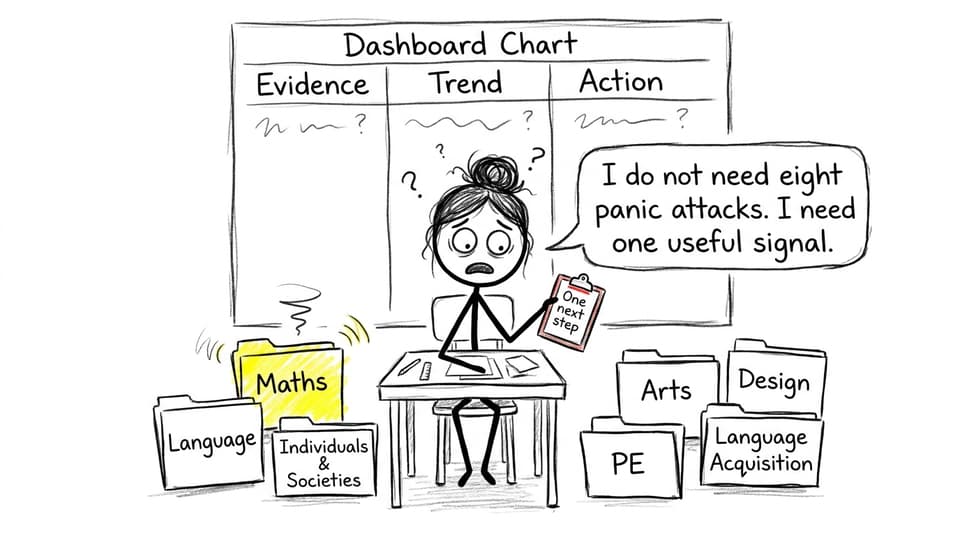
Turn feedback into one observable action
“Improve science” is too vague to guide a study session. “Write a conclusion that refers to processed data” is visible and testable.
Translate each main gap using this structure:
Next time, I will do a specific behaviour to improve a named criterion or skill.
Examples include:
- Next time, I will explain how each quotation supports my interpretation.
- Next time, I will show units throughout the calculation.
- Next time, I will evaluate one strength and one limitation of my method.
- Next time, I will justify why my design choice meets the user's needs.
This MYP revision technique connects feedback to the next attempt. The guide to balancing formative and summative MYP assessment explains the wider feedback loop.
Schedule the next evidence check
A next action without a date often disappears. Assign every weak area a short practice session within the next seven days.
Use spacing rather than repairing every subject in one evening. During each session, retrieve information from memory, attempt a task, check feedback, and correct the error. Re-reading can support understanding, but it does not show what you can produce independently.
For a broader structure, adapt the MYP revision guide and study tips. Students preparing for digital assessment can also use these MYP eAssessment strategies.
Review the dashboard for ten minutes each week
Choose a fixed weekly time. Then answer four questions:
- What new evidence did I collect?
- Which criterion is improving?
- Which error has appeared more than once?
- What is the smallest useful task for next week?
Update only what changed. A tracker should reduce mental clutter, not become another elaborate assignment.
Use three types of progress evidence
Reliable tracking combines outcomes, performance, and habits.
Outcome evidence
This includes criterion levels, task results, and teacher judgements. It tells you what happened, but not always why.
Performance evidence
This includes question accuracy, reasoning quality, time taken, independence, and repeated error types. It is useful between school assessments because it gives you something current to improve.
Habit evidence
Track whether you completed planned retrieval, corrected mistakes, or returned to a topic after several days. Hours studied are not proof of mastery. Time matters, but what you do during that time matters more.
Your criterion level might be stable while timed accuracy and revision consistency improve. That remains meaningful progress before the next formal result arrives.
Connect your tracker to RevisionDojo
The RevisionDojo MYP hub brings subject resources into one connected system. Begin with the gap named in your tracker, not the resource that feels easiest.
If understanding is the problem, use Study Notes or ask AI Chat for a simpler explanation. If recall is weak, use Flashcards without looking at the answer first. If application is the issue, complete a targeted Questionbank set and use Grading tools to examine the response. Record the result, error type, and next action.
Later, Mock Exams and Predicted Papers, where available for the relevant course, can test timing and stamina. The Coursework Library can reveal how effective work is structured, while Tutors can diagnose a persistent pattern that independent revision has not resolved.
For a subject example, see how MYP mathematics is assessed and revised. The method transfers: identify the criterion, produce evidence, diagnose the gap, and try again.
Avoid tracking mistakes that create false confidence
Do not colour every subject green because homework is complete. Completion measures activity, not understanding.
Do not compare unlike tasks as if they were identical. A short knowledge quiz and an extended investigation may assess different criteria.
Do not make the dashboard too detailed. Tracking every minute, page, and flashcard can consume the time intended for learning.
Finally, do not use red as a judgement about yourself. Red means “choose this next,” not “I am bad at this subject.” Tracking helps you decide where the next focused hour will matter most.
Make progress visible, then make it useful
The best MYP study tips are rarely complicated. Collect real evidence. Track the relevant criterion. Find the repeated gap. Schedule one action. Review the trend next week.
You do not need perfect control over every subject at once. You need a system that shows what deserves attention now. RevisionDojo is the ultimate IB resource for making that system practical, connecting notes, recall, questions, feedback, realistic practice, coursework support, and tutoring.
Start with one row today. Add your latest evidence, name one gap, and complete one next action. Progress becomes less mysterious when you leave yourself proof.