
You can be “good at maths” and still feel blindsided by MYP Mathematics.
It happens in a very specific way. You finish a test thinking, I got most of the answers right, then the result comes back and it doesn’t match your effort. The frustrating part is that nothing feels obviously wrong. You revised formulas. You practised procedures. You did the work.
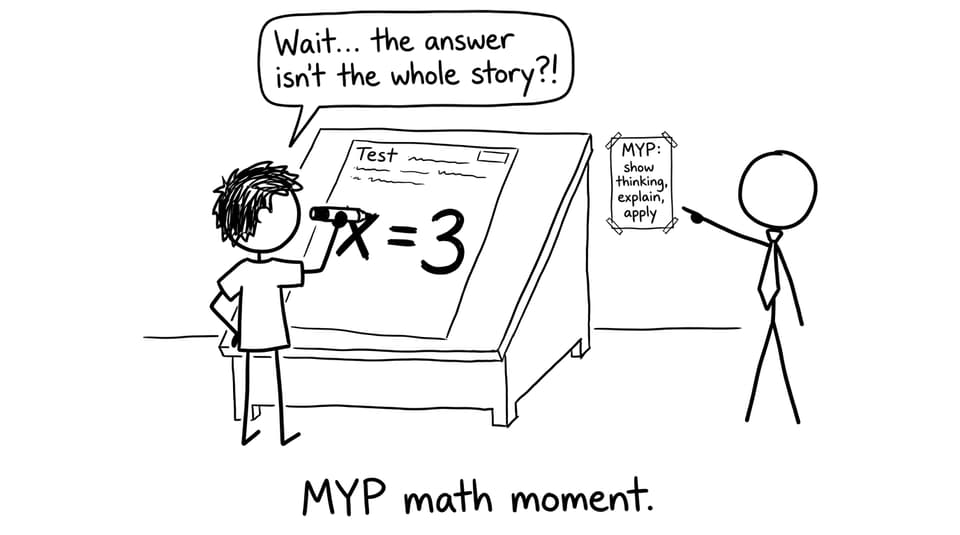
But MYP Mathematics isn’t built to reward only correct answers. It’s built to reward mathematical thinking you can prove on the page.
The one idea that explains most MYP Maths grades
In MYP, mathematics is assessed through four criteria. Most tasks target one or two criteria at a time, and your grade depends on which criterion the task is actually measuring.
If you revise like a traditional course, you often train Criterion A (skills) while quietly neglecting the others.
Quick checklist before any revision session:
-
Identify which MYP criterion you’re practising (A, B, C, or D)
-
Decide what “full marks” looks like in that criterion
-
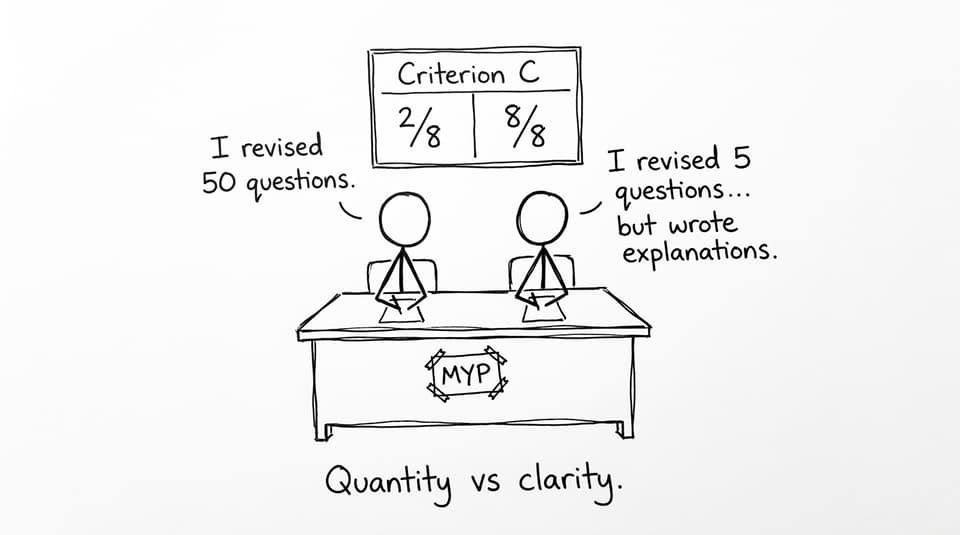
Do fewer questions, but write more reasoning
-
Review mistakes using criterion language, not just “silly errors”
For a broader overview of how grading works across subjects, see How Are IB MYP Students Graded? Criteria Explained.
The four MYP Mathematics assessment criteria (what they really mean)
Criterion A: Knowing and understanding
Criterion A is the part that feels most familiar: recall, method, accuracy.
To score well, you need to show you can:
-
Select correct formulas and techniques
-
Carry out procedures accurately
-
Present relevant working (not just a final line)
This is where RevisionDojo’s MYP Standard Mathematics resources help because you can rebuild weak topics quickly with Study Notes, then immediately confirm them with Questionbank practice.
Criterion B: Investigating patterns
Criterion B is where students often say, “I didn’t know what they wanted.” What they want is: can you notice structure, generalise, and justify the generalisation?
High-scoring work usually includes:
-
A clear pattern statement
-
A rule written in general form
-
Evidence the rule holds (testing, reasoning, or a convincing argument)
If you need a refresher on how to write a strong generalisation, use Patterns and generalisations notes and then practise a set of similar prompts using the Questionbank.
Criterion C: Communicating
Criterion C is the quiet grade-killer: you can be correct and still lose marks if your thinking is invisible.
Strong MYP communication looks like:
-
Working that follows a logical order
-
Correct mathematical notation
-
Short sentences that explain why you chose a method
A simple habit: after every key step, add one line of explanation (even if it feels obvious). That one line often separates a 5 from a 7.
Criterion D: Applying mathematics in real-life contexts
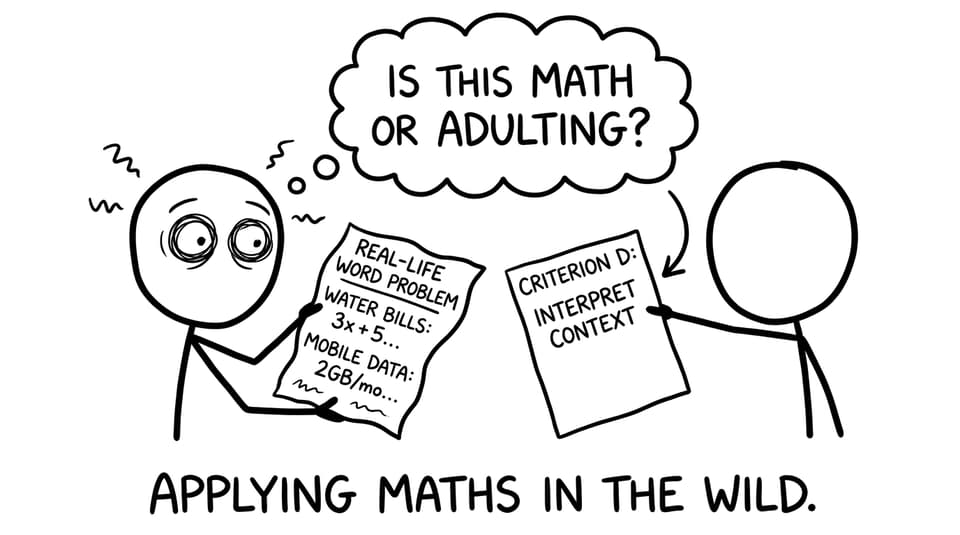
Criterion D is where maths becomes “messy on purpose.” The numbers aren’t the challenge. The interpretation is.
To score highly you must:
-
Translate the context into maths correctly
-
Choose a model or strategy that fits
-
Interpret your answer back in context (units, reasonableness, limitations)
If you find you misread scenarios, practise with timed, context-heavy sets and then do a second pass where you rewrite the final interpretation more clearly.
How to revise for MYP Mathematics without plateauing
Most plateaus in MYP Maths come from one pattern: doing lots of questions that only train Criterion A.
A smarter approach is “criterion rotation”:
-
Day 1 (A): methods and accuracy
-
Day 2 (B): patterns and general rules
-
Day 3 (C): rewrite one solution for clarity and notation
-
Day 4 (D): real-life modelling and interpretation
On RevisionDojo, this is easier because the ecosystem supports the whole loop: Questionbank for targeted sets, Study Notes for quick rebuilding, Flashcards for active recall, and AI Chat to challenge your reasoning when you get stuck.
Helpful starting points:
A simple weekly MYP revision routine (30-45 minutes a day)
-
Two short Criterion A sets (accuracy + method)
-
One Criterion B investigation (pattern + justification)
-
One Criterion D context problem (model + interpret)
-
One Criterion C “rewrite”: take an old solution and improve communication
If you’re preparing for broader MYP exam formats too, the pacing and structure in MYP eAssessments: 30-Day Study Plan That Works adapts well to maths.
The quiet advantage of understanding MYP assessment
The students who score highest in MYP Mathematics don’t necessarily do more maths. They do more explainable maths.
So the next time you revise, don’t just ask: “Did I get it?” Ask: “Which MYP criterion was this, and did my page prove it?”
If you want that practice loop in one place, with Questionbank, Study Notes, Flashcards, AI Chat, Grading tools, Predicted Papers, Mock Exams, a Coursework Library, and Tutors when you need human support, start with the MYP Standard Mathematics resources and build from there.