Join 650k+ students breezing through the IBReady to breeze through the IB?
A blank document can feel like a verdict.
You open your TOK essay draft, stare at the prescribed title, and suddenly every sentence sounds either too confident (which feels un-TOK) or too vague (which feels like you are hiding). That tension is normal. In TOK, you are not rewarded for sounding certain. You are rewarded for showing how knowledge becomes convincing, where it breaks, and what it costs to treat it as true.
This guide walks you through TOK essay strategies step by step: how to choose a title you can actually sustain, how to build a knowledge question that doesn’t collapse into a topic summary, how to structure claims and counterclaims that feel real, and how to use examples that do more than decorate your paragraphs.
Along the way, you’ll see how to tighten your draft with the right tools and feedback loops. If you want a reliable home base while you work, keep the IB Theory of Knowledge (TOK) hub open in a tab so you can bounce between guidance and execution without losing momentum.
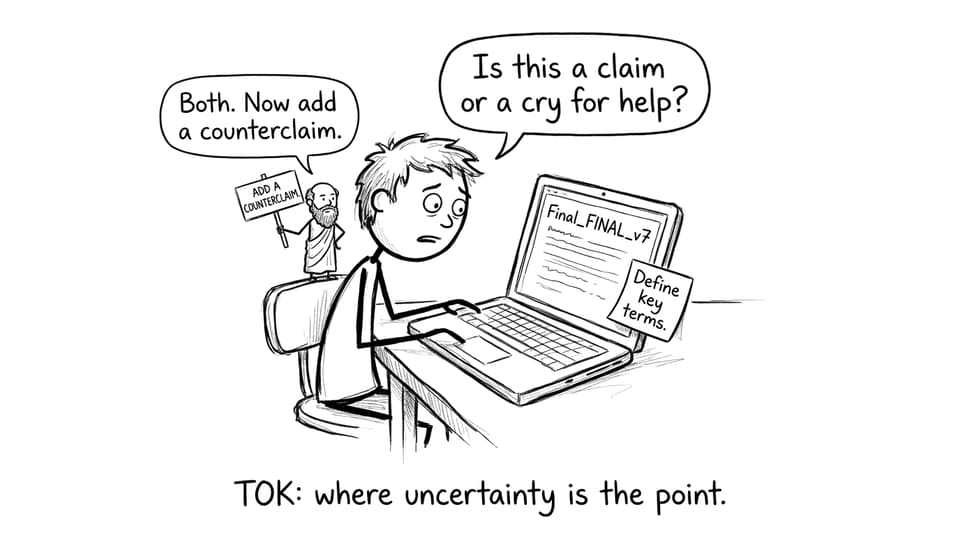
TOK essay draft panic but productive
A quick TOK essay checklist (save this before you draft)
If your TOK essay is drifting, this is the reset. Run this list before you write, and again after each revision.
I can rewrite the TOK title in simpler words without changing its meaning.
I have a single, debatable knowledge question (not a topic).
min read
min read
min read
min read
Each body section contains a claim and a counterclaim that truly disagree.
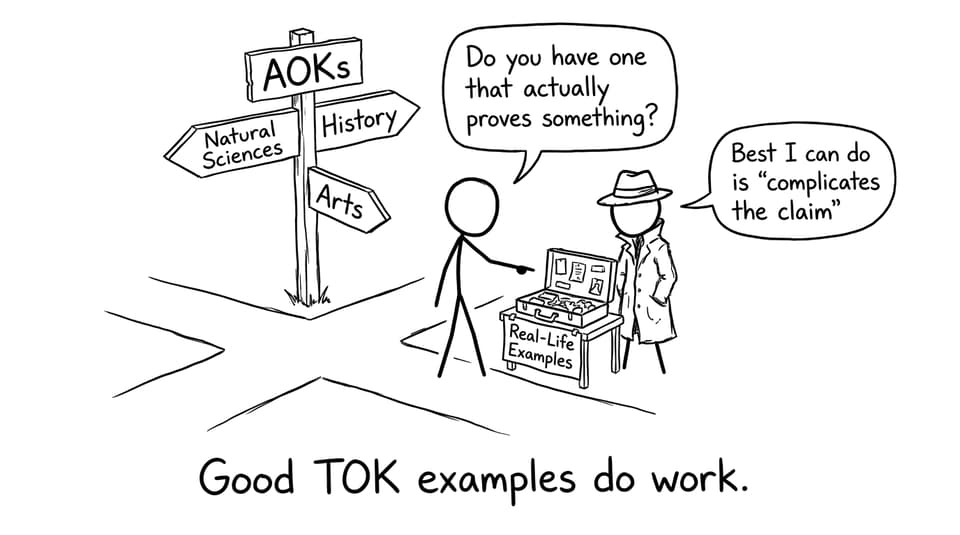
Every example is followed by analysis: what it shows about knowledge.
I explicitly connect to Areas of Knowledge (AOKs) and methods in those AOKs.
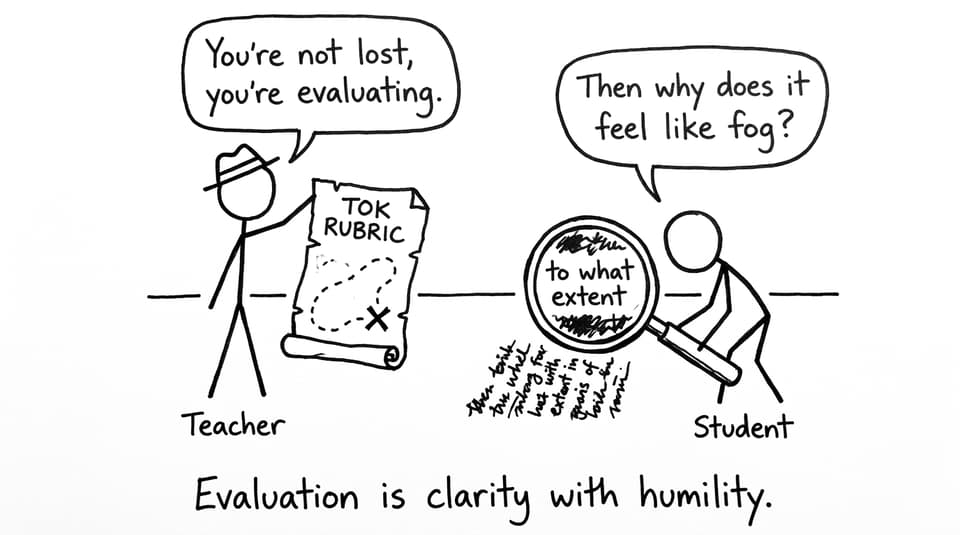
I evaluate, not just explain: I weigh conditions, limits, and implications.
My conclusion answers “to what extent” and reflects on what the discussion reveals.
Most students choose a TOK title the way you choose a seat on the first day of class: quickly, hoping it won’t matter.
But it matters because a TOK essay is a long conversation with one question. If you don’t care about the question, you will start writing for word count instead of for insight. And examiners can feel that.
Here’s a calmer approach.
A better way to pick a TOK title
Read all titles once, slowly. Then do a second pass and score each title 1 to 5 on three factors:
Interest: Would you enjoy arguing about this for two weeks?
Examples: Do you already know two or three real-life examples you could use?
Contrast: Can you see two AOKs that would naturally disagree or use different methods?
If a title scores high on interest but low on examples, it is still viable. You can build examples. If it scores high on “sounds easy” but low on interest, it usually becomes a shallow essay.
Step 2: Turn the prescribed title into a sharp knowledge question
In TOK, your title is the doorway. Your knowledge question is the room you actually live in.
A common mistake is to treat the prescribed title as a theme (like “technology” or “bias”) instead of a question about knowledge itself (like how we justify claims, who we trust, what counts as evidence, or when certainty is possible).
The TOK test: is it really a knowledge question?
A TOK knowledge question should be:
Open-ended (it cannot be answered with a single fact)
About knowledge (not about the event itself)
Transferable across AOKs (you can explore it in more than one domain)
Evaluative (it invites “to what extent,” “under what conditions,” or “how far”)
Under what conditions should we treat X as reliable knowledge, and what limits does Y create?
Where X might be “expert testimony,” “data,” “historical sources,” “mathematical proof,” or “artistic interpretation.”
This keeps your TOK essay from becoming a report. It forces evaluation, which is what TOK rewards.
Step 3: Build a thesis that actually argues
A TOK thesis is not “There are different perspectives.” Everyone knows that. The examiner wants to see what you think happens when those perspectives collide.
A useful TOK thesis has three parts:
Your judgement (a clear answer direction)
The condition (when your judgement holds)
The trade-off (what is lost or limited)
Example pattern:
In TOK, we should treat X as reliable when conditions A and B are met, but this reliability is limited by C because it reshapes what counts as evidence.
You can be nuanced without being indecisive. In TOK, precision is kindness to your reader.
Step 4: Choose AOKs that create tension, not symmetry
Students often pick two AOKs that feel familiar, then write two nearly identical paragraphs. That reads like balance, but it’s usually just repetition.
Instead, choose AOKs that disagree by design.
Natural sciences often prioritise reproducibility, measurement, models.
History often works with incomplete sources, interpretation, context.
The arts can treat ambiguity as value, not failure.
Human sciences deal with humans who react to being studied.
The best TOK essay strategies create productive friction: one AOK makes your claim look strong, another exposes its limits.
Step 8: Use feedback loops that actually improve your TOK essay
Feedback is only useful if it changes your next decision. “This is unclear” is not feedback. “Your claim is implied but not stated, and your counterclaim doesn’t challenge the same assumption” is feedback.
How to get better feedback from peers and teachers
Ask targeted questions:
Which sentence feels like my thesis?
Where do I stop doing TOK and start summarising?
Which example feels least connected to the title?
What is my counterclaim actually countering?
If you want a fast rubric-aligned diagnostic, use IB Coursework Grader to spot where your TOK essay is losing marks (often: weak evaluation, vague examples, unclear focus). Then use your fixes to drive a second draft.
And when you need to see what “strong” looks like, browse a few TOK Essay exemplars. Don’t copy structure blindly. Notice how they keep returning to the title, and how each example is used to test a claim.
Rubric as treasure map, evaluation as fog
Step 9: Polish for clarity (TOK rewards clean thinking)
TOK writing should feel like a careful conversation, not a performance.
A TOK editing pass that takes 30 minutes
Highlight every time you mention the prescribed title or KQ. If it disappears for long stretches, add signposts.
Underline evaluation phrases: “to what extent,” “under what conditions,” “this depends on,” “a limitation is.” If you have very few, you’re probably explaining not evaluating.
Check that each paragraph has one central dispute. If it has three, split it.
How RevisionDojo helps you execute TOK essay strategies faster
When TOK is hard, it’s usually because you’re trying to hold everything in your head at once: title, KQ, claims, AOKs, examples, counterclaims, and the rubric.
RevisionDojo is built to reduce that cognitive load with a connected workflow:
Use Study Notes to clarify core TOK terms and essay expectations in one place.
Use Flashcards to keep key concepts (AOK methods, common fallacies, justification language) alive daily.
Use AI Chat to pressure-test a claim, generate counterclaims, or ask “what assumption am I making here?” without losing study momentum.
Use Grading tools (especially the IB Coursework Grader) to get rubric-aligned feedback on your TOK essay draft.
Use the Coursework Library to browse annotated examples and calibrate your own standard.
When you want human guidance, use RevisionDojo Tutors to turn feedback into a plan.
Even if TOK is your focus, the same system supports your other subjects too. The home base is RevisionDojo, and the habits you build for TOK will carry into every argumentative task in the IB.
Bringing it together: the calm way to write a high-scoring TOK essay
The best TOK essay strategies are less like “writing tips” and more like a way of thinking under pressure. You pick a title you care about, turn it into a sharp knowledge question, create real tension between AOKs, and use examples as tests, not ornaments. Then you revise for evaluation: conditions, limits, implications.
If you want that whole process to feel less improvised, build your workflow inside RevisionDojo: plan with the IB Theory of Knowledge (TOK) hub, calibrate with TOK examples, and tighten your draft using the IB Coursework Grader. TOK is hard, but it becomes steadily easier when every draft has a purpose.
And when your document name becomes “Final_FINAL_v7,” remember: in TOK, uncertainty isn’t the problem. Unexamined uncertainty is.