


If you have ever opened the May 2026 prescribed titles and felt your brain try to quietly exit the room, you are not alone. TOK does that. Not because the questions are impossible, but because they are slippery in a very specific way: they ask you to show judgment about knowledge, not just knowledge itself.
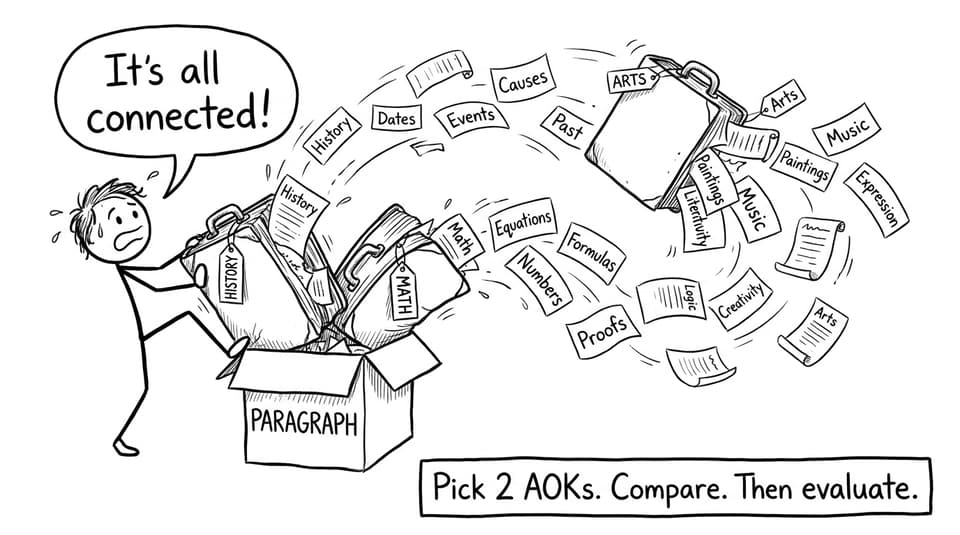
The good news is that the May 2026 TOK essay prompts are predictable in one sense: each one hides a small set of moves the rubric rewards. Make definitions arguable. Build a claim and a counterclaim that are both intelligent. Compare two Areas of Knowledge (AOKs) rather than writing two mini-essays. Then evaluate which view holds up best, and under what conditions. That is the whole game.
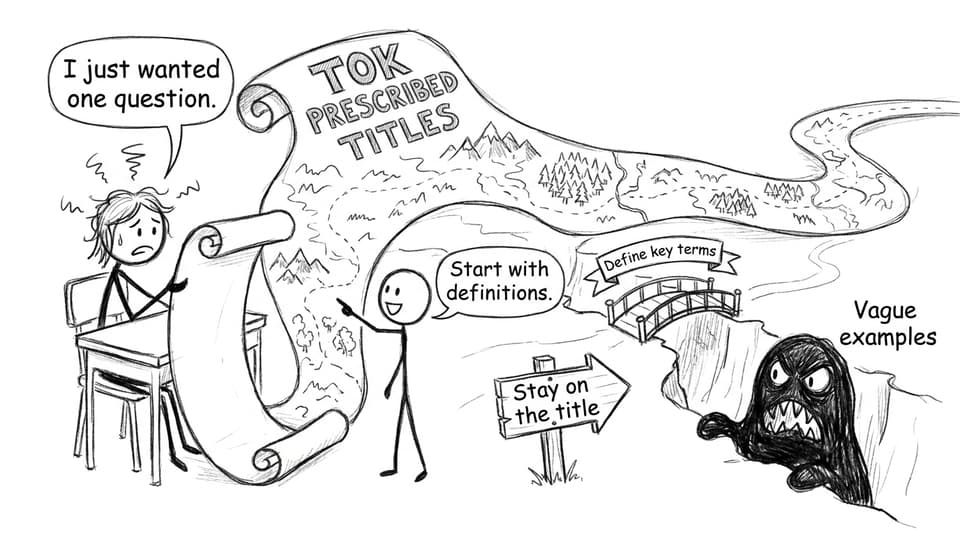
Quick start checklist for a high-scoring TOK essay
Before you commit to any title, run this TOK checklist. It will save you hours.
-
Pick one prescribed title and stick to it throughout your TOK essay.
-
Define the key terms early, but define them in a way you can argue with later.
-
Choose two AOKs that create real tension (not two versions of the same point).
-
Collect 2-4 sharp real-life examples you can explain in detail.
-
Write in a claim, counterclaim, evaluation rhythm.
-
Audit every paragraph for sustained focus on the TOK title.
If you want structured help choosing, use How to Choose the Best TOK May 2026 Essay Title. For planning, the deeper tools live inside the RevisionDojo Ultimate TOK May 2026 Essay Guide.
The May 2026 (M26) TOK essay prompts, explained
Below are the six May 2026 TOK prompts with what they are really asking, plus angles that tend to produce stronger evaluation.
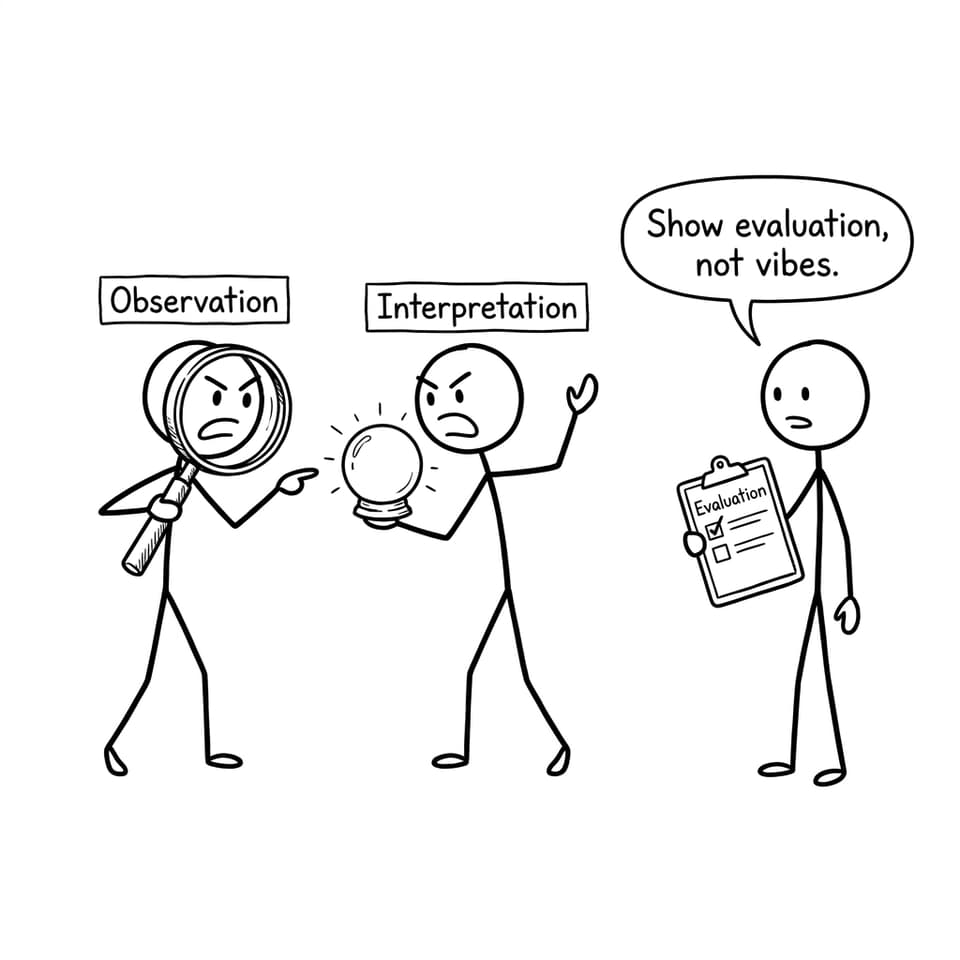
Prompt 1: Observation is essential but flawed
Title: In the production of knowledge, does it matter that observation is an essential but flawed tool?
AOKs: Natural Sciences and one other AOK.
This TOK prompt is about dependency. In the natural sciences, observation is not optional: data, measurement, and replication all lean on it. But flawed observation is not a minor inconvenience; it can shape what counts as evidence in the first place, especially when instruments limit what we can detect.
A strong comparison AOK is history. Historians also rely on “observation,” but indirectly: sources, artifacts, testimony. That distance changes the error profile. In science, you can sometimes improve observation with better instruments. In history, you often cannot rerun the past, so you compensate through corroboration and historiography.
To avoid a generic TOK essay, push your evaluation toward conditions: when do observation flaws matter more (high-stakes contexts, low signal-to-noise data, biased sampling) and when do methods contain the flaws well enough?
For more targeted angles, see TOK Counterclaims for May 2026 Titles (Best Picks).
Prompt 2: Doubt as a driver of knowledge
Title: To what extent do you agree that doubt is central to the pursuit of knowledge?
AOKs: Two AOKs of your choice.
This is classic TOK because it tempts you into preaching “skepticism is good.” Examiners want something more careful: doubt can be productive, but it can also be corrosive or performative.
In the natural sciences, doubt is built into peer review, replication, and the habit of falsification. In ethics or religion, doubt can open moral reasoning, but it can also destabilize communities that depend on shared certainty. The evaluation move here is to separate methodical doubt (a tool) from radical doubt (a worldview) and show how each plays differently across AOKs.
If you want an AOK-specific breakdown, use TOK May 2026 Title 2 Guide.
Prompt 3: Does conveying knowledge determine its power?
Title: Is the power of knowledge determined by the way in which the knowledge is conveyed?
AOKs: Mathematics and one other AOK.
This TOK prompt is about translation: turning ideas into forms other people can access. Mathematics looks “pure” because proofs do not depend on persuasion. Yet the power of mathematical knowledge in the world often depends on communication: notation, explanation, pedagogy, and the ability of others to apply the result.
Pair math with the arts, where knowledge is frequently conveyed through performance, image, and emotion. Here, conveyance is not a wrapper; it is part of the message. Your evaluation can ask: is knowledge powerful because it is true, because it is usable, or because it moves people?
For a focused read, see TOK May 2026 Title 3 Guide.
Prompt 4: Can we only understand through context?
Title: In the acquisition of knowledge, can we only understand something to the extent that we understand its context?
AOKs: Two AOKs of your choice.
This TOK title rewards nuance. In history and the human sciences, context is often the difference between explanation and oversimplification. A statistic without context becomes a weapon. A document without context becomes a trap.
But mathematics (and sometimes natural science laws) push back: a proof can hold regardless of culture or time. Your evaluation should not become “context matters in humanities, not in math.” Better is to show different kinds of context: conceptual context (definitions and axioms), historical context (why an idea emerged), and social context (how an idea is used).
If you struggle to turn titles into arguable questions, read TOK Essay Titles: What Are Knowledge Questions?.
Prompt 5: “All things are numbers” (Pythagoras)
Title: To what extent do you agree with the claim that "all things are numbers" (Pythagoras)?
AOKs: The Arts and the Human Sciences.
This prompt is a beautifully dangerous TOK invitation to reductionism. In the human sciences, numbers create clarity: measurement, trends, prediction. But what do numbers leave out? Meaning, motive, culture, identity, the hard-to-measure parts that still shape outcomes.
In the arts, you can argue both ways. Numbers show up as rhythm, harmony, proportion, and digital tools. Yet art also carries knowledge that resists full quantification: personal interpretation, aesthetic judgment, and emotional resonance. The evaluation move: decide what “are” means. Are numbers the best description of reality, or only one powerful lens?
Prompt 6: Is interpretation reliable in producing knowledge?
Title: To what extent is interpretation a reliable tool in the production of knowledge?
AOKs: History and one other AOK.
History cannot escape interpretation: sources conflict, perspectives differ, and narratives compete. Reliability here is not about eliminating interpretation; it is about disciplining it with method, transparency, and corroboration.
Compare history with the natural sciences to show a deeper TOK point: scientists also interpret data. Graphs do not speak. Models sit between observation and explanation. Your evaluation can ask when interpretation is a strength (pattern-finding, sense-making) and when it becomes a weakness (confirmation bias, motivated reasoning).
A practical TOK planning workflow (that feels calmer)
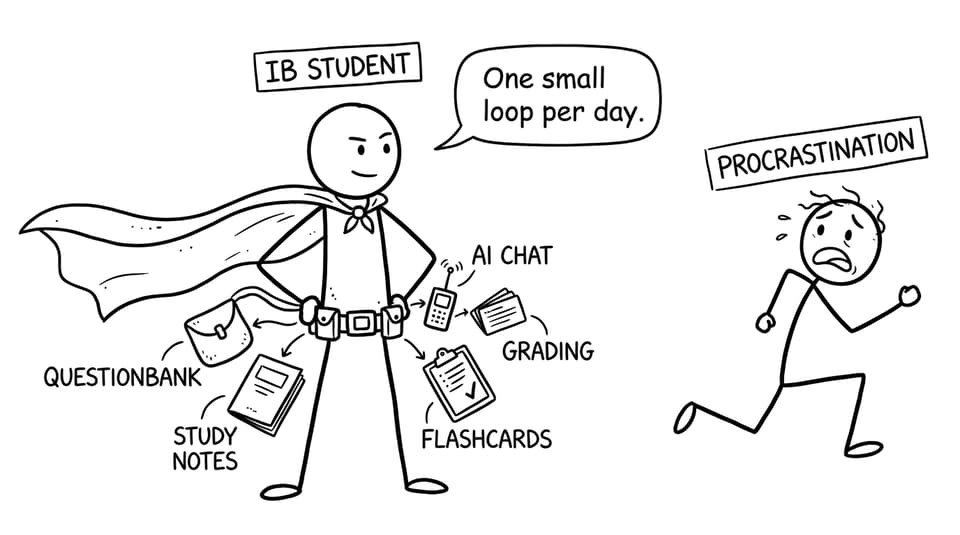
The fastest way to stop overthinking TOK is to build a repeatable loop.
-
Collect 3 candidate prompts and test them with 2 AOK pairings each.
-
Draft one knowledge question that matches the title language.
-
Choose 2-4 real-life examples you can explain in 90 seconds each.
-
Write one claim and one counterclaim per AOK.
-
Evaluate using “under what conditions” and “for whom.”
RevisionDojo makes this loop easier because everything connects: the Questionbank trains exam-style thinking across subjects, RevisionDojo App: IB Exam Prep helps you run consistent routines, and the TOK Essay Example Hub shows what strong structure looks like.
Closing: make TOK smaller, then make it better
The May 2026 TOK essay prompts can feel like they are asking for the “right” answer. They are not. They are asking whether you can think like someone who knows that knowledge is built with tools that sometimes fail: observation, doubt, language, context, and interpretation.
Keep your TOK essay simple on purpose: one title, two AOKs, a few sharp examples, and honest evaluation. Then use RevisionDojo to tighten the loop: Study Notes for clarity, Flashcards for recall, AI Chat when you are stuck, Grading tools to align with criteria, and the Coursework Library and Tutors when you want models and feedback that feel real.
When you are ready to go from “I kind of get the prompt” to “I can write this,” start with the RevisionDojo Ultimate TOK May 2026 Essay Guide and build your TOK plan in one focused sitting.