
A TOK conclusion is where your thinking finally shows
At some point in every TOK essay draft, there’s a moment that feels oddly familiar: you’ve written 1,200+ words, your examples are in place, your claims and counterclaims are behaving… and then you reach the last paragraph and your brain quietly suggests, “Let’s just summarise.”
It’s tempting because it’s safe. It’s also where many IB students lose the chance to sound like a knower instead of a note-taker.
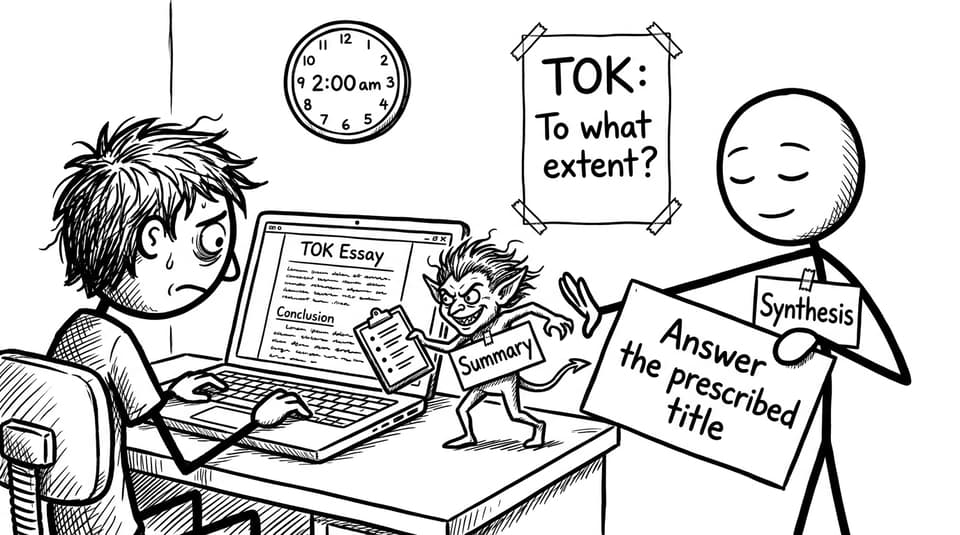
A strong TOK conclusion isn’t a final list of what you already said. It’s the moment you step back and do the most TOK thing possible: weigh the value and limits of what you’ve argued, return directly to the prescribed title, and show what your discussion reveals about knowledge itself.
If your introduction is the promise, your body paragraphs are the work, then your TOK conclusion is the proof that you actually learned something by doing the work.
Quick checklist: what a strong TOK conclusion must do
Use this as a fast diagnostic before you submit.
-
Re-state the prescribed title (or the knowledge question) in precise, simple language.
-
Give a clear final judgement that matches the “to what extent” or “how far” wording.
-
Synthesise your claim and counterclaim (do not list them).
-
Show how your Areas of Knowledge led you to that judgement.
-
Add a final insight: an implication, limitation, or “what this suggests about knowledge.”
-
End with purpose: a thoughtful closing line, not a filler sentence.
If you want a bigger structure check, pair this with the Comprehensive Guide to IB TOK Essay Structure so your ending aligns with what you set up at the start.
Why conclusions matter in TOK (more than in most essays)
In many subjects, a conclusion is a tidy wrap-up. In TOK, it’s part of the assessment’s spirit.
TOK is not asking you to “prove” a thesis like a courtroom drama. It’s asking you to explore knowledge claims responsibly: how they’re built, when they work, why they fail, and what their consequences are. That means the ending has to do something more mature than repeat your paragraphs.
A strong TOK conclusion signals three things to an examiner:
-
You understood the prescribed title, including its command terms.
-
You can evaluate competing perspectives without collapsing into “both sides are valid.”
-
You can connect your discussion to bigger consequences: reliability, ethics, bias, context, methodology.
RevisionDojo’s IB Theory of Knowledge resources are built around that same mindset: not just “what to write,” but “what TOK rewards when it reads your writing.”
The five-part TOK conclusion formula that actually sounds human
You don’t need a script. You do need a sequence.
Re-anchor in the prescribed title
Start by returning to the exact question you were asked. Don’t paraphrase into something easier. Use the key terms.
A useful first sentence often:
-
echoes the title’s key wording (“to what extent,” “in what ways,” “how far,” “are we justified”)
-
avoids dramatic certainty (“always,” “never”) unless your essay truly defended that level of confidence
This re-anchoring is especially important if your body paragraphs got complex. The examiner should feel you steering the ship back into harbour.
State your final judgement (with degree)
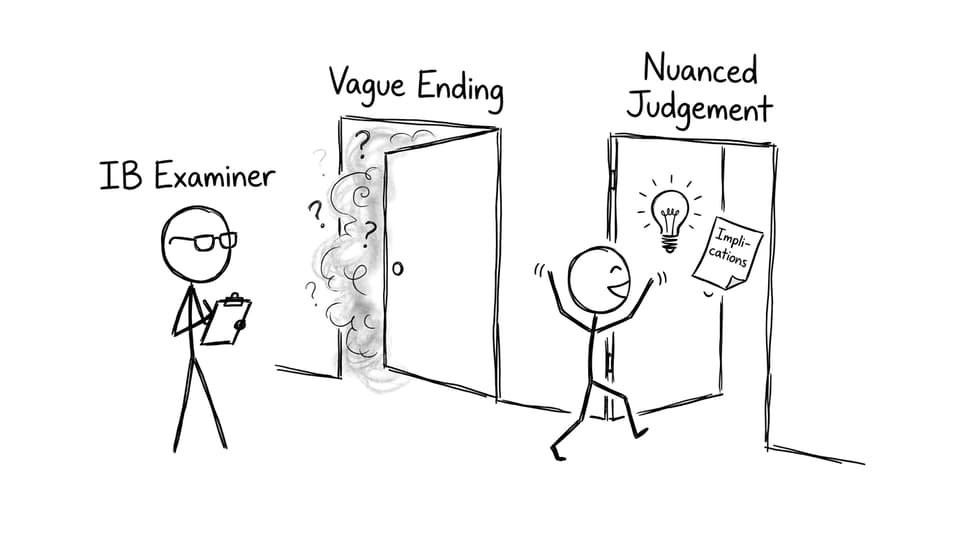
TOK conclusions are not a place to be vague. If the title asks “to what extent,” then give an extent.
Try writing a one-sentence judgement that includes a modifier:
-
“To a large extent…”
-
“Only in contexts where…”
-
“More reliably in X than in Y…”
-
“We are justified up to the point that…”
Your TOK conclusion should feel like a decision made after weighing evidence, not a preference.
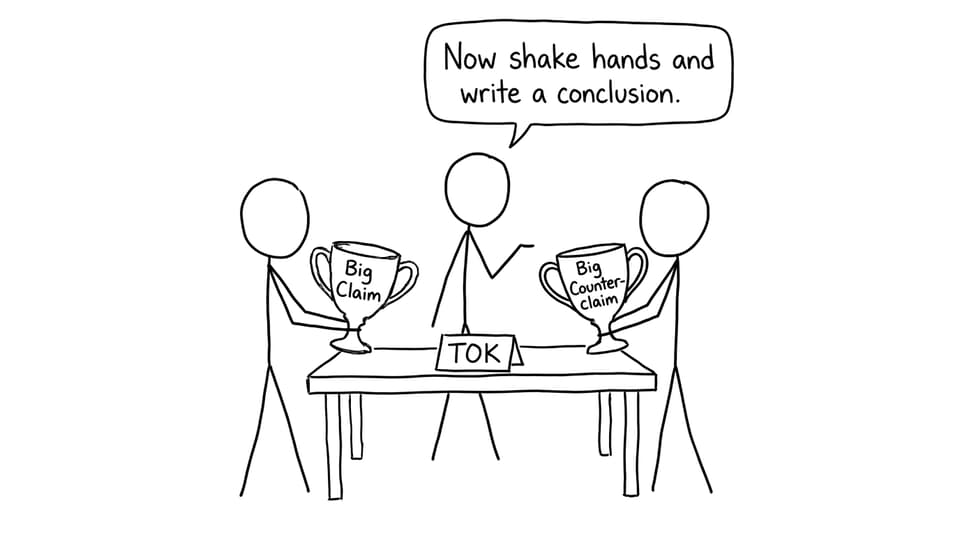
Synthesise claim and counterclaim (don’t recap)
Synthesis is not “I discussed A and B.” Synthesis is “A and B together suggest C.”
A simple move:
-
Identify the tension: what exactly made the counterclaim persuasive?
-
Resolve it conditionally: when does the claim hold, and when does it break?
If you want a conclusion-specific walkthrough, read How to Write Effective TOK Essay Conclusions and compare the difference between listing points and integrating them.
Connect back to your Areas of Knowledge (as methods, not labels)
Examiners don’t reward name-dropping “History” and “Natural Sciences.” They reward what you show about how those Areas of Knowledge produce and validate knowledge.
So in your TOK conclusion, reference AOKs through what they do:
-
“In the natural sciences, replication and measurement reduce personal bias, but they can’t eliminate theory-laden observation.”
-
“In history, the reliance on sources makes interpretation unavoidable, which increases explanatory depth but also raises disputes about reliability.”
Notice how the AOK is present, but the focus is method and limitation.
For deeper AOK-specific thinking, use RevisionDojo’s TOK notes, like What TOK Is (and isn’t), which help you phrase these ideas with cleaner conceptual vocabulary.
Add one final insight: implication, limitation, or “so what?”
This is where your conclusion becomes memorable.
Good TOK endings often point to:
-
a limitation: “This judgement depends on how ‘reliable’ is defined in the context.”
-
an implication: “If we accept this, it changes how we should trust expert knowledge in public debates.”
-
a further question: “What happens when knowledge is shared faster than it can be evaluated?”
Not as a new argument. As the natural consequence of the argument you already made.
Common TOK conclusion mistakes (and how to fix them fast)
Mistake: writing a summary paragraph with TOK vocabulary sprinkled on top
This is the most common problem: the conclusion becomes a “mini-essay” that repeats each section.
Fix: replace your recap sentences with “therefore” sentences.
-
Recap: “This essay discussed reason and emotion in ethics and the arts.”
-
Therefore: “Therefore, reason and emotion don’t compete as tools of knowing so much as they trade dominance depending on what the community counts as justification.”
Mistake: ending with certainty you didn’t earn
If your body paragraphs were cautious but your final line is “Thus, we can clearly see…,” it sounds like you panicked.
Fix: match your conclusion’s confidence to your evaluation. Use conditional language when needed.
Mistake: introducing a new example right at the end
New examples belong in body paragraphs where they can be analysed.
Fix: in the TOK conclusion, refer back to examples briefly only to show what they collectively imply.
Mistake: the “both sides” ending
TOK rewards balance, but it doesn’t reward indecision.
Fix: take a position with conditions. “Both sides” becomes “The claim holds in these conditions, but the counterclaim dominates in those.”
If you’re short on time before submission, the Last-Minute Tips for the TOK May 2026 Essay is a helpful final polish checklist.
How to make your TOK conclusion feel insightful (without sounding dramatic)
A useful rule: your last paragraph should sound like a calmer version of your introduction.
In the introduction, you interpret the title and promise a line of inquiry. In the conclusion, you return to that promise and show what the inquiry revealed.
Use “conceptual verbs” instead of filler verbs
Swap empty endings like “This shows…” for verbs that signal TOK thinking:
-
“suggests” (careful inference)
-
“complicates” (adds nuance)
-
“depends” (context sensitivity)
-
“exposes” (reveals assumption)
-
“reframes” (changes interpretation)
These verbs help your TOK conclusion sound evaluative rather than repetitive.
Name the assumption you uncovered
Many strong conclusions include one quiet line that reveals an assumption:
- “This debate assumes that reliability must mean consistency, but in some AOKs reliability may instead mean interpretive richness.”
That sentence often does more for quality than adding three more summary sentences.
Link to knowledge communities (not just individual knowers)
TOK is full of individuals, but knowledge is often shaped by communities: scientists, historians, artists, journalists.
A strong TOK conclusion can reflect on community standards:
- “The judgement ultimately depends on what the knowledge community demands: prediction, explanation, or meaning.”
Planning your conclusion before you write it (the 10-minute method)
Most students write conclusions last, when their energy is lowest. A better move is to plan the ending early so your body paragraphs build toward it.
Here’s a quick method:
Draft a “temporary conclusion” after outlining
Write 4 sentences:
-
Restate the title.
-
Your provisional answer (“to a large extent…”).
-
The condition that could change the answer.
-
The biggest implication.
This becomes your compass. As you write body paragraphs, you refine those sentences.
Keep a running “insight list” while drafting
Every time you notice a tension, limitation, or unexpected link between AOKs, jot it down. That list is where strong TOK conclusions come from.
Use RevisionDojo tools to sharpen the final paragraph
This is where students often benefit from structured feedback loops:
-
AI Chat (Jojo) to test whether your conclusion actually answers the prescribed title in one sentence.
-
Grading tools to check if your final paragraph aligns with what the rubric rewards.
-
The Coursework Library to see how top-level writing sounds when it’s being concise.
If you’re building an exam-prep routine alongside coursework writing, RevisionDojo App: The Smarter Way to Prep for IB Exams shows how to combine Study Notes, Flashcards, and targeted practice without burning out.
Using real-life examples in the conclusion (yes, but carefully)
Real-life examples are essential in TOK, but the conclusion is not the place to re-tell them.
Instead, use examples in the ending to do one of these jobs:
-
Show scope: “Across both examples, the method mattered more than the topic.”
-
Show limitation: “The example works, but only because the knowledge community agreed on standards of evidence.”
-
Show implication: “If this is true, then public trust in knowledge becomes fragile when standards of evidence are unclear.”
A good TOK conclusion might mention an example in half a sentence, then move immediately to what it reveals.
Clarity wins marks: how to keep your TOK conclusion simple
TOK can sound abstract. Your conclusion shouldn’t be.
Try these editing moves:
Cut the throat-clearing phrases
Remove:
-
“In conclusion…”
-
“Overall, it can be said that…”
-
“This essay has shown…”
Your first sentence should start with meaning.
Keep sentences slightly shorter than your body paragraphs
The conclusion is the landing. You want control.
Use one piece of TOK vocabulary per sentence max
If you stack terms like “perspective, bias, justification, methodology, paradigm” in one line, you sound like you’re trying to prove you learned the glossary.
Choose one term, use it precisely, then move on.
Feedback: the fastest way to upgrade a TOK conclusion
Most conclusions are written in isolation, which is ironic for TOK. The subject is about perspectives, and yet students avoid external perspective on their writing until it’s too late.
Here’s a feedback routine that works.
Ask for one specific type of feedback at a time
Don’t ask, “Is this good?” Ask:
-
“Does my conclusion answer the title with an extent?”
-
“Where do I sound like I’m summarising?”
-
“What implication feels most convincing?”
Specific questions create useful feedback.
Use criterion-aligned feedback, not general opinions
This is where RevisionDojo’s Grading tools shine. General feedback often becomes “sound smarter.” Rubric-aligned feedback becomes “your final judgement is unclear” or “your AOK comparison is descriptive.” That changes what you edit.
Re-write the final judgement in three versions
Write a cautious version, a confident version, and a conditional version. Pick the one that best matches your evidence.
That single exercise often transforms a TOK conclusion from vague to calibrated.
A mini template you can adapt (without sounding templated)
Use this as a flexible shape, not a copy-paste.
-
Sentence 1: Return to the prescribed title and key term.
-
Sentence 2: State your final judgement with degree.
-
Sentence 3: Synthesise the key tension between claim and counterclaim.
-
Sentence 4: Compare what your AOKs show about how knowledge is produced or validated.
-
Sentence 5: Offer an implication or limitation that matters beyond the essay.
If you want help building the full essay around this kind of ending, TOK Essay Planning Templates for May 2026 Titles can keep your structure consistent and your conclusion easier to write.
Bringing it home: your last paragraph is your final scorecard
A TOK essay conclusion is the point where you stop sounding like someone who collected ideas and start sounding like someone who evaluated them.
Return to the prescribed title. Make a judgement with an extent. Synthesis your claim and counterclaim into something truer than either one alone. Then offer one implication that proves you understand why knowledge questions matter outside the classroom.
If you want a simple next step, open your draft and rewrite only the first and last sentence of your TOK conclusion. Make the first sentence anchor the title. Make the last sentence carry an implication. That small change often upgrades the whole ending.
For a full support system while you practise, RevisionDojo is built to keep your IB work moving: Study Notes, Flashcards, Questionbank, AI Chat, Grading tools, Predicted Papers, Mock Exams, Coursework Library, and Tutors, all designed so your final paragraph feels earned, not improvised.