


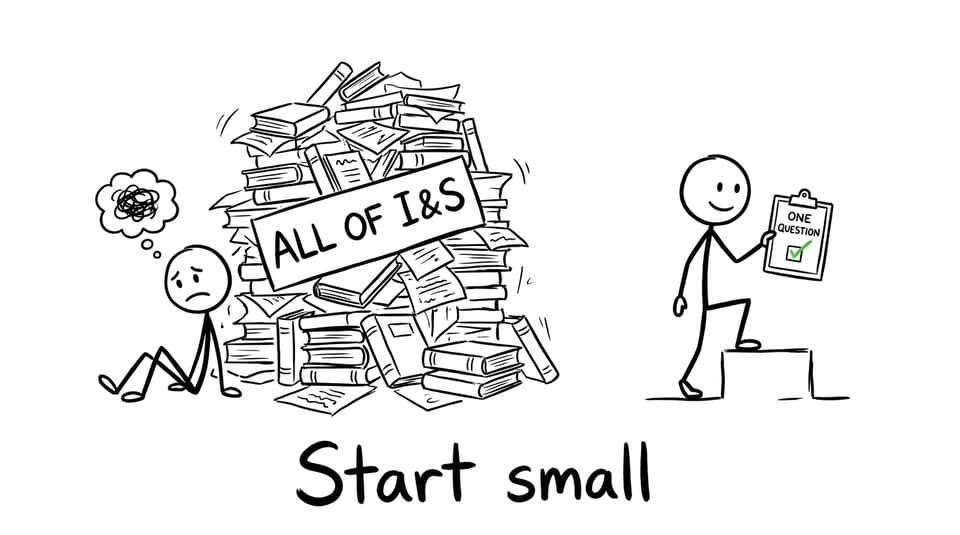
Motivation in MYP Individuals and Societies rarely appears before you begin. More often, it arrives after one manageable action: answering a question, recalling a case study, or improving a paragraph.
That is the practical answer to staying motivated studying MYP Individuals and Societies. Make the starting point small, give every session a specific purpose, and finish with evidence that you improved something. You do not need to feel inspired first.
This matters because Individuals and Societies is broad. Depending on your school, you may encounter history, geography, economics, politics, sociology, or integrated humanities. A vague goal such as “revise I&S” feels endless. A concrete goal such as “explain one cause of migration using evidence” gives your mind somewhere to begin.
Your motivation checklist
Use these principles whenever revision feels difficult:
- Reduce the first task to five minutes.
- Choose one topic and one MYP criterion.
- Produce something instead of only rereading.
- Separate learning, practice, and feedback.
- Record one visible improvement after each session.
- Decide tomorrow’s first task before stopping.
The MYP Individuals and Societies resource hub brings together Study Notes, Flashcards, lessons, definitions, and question practice for the subject.
Why motivation disappears during I&S revision
Students often assume low motivation means laziness. Usually, the task is simply poorly defined.
“Study globalization” does not tell you what to do. Should you memorize a definition, examine trade data, compare perspectives, or evaluate consequences? When the next action is unclear, delaying it becomes easy.
The subject also demands more than factual recall. The MYP framework organizes Individuals and Societies around four equally weighted criteria: knowing and understanding, investigating, communicating, and thinking critically. Memorizing notes can therefore feel unsatisfying because it covers only part of what success requires.
Use the criteria as four types of task:
- Criterion A: Retrieve and explain knowledge.
- Criterion B: Form questions, plan research, and assess methods.
- Criterion C: Organize and communicate ideas clearly.
- Criterion D: Analyse evidence, perspectives, and implications.
The guide to MYP Individuals and Societies criteria explains how to turn these categories into focused practice. Once you know which skill you are training, revision feels finite.
A 45-minute method for getting started
This routine works without rebuilding your entire timetable.
Choose one finish line
Spend two minutes writing a result you can see. Useful finish lines include explaining two consequences of urbanization, evaluating one source, comparing two perspectives, or recalling six terms without looking.
Avoid goals based only on time. “Study for 45 minutes” tells you when to stop, but not what to accomplish.
Make a five-minute first move
Set a timer and do the easiest useful action. Open the relevant notes, write what you remember, or complete a short Flashcard deck. You are not promising to finish the unit. You are only crossing the distance between not working and working.
If the topic is unfamiliar, use RevisionDojo Study Notes to build a concise foundation. Then close them and explain the idea in your own words. Retrieval quickly reveals what you understand and where the gaps remain.
Build one useful connection
Spend ten minutes linking the topic to a concept, example, and perspective. For migration, you might connect push-pull factors to systems, use one studied example, and compare the perspectives of migrants and governments.
This is one of the most useful MYP Individuals and Societies revision techniques because it reflects the subject’s inquiry-based character. You are using evidence to explain how societies work, not collecting disconnected facts.
For broader topics, the guide to interdisciplinary learning in Individuals and Societies shows how history, geography, economics, and politics can offer different lenses on one issue.
Answer one question without notes
Spend 15 minutes producing an answer. Use the Questionbank, a teacher-provided prompt, or a question you create from the unit. Write a paragraph, plan an investigation, interpret a source, or construct a comparison.
A dependable paragraph pattern is:
Point -> Evidence -> Explanation -> Link
If extended writing feels difficult, the MYP I&S essay structure guide shows how to turn evidence into a focused argument. Attempt the response before checking an ideal structure.
Review one weakness
Spend ten minutes comparing your answer with the relevant criterion, feedback, or notes. Do not rewrite everything. Identify the single change that would improve it most.
Perhaps your evidence was vague. Perhaps you described two perspectives without comparing them. Use RevisionDojo’s Grading tools or AI Chat to ask a precise question such as, “Where does this paragraph stop analysing and begin describing?” Then revise the weakest section. Feedback becomes motivating when it creates a visible before-and-after difference.
Leave a breadcrumb for tomorrow
Use the final minutes to record what improved, what remains unclear, and tomorrow’s first five-minute task. For example: “I can explain two causes of migration, but my evidence is general. Tomorrow I will retrieve three specific details from our case study.” This removes the next session’s first decision.
Use progress, not mood, as your signal
A useful revision system should work on an ordinary day when you are tired. That is why tracking completed actions is better than waiting for enthusiasm.
Create a weekly record with four boxes: recall, investigation, communication, and critical thinking. Mark the relevant box whenever you complete a meaningful task. The goal is not a perfect streak. It is to notice whether your revision has become unbalanced.
Use different RevisionDojo tools for different jobs. Flashcards support retrieval. The Questionbank turns knowledge into practice. AI Chat challenges weak reasoning, while Grading tools translate criteria into improvements. Mock Exams and Predicted Papers develop timing near formal assessments. The Coursework Library provides models to examine responsibly, and Tutors can diagnose recurring difficulties when independent revision stalls.
The tools are most valuable as a sequence, not as a collection of tabs.
Make difficult topics easier to revisit
Students naturally avoid topics associated with confusion. Instead of forcing a two-hour session, reduce the difficulty until returning feels safe.
For a difficult case study, make a compact card containing the issue and location, two specific pieces of evidence, one cause and consequence, two perspectives, and one limitation or counterargument. The guide to using MYP case studies effectively explains how to select evidence for an argument rather than retelling everything you know.
Vary the activity while keeping the topic constant. Retrieve definitions one day, analyse a source the next, and write a judgement later. Variety reduces boredom without sacrificing continuity.
Build a routine that survives a bad week
An ambitious schedule can feel exciting on Sunday and impossible by Wednesday. Build two versions instead:
- Standard session: 45 minutes using the full method.
- Minimum session: 10 minutes with three Flashcards, one short question, and one corrected mistake.
The minimum version preserves the habit during busy periods without pretending that ten minutes equals deep practice. When more time becomes available, return to the standard session.
For a wider weekly structure, use the MYP revision guide and study routine. Plan demanding writing when concentration is strongest and lighter retrieval for lower-energy periods.
Turn curiosity into momentum
Individuals and Societies becomes more engaging when revision returns to the questions underneath the content: Why do systems change? Who benefits from a policy? Why can two credible sources interpret one event differently?
Pick one question that interests you and connect it to the current unit. Curiosity cannot replace criterion-based preparation, but it gives factual knowledge a purpose.
Staying motivated does not mean enjoying every session. It means having a reliable way to begin, practise, improve, and return. Start with one finish line and one 45-minute loop. Then let RevisionDojo, the ultimate IB resource, connect your notes, active practice, feedback, assessments, coursework support, and tutoring into a system where progress is easier to see.