

If you have ever walked into an exam thinking, I know so many case studies, I have to score well, you are not alone.
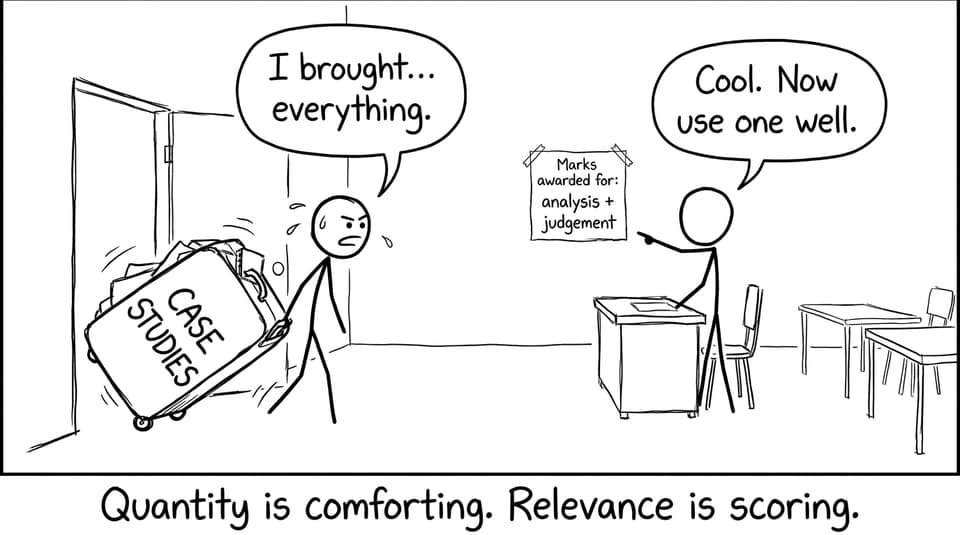
In MYP Humanities (Individuals & Societies), case studies can feel like armour. Names, dates, policies, statistics, they feel solid. But marks are not awarded for how heavy your suitcase of examples is. Marks come from how well your evidence supports analysis and judgement.
That shift: from collecting case studies to using them, is what separates busy answers from high-scoring MYP answers.
Quick checklist: what “effective” looks like in MYP
Before you write, run this MYP case study checklist:
-
Argument first: you know your point before you pick the case study.
-
One clear purpose: the case study is doing a job (explaining cause, supporting a judgement, comparing perspectives).
-
Specific evidence: one or two precise facts beat a long timeline.
-
Significance: you explain why the evidence matters.
-
Link back: every paragraph returns to the question and command term.
If you want topic-specific practice, start with MYP Individuals & Societies Resources and use the Questionbank to rehearse this under exam conditions.
Why case studies don’t automatically earn marks in MYP
In MYP, examiners are not rewarding “revision effort.” They are rewarding visible thinking.
A case study only earns marks when it strengthens your response to the question. That usually means it helps you:
-
explain cause and consequence (not just describe events)
-
justify a judgement (not just state an opinion)
-
compare outcomes or perspectives (not just list similarities)
-
show significance and limitations (not just give background)
This lines up closely with what teachers often mean by “more analytical,” especially in tasks targeting critical thinking. If you want the rubric language made clearer, MYP Individuals & Societies Criteria Explained is a helpful reference point.
Start with the argument, then choose the case study
A common MYP trap is picking your favourite case study first and then trying to force the question to fit it.
Flip it:
-
Decode the question. What is the command term asking you to do (explain, analyse, evaluate)?
-
Write a one-sentence answer. Your claim or judgement in plain language.
-
Choose the case study that best proves that sentence. Not the most interesting one, the most useful one.
This is also why timed Questionbank practice is so powerful: it trains you to decide quickly. Try a set from Demographic transition Questionbank to practise choosing evidence that matches the question, not your memory.
Depth beats breadth: one case study, used well
High-scoring MYP writing often uses one case study per paragraph, but uses it with purpose.
A strong “deep” case study paragraph usually has:
-
Context (1 sentence): just enough to locate the example.
-
Evidence (1-2 details): a policy, decision, data point, or outcome.
-
Explanation (2-3 sentences): how the evidence supports your claim.
-
Significance (1 sentence): why this matters for the wider issue.
A weak paragraph often flips the ratio: lots of context, little explanation.
Integrate your case study into a repeatable paragraph structure
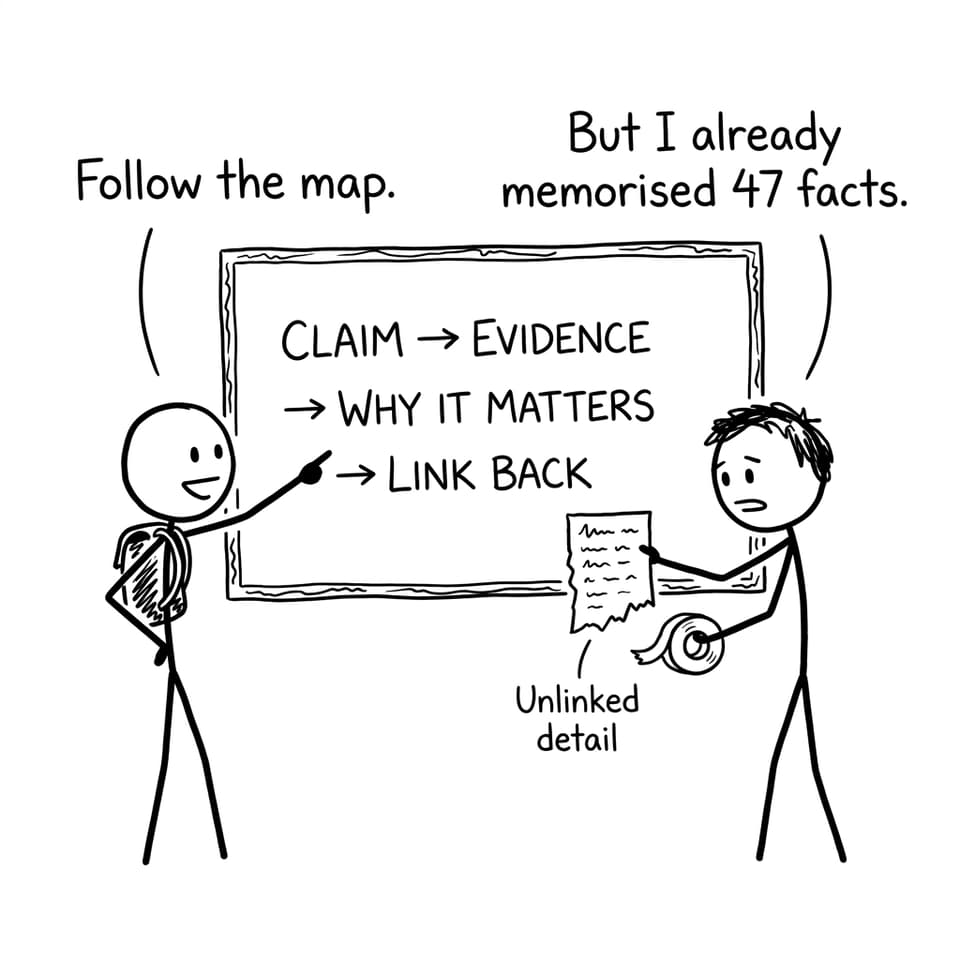
If your case study sits in a block by itself, it usually reads like an “evidence dump.” In MYP, you want your evidence braided into your reasoning.
Use this simple structure:
Claim
State the point that answers the question.
Evidence
Introduce one case study detail that supports your claim.
Why it matters
Explain the cause/consequence, significance, or limitation.
Link back
Return to the question and command term.
If you want an essay-level version of this, How to Structure High-Scoring MYP Individuals & Societies Essays breaks down what clear organisation looks like under pressure.
Avoid the “everything I know” trap
In MYP Humanities, extra detail can be tempting because it feels like protection. But too much detail often does three quiet things:
-
it dilutes your argument
-
it buries your judgement sentence
-
it makes your response harder to follow, lowering communication marks
A better mindset is: My job is not to prove I studied. My job is to prove my point.
To strengthen your precision, keep a small bank of flexible examples and definitions you can deploy quickly. The MYP Individuals & Societies Key Definitions page is useful for tightening terminology so your explanation sounds intentional.
Use case studies to show critical thinking (especially in MYP)
The strongest MYP case study use usually includes one of these critical-thinking moves:
-
compare outcomes: why did the same approach lead to different results?
-
evaluate success: what counts as “success,” and for whom?
-
acknowledge limits: what did the policy fail to address?
-
consider perspectives: who benefits, who loses, who decides?
If you need content refreshers to make those moves easier, RevisionDojo’s Study Notes help you rebuild understanding fast (for example, Identity formation Notes or Economic drivers Notes).
The key shift: treat your case study like a tool, not a trophy
In MYP, higher marks come when you stop asking, “What case study can I include?” and start asking, “How does this case study prove my point?”
If you want to train that skill quickly, use RevisionDojo as a loop: Study Notes to clarify, Flashcards to retain, Questionbank to apply under pressure, AI Chat and Grading tools to tighten your analysis, and Mock Exams and Predicted Papers to make exam day feel familiar. Start from the MYP hub and build the habit of evidence-with-purpose.
Case studies are not the destination. In MYP, they are the bridge between what you know and what you can prove.