
When you walk out of an MYP Individuals & Societies essay feeling confident, the disappointment can be sharp: the ideas were solid, the examples were real, and you knew the topic.
But the mark still lands lower than you expected.
In MYP, that gap is rarely about intelligence or effort. It’s usually about structure. Not the kind that makes writing sound fancy, but the kind that makes your thinking easy to reward. Once you learn to build an essay the way the criteria want to see it, your marks start to move.
The MYP essay checklist (save this)
Use this quick checklist before you write any MYP Individuals & Societies response:
-
Identify the command term and what it demands (explain vs analyse vs evaluate).
-
Rewrite the question into a one-sentence answer (your argument).
-
Plan 2-3 body paragraphs, each with one job.
-
In every paragraph: Point -> Evidence -> Explanation -> Link.
-
Finish by answering the question again, more precisely.
If you want topic-specific support alongside this structure, start from the MYP Individuals & Societies resources hub and pair the checklist with targeted practice.
What MYP Individuals & Societies essays are really assessing
A strong MYP essay isn’t a container for everything you remember. It’s a demonstration that you can think in a disciplined way.
Most MYP Individuals & Societies tasks reward students who can:
-
Make a clear claim that answers the question.
-
Select evidence that is relevant, not just impressive.
-
Explain cause, consequence, and significance.
-
Organise ideas so a reader can follow your reasoning without effort.
That’s why structure matters so much: it turns your knowledge into visible performance.
For a deeper criteria view, keep this nearby: MYP Individuals & Societies criteria explained.
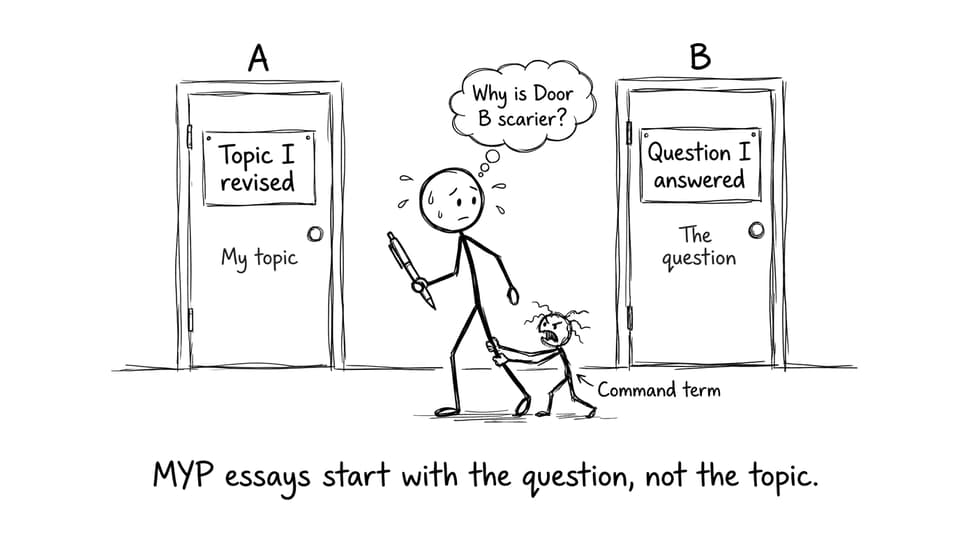
Start your MYP essay with the question, not the unit
Students often revise a unit title (migration, conflict, urban systems) and then try to squeeze that into the prompt. High-scoring MYP writers do the reverse: they treat the question as the only boss in the room.
Do this before you write a single paragraph:
-
Circle the topic focus (what is the essay about?).
-
Underline the time/place (which case study or context fits?).
-
Box the command term (how deep must your thinking go?).
-
Draft a one-line thesis: “This essay argues that…”
That one line becomes your map. Without it, you drift into background and description.
The MYP structure that consistently scores well
Different schools set different tasks, but the same MYP structure keeps working because it makes your reasoning easy to mark.
Introduction: answer immediately
A high-scoring MYP introduction does three things:
-
Answers the question in the first 1-2 sentences.
-
Gives a line of argument (what you will prove).
-
Defines a key term only if it prevents confusion.
Avoid long scene-setting. Background feels safe, but it delays the thing you’re graded on.
Body paragraphs: one idea each
Each MYP body paragraph should feel like a small, complete argument.
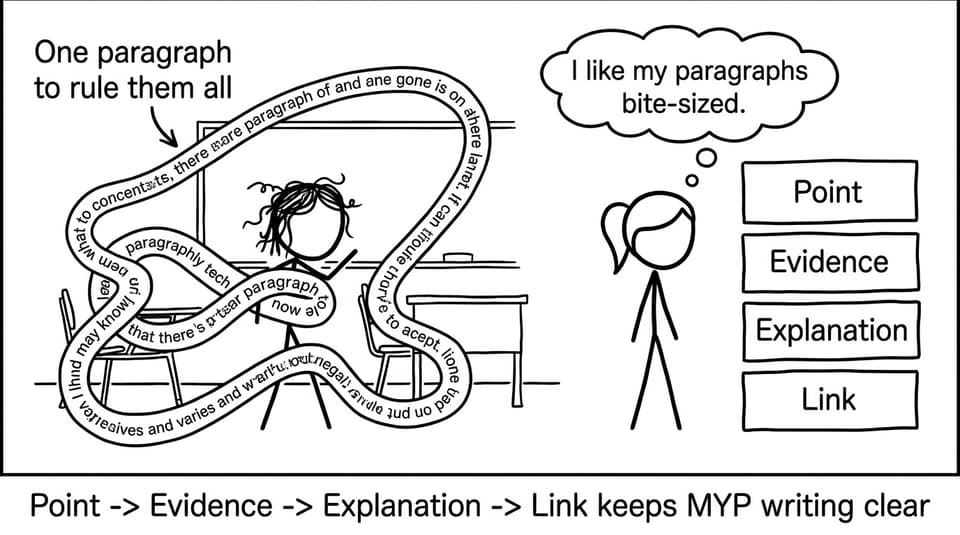
Use this dependable flow:
-
Point: a claim that links directly to the question.
-
Evidence: one or two specific facts, events, data points, or examples.
-
Explanation: how the evidence proves your point (cause, consequence, significance).
-
Link: connect back to the question and your overall argument.
A simple way to improve fast is to practise this paragraph pattern in short bursts using the RevisionDojo Questionbank, then refine using feedback.
Evidence in MYP: strategic beats excessive
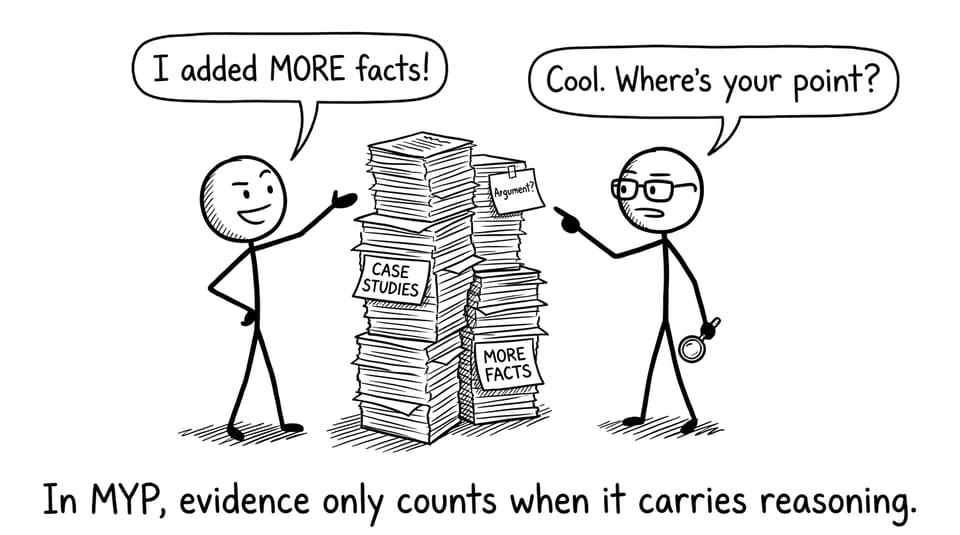
In MYP Individuals & Societies, more examples don’t automatically create a better essay. Markers can’t award analysis you didn’t write.
High-scoring evidence is:
-
Chosen because it fits the claim.
-
Specific (names, dates, policies, outcomes, trends).
-
Explained for meaning, not just mentioned.
If you have strong content knowledge but your marks plateau, it’s often because evidence is being dropped in without a sentence that explains why it matters.
To rebuild key concepts quickly, pair practice with Flashcards and topic Study Notes so your examples stay sharp.
Conclusion: answer again, but sharper
A high-scoring MYP conclusion is not a summary of what you talked about. It is a final judgement that makes your argument more precise.
Include:
-
A direct answer to the question, rephrased.
-
One sentence on which factor mattered most (or under what conditions your claim holds).
-
A short implication (why this matters beyond the case).
Why MYP essays often stall at 5 or 6
The frustrating part: a 5 or 6 can come from essays that feel “full.” The issue is that fullness can hide the thinking.
Common MYP plateau patterns include:
-
Writing description of events instead of analysis of causes and consequences.
-
Over-explaining background and under-explaining significance.
-
Mixing two or three ideas in one paragraph.
-
Answering the topic instead of answering the exact question.
The fix is rarely “learn more.” It’s usually “make the argument easier to see.”
If you want a wider MYP routine that supports this skill, use: MYP eAssessments: 30-Day Study Plan That Works.
A practice routine that improves MYP structure quickly
Structure is a skill, so treat it like training.
Try this loop 3 times a week:
-
Pick one prompt from the MYP Individuals & Societies Questionbank.
-
Spend 6 minutes planning (thesis + 2-3 paragraph points).
-
Write one full body paragraph only.
-
Use AI Chat to challenge your reasoning: “What counterargument would weaken this?”
-
Improve with criteria language, then rewrite just the explanation lines.
When you need human eyes, RevisionDojo Tutors and Grading tools can help you see exactly what to change, not just what was “unclear.”
Close: the structural shift that changes MYP marks
The strongest MYP Individuals & Societies writers don’t ask, “How much should I write?”
They ask, “How clearly does each paragraph answer the question?”
If you want a place to practise that skill without guessing, use RevisionDojo: build knowledge with Study Notes, keep it alive with Flashcards, train structure through the Questionbank, pressure-test with Mock Exams and Predicted Papers, and refine with AI Chat, Grading tools, the Coursework Library, and Tutors when you need deeper feedback.
Structure makes your thinking visible. In MYP, visibility earns marks.