
The moment MYP I&S starts to feel “unfair”
Most students hit the same wall in MYP Individuals & Societies.
You walk out of a task thinking, I included loads of facts. Then the mark comes back… and it doesn’t match the effort.
That feeling isn’t you being unlucky. It’s you aiming at the wrong target.
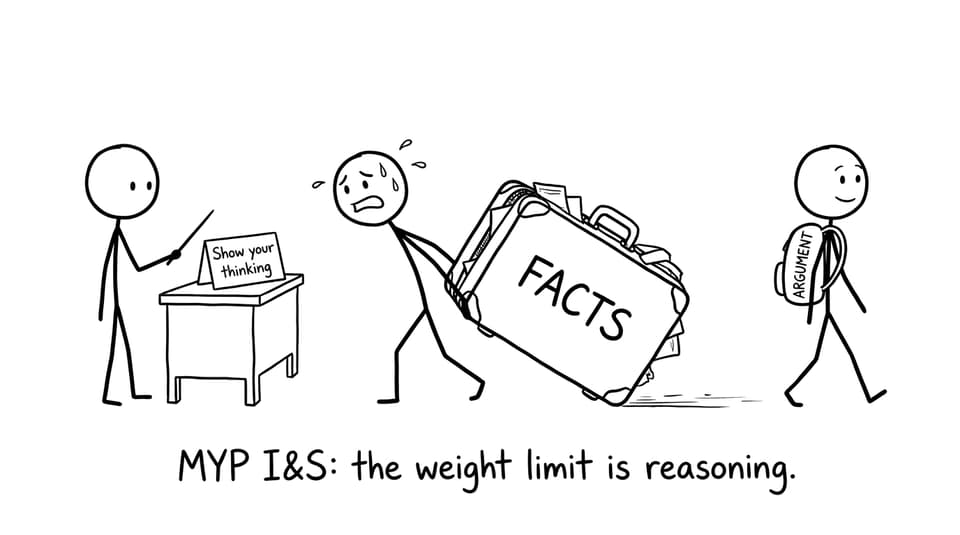
In MYP, Individuals & Societies isn’t graded by how much information you can carry into a response. It’s graded by how well you use knowledge to investigate, communicate, and think critically. Once you see the criteria as a map (not a mystery), your grades stop feeling random.
Quick MYP checklist: what the criteria are really testing
Before you revise, lock in these MYP truths:
-
Individuals & Societies uses four criteria (A-D).
-
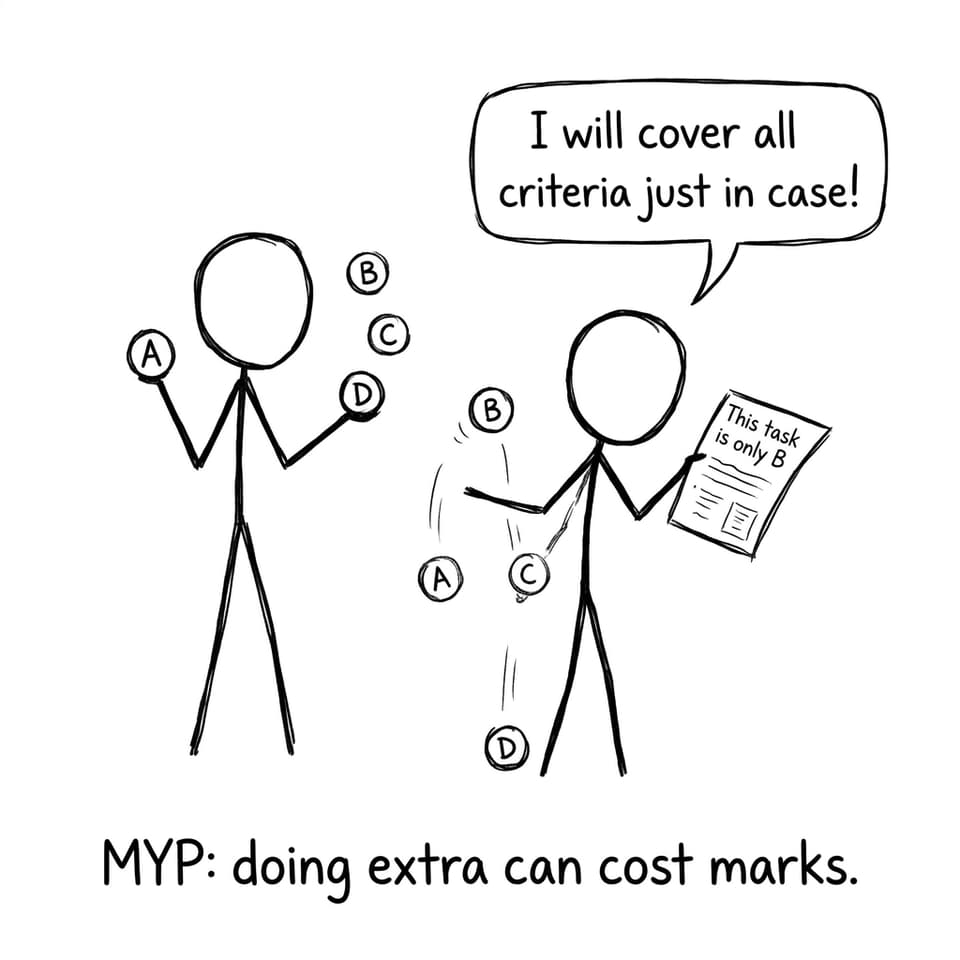
Most assessments target one or two criteria, not all four.
-
Extra content only helps if it creates clearer explanation, analysis, or judgement.
-
The fastest improvement comes from revising by criterion, not just by topic.
If you want one place to practice this, start with MYP Individuals & Societies Resources and use the Questionbank to train each criterion deliberately.
MYP Criterion A: Knowing and understanding
Criterion A in MYP Individuals & Societies is about what you know, but more importantly, what you can do with what you know.
High-scoring Criterion A usually shows:
-
Accurate, relevant terminology
-
Carefully chosen examples (not a list)
-
Concepts explained in your own words
-
Knowledge applied to the question’s focus
The common trap: students “name-drop” a case study and assume it earns credit automatically. In MYP, knowledge earns marks when it has a job: it should clarify a cause, support an inference, or strengthen an explanation.
To build sharp Criterion A knowledge quickly, use MYP Individuals & Societies Key Definitions and practise recalling terms with MYP Individuals & Societies Flashcards.
MYP Criterion B: Investigating
Criterion B is where MYP I&S starts to look like real academic work. It rewards how you design and evaluate inquiry.
Strong Criterion B evidence includes:
-
A focused research question
-
Sources chosen for a clear reason
-
Comments on reliability, bias, or limitations
-
A method that fits the task
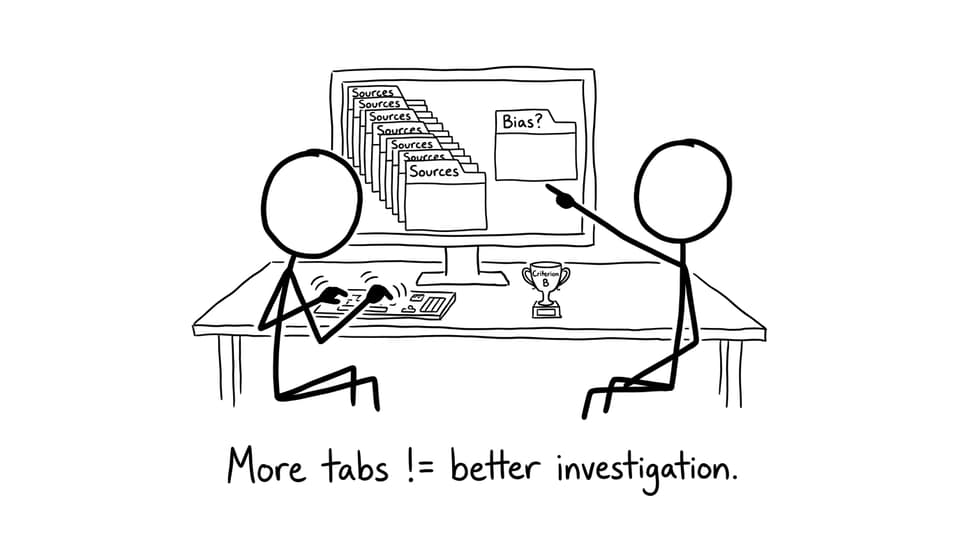
A mistake that keeps students stuck: confusing “more sources” with “better investigation.” A shorter bibliography with sharp evaluation often outperforms a long list with no judgement.
To practise Criterion B thinking, pick one topic from RevisionDojo notes (for example, Identity formation Notes or Economic drivers Notes) and ask RevisionDojo’s AI Chat to challenge your source choices and reasoning.
MYP Criterion C: Communicating
Criterion C in MYP Individuals & Societies is the silent grade-killer because it’s easy to underestimate. You can have strong ideas and still lose marks if your writing makes the examiner work too hard.
High-scoring Criterion C tends to have:
-
Clear paragraph structure
-
Topic sentences that answer the question
-
Subject-specific vocabulary used accurately
-
A logical flow from claim to evidence to explanation
One practical fix: use a simple structure repeatedly. RevisionDojo breaks this down well in How to Structure High-Scoring MYP Individuals & Societies Essays. Then practise writing under time pressure with the Questionbank and grade yourself using RevisionDojo’s Grading tools.
MYP Criterion D: Thinking critically
Criterion D is where MYP top scores are won or lost. It’s not about being “negative” or “complex.” It’s about making your thinking visible.
Strong Criterion D usually shows:
-
Cause and consequence (with significance)
-
Multiple perspectives compared fairly
-
A judgement that is supported and qualified
-
Evaluation of claims, not just description of events
If your answer reads like a timeline, you’re probably stuck below the top band. If your answer reads like an argument (with reasons), you’re moving into 7-level thinking.
To sharpen this skill, use MYP Case Studies: How to Use Them for Higher Marks and practise turning evidence into judgement.
How to revise MYP I&S without plateauing
Here’s a calmer MYP revision loop that actually changes marks:
-
Pick one criterion (A, B, C, or D).
-
Do a short set of criterion-aligned questions in RevisionDojo’s Questionbank.
-
Review mistakes and rewrite just one paragraph at a higher level.
-
Use Flashcards to keep key terms alive.
-
Use AI Chat to ask: “Where is my analysis thin?”
If you need a bigger plan around this, use MYP eAssessments: 30-Day Study Plan That Works or zoom out with the Middle Years Program (MYP) hub.
The shift that makes MYP I&S predictable
The big upgrade in MYP Individuals & Societies happens when you stop asking, “What information should I include?” and start asking, “Which MYP criterion is being assessed, and what does a top-band response look like?”
If you want that approach to feel simple in real revision, RevisionDojo is built for it: Questionbank practice, Study Notes, Flashcards, AI Chat, Grading tools, Predicted Papers, Mock Exams, a Coursework Library, and Tutors to keep your improvement specific and measurable.
Open your next task, identify the criterion, and train that skill on purpose. That’s how MYP grades stop feeling inconsistent.