


You do not have to enjoy every mathematics lesson to stay engaged. Staying engaged in MYP Standard Mathematics is usually less about endless motivation and more about creating a routine that still works when the subject feels dull, difficult, or disconnected from your interests.
The practical answer is simple: make each session short, give it one clear purpose, vary the kind of mathematics you practise, and finish with evidence that you improved. Engagement often follows action. Waiting to feel interested first can leave you waiting.
Your quick engagement checklist
Before studying, choose five things:
- One micro-goal: Solve three linear equations accurately.
- One MYP criterion: A, B, C, or D.
- One short time limit: Usually 20 to 30 minutes.
- One active task: Solve, explain, investigate, or apply.
- One visible result: A corrected answer or understood mistake.
This turns “study mathematics” from an uncomfortable cloud into a specific next move. If you need your materials together, begin with the MYP Standard Mathematics resource hub.
Stop expecting yourself to love every topic
Disliking mathematics is not a character flaw. A topic may feel repetitive, an earlier knowledge gap may make a lesson confusing, or you may understand the method without seeing why it matters.
A healthier mindset is: I do not need to love this topic, but I can learn how to handle it. Enjoyment is an emotion, while engagement is a behaviour. You cannot command yourself to become fascinated by algebra at 7:30 p.m., but you can complete four questions and review one mistake.
This distinction also protects you from an unhelpful identity. “I dislike this unit” describes a temporary experience. “I am not a maths person” turns that experience into a permanent label. Keep the description narrow and the possibility of improvement open.
Make progress small enough to see
“Revise geometry” is too broad. Your brain cannot see a clear finish line, so starting feels expensive. Replace it with a target such as:
- Find missing angles in four diagrams.
- Explain why a triangle's angles total .
- Correct one earlier similarity problem.
- Create a flashcard for a forgotten formula.
Small goals do not lower your standards. They shorten the distance between effort and feedback. Completing a manageable task successfully can make the next attempt feel more possible.
Use the MYP Standard Mathematics Questionbank to select one topic instead of opening an enormous mixed set. Stop after a small number of carefully reviewed questions. Five thoughtful attempts can be more engaging than 30 rushed ones because you can notice what changed.
Use the four criteria to create variety
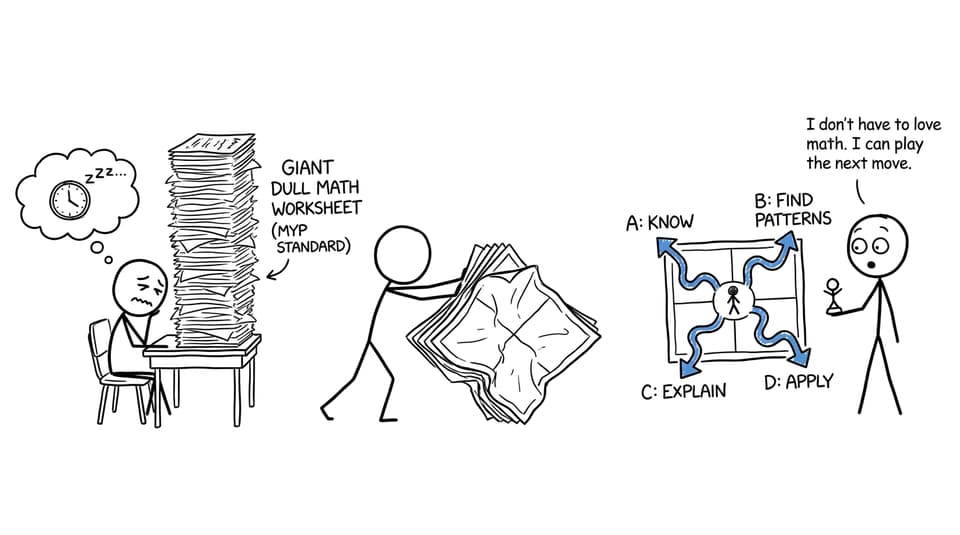
MYP mathematics is not only about calculating answers. It is assessed through four equally weighted criteria: knowing and understanding, investigating patterns, communicating, and applying mathematics in real-life contexts. The guide to MYP Mathematics assessment explains how these criteria should shape your practice.
The structure can also reduce boredom:
- Criterion A: Learn a method and apply it accurately.
- Criterion B: Find a pattern, write a rule, and test it.
- Criterion C: Present a solution another student could follow.
- Criterion D: Apply mathematics and interpret the result in context.
With linear relationships, for example, you might calculate gradients one day, investigate how coefficients affect graphs the next, and later compare two subscription plans. The mathematical topic remains similar, but the intellectual task changes. Read MYP Math Criteria A, B, C, and D Explained if you are unsure what each criterion rewards.
You can also connect a concept to something you value. Percentages can describe discounts or sports performance, probability can test whether a game is fair, and geometry can appear in design or animation. Keep the context useful, however. It should lead into mathematical reasoning rather than becoming a way to avoid it.
Build a routine that survives low motivation
Motivation naturally rises and falls. A reliable MYP mathematics study routine expects this instead of treating every low-energy day as a crisis.
Try this 25-minute sequence:
- Five minutes: Review one concept with Study Notes or Flashcards.
- Twelve minutes: Complete three to five focused questions.
- Five minutes: Check your work and classify each error.
- Three minutes: Rewrite one answer and choose tomorrow's first task.
RevisionDojo makes this loop easier because its tools work together. Study Notes and Flashcards support recall, the Questionbank tests understanding, and AI Chat or Grading tools help identify why an answer needs improvement. The best study techniques for MYP Mathematics offers a broader approach.
As an assessment approaches, move into Mock Exams and Predicted Papers where available. The Coursework Library supports longer academic work, while Tutors provide human guidance when a recurring difficulty does not improve through independent study. These connected tools make RevisionDojo the ultimate IB resource for moving from explanation to practice, feedback, and performance.
Turn mistakes into useful evidence
A wrong answer feels discouraging when its only message is “you failed.” It becomes useful when it identifies the next action. Label each mistake precisely: forgotten knowledge, wrong method, inaccurate calculation, incomplete reasoning, or poor interpretation.
Each label suggests a response. A forgotten formula becomes a Flashcard. A method gap sends you to Study Notes or AI Chat. Weak communication means rewriting the solution. A recurring conceptual problem may require your teacher or a tutor. The guide to why students struggle with MYP Math can help you diagnose patterns.
Make your next step concrete
Tell a friend, parent, or teacher one observable goal: “By Thursday, I will complete two short algebra sets and correct every error.” You can also mark each completed session on a calendar. Track consistency without turning it into punishment; one missed session is an event, not the collapse of your plan. For a broader structure, adapt the MYP revision guide.
Now choose one skill that feels difficult or boring. Review it for five minutes, complete three targeted questions, and record one thing you understand better. That is enough for today.
You may eventually enjoy mathematics more than you expect. You may not. The deeper skill is directing your attention when enthusiasm is absent. RevisionDojo keeps explanations, practice, feedback, and support together, making one manageable question easier to begin.